
FSD, android & LLM naysayers never got the ‘deep’ of ‘deep learning’
It’s not hype.
The point is the ‘deep’ means that, trained on enough data, the systems can accurately build internal models of ‘what’s really going on’.
They ‘get it’. They get what’s behind the data. The essence of the phenomenon.
Whether it’s language or vision.
It’s all because of the literal ‘depth’ or number of layers of the neural network that allows it the luxury of forming ‘deeper’ representations of the training and live input data.
I’ll give you an example below.
It means these systems generalize, they handle unexpected, so-called ‘out of distribution’ data well.
If a UFO lands on the road in front of an FSD car, based on all its normal training, it’s unlikely to ram into the spaceship or careen off onto the other side of the road either.
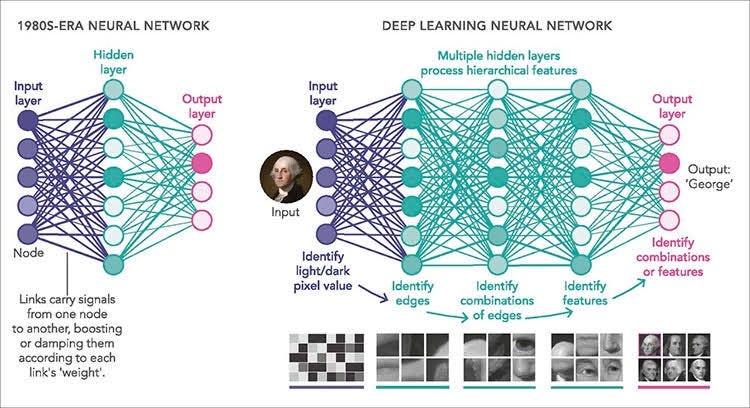
There are numerous expert and non-tech naysayers alike out there that still haven’t realized that the new AI is not hype.
They missed that we weren’t kidding when we got excited about ‘deep learning’.
The ‘deep’ in that term is not an exaggeration.
As a mathematical physicist & biophysicist in the 1990s I had always been interested in what would happen if we add more layers to a neural net.
And persisted with (slow) training.
I’m kicking myself for not exploring it. As the Hintons, LeCuns, Ngs & Bengios did.
Finally in the 2010s as a deep learning developer I got to experience these systems where networks a dozen layers deep showed us their capabilities.
And then of course we got LLMs and vision FSD.
Translation
I was working in neutral machine translation (NMT) where we use neural nets to solve language translation.
NMT systems are awesome.
I was initially shocked that we train the models on millions of pairs of sentences (many from United Nations transcripts) WITHOUT aligning the words.
We just let the neural networks work it out.
And they do.
Beautifully.
They disentangle all the non-one-to-one correspondences automatically. And In the right contexts.
We don’t give these systems any dictionaries (except we supplement with proper nouns lists) or linguistics like earlier systems.
It’s incredible (to me) how the system picks up German grammar.
LLMs
And LLMs learned logic as tested by responses. Not just regurgitation.
LLMs generalize to combinations of logic not seen before. We know this because there are too many possible nestings of logic. And LLLMs kill on logic tests.
So, what’s going on?
Deep learning neural nets are essentially code decipherers.
They find the most parsimonious (frugal, minimal) model that explains the data.
And with enough training that means they generalize well.
So FSD cars will be much safer than human drivers soon, check out the Tesla FSD beta ver 12.3 videos.
Androids are coming.
And they’ll be incredible.