
Frozen Time
GiaB prompt # 2–2: time
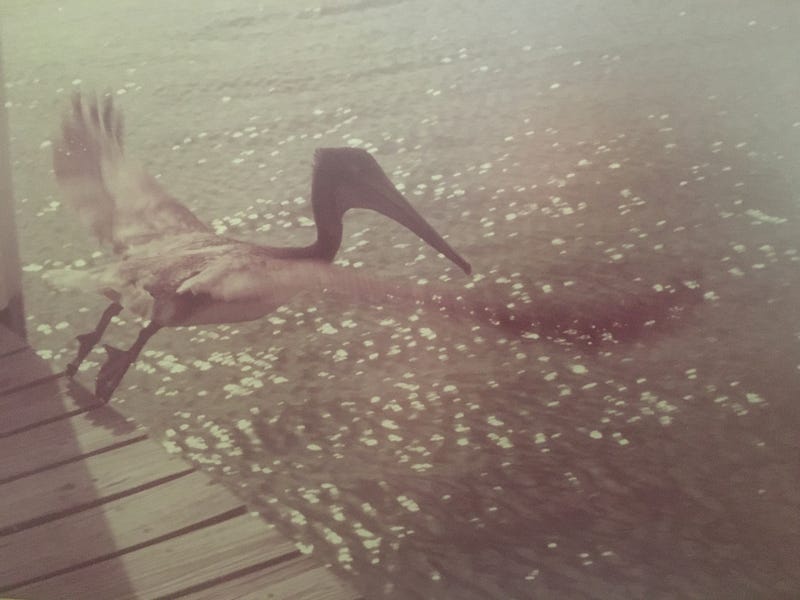
If a shutter clicks in the forest, does it take a picture?
Imagine your favorite photograph. Everyone has one. When the shutter snaps and an image is captured, what a rush.
One of my favorites is of a pelican going aloft over shining water. Wings fully extended, its toes barely touch the dock. Reflected sunlight shines through its wings’ blurred first flap, as it takes flight. I vividly remember inching forward, peering at the bird through the view-finder of my Argus, finger poised on the shutter. And then it was gone.
A fleeting expression, a girl’s sly smile and wistful eyes, easily missed, can be revisited over and again in a photograph. That girl, your grandmother, has now entered eternity. She has stepped out of time. But we who continue to dwell in time’s flow, enjoy her childlike spirit, caught in a snapshot a century ago.
How much time does it take to capture a moment? Buy the camera. Select and load the film. Read the light. Set the shutter speed and aperture. Focus. Choose the moment. Click the shutter, develop the film, edit the negative, enlarge and print the image. How long does it take to examine a moment? Admire an instant in time as long as you like. It took hours to produce.
One thirtieth of a second? One one-thousandth? The first might allow some blur, like bird wings in motion. The other, might freeze the image of a bullet in transit, about to penetrate an apple. It’s all in the timing.
Either way, it takes time to look at that moment which might have gone unnoticed except for a camera’s presence. What could you do with that time? Would it be better spent?
~
Twenty-four frames per second is the standard for the motion picture to create the illusion of motion. That would be twenty-four still pictures, taken in sequence. A second of time, sliced into twenty-four discrete moments and projected from a continuous strip of film.
There is no motion in a motion picture. Persistence of vision tricks the mind into believing the witness of something which might never have occurred, except as images projected on a screen. Yet, millions will swear they saw it all.
~
Light travels vast distances in no time at all. Astro-physicists speak in terms of light years, the distance a light particle, unmolested, travels in a year. The stars we enjoy at night are glimmers of light emitted eons ago. The source may have been snuffed out or swallowed by a black hole in the interim. We’ll never know. When that old news hits our doorstep, we too, will be stardust.
As physicists look to the farthest reaches of space, they also look back in time. What do they expect to find winking back at them? A signature on the grand opus?
Considering the time it takes for starlight to reach us, even sunlight, what do we mean by the word ‘now’? Every moment noticed, has passed by the time our consciousness registers it.
Photography is one of history’s major technical achievements. The ability to freeze an instant of time, a fraction of a second, on film, or digitally, is an extraordinary accomplishment. The blending of mechanical genius and chemical inspiration is almost magical in how images captured from the photographer’s heart are transmitted through time, into the heart of the viewer.
Viewed, not as technical obsession, nor disposable, commercial distraction, the photographer engages in a form of worship. He re-enacts a sacred ritual which arranges light particles in a shadow of creation itself.
~
Universal in appeal, and always fresh, timeless stories never get old. How much time do we spend absorbing them? The best linger in memory our whole lives. We are but the latest of untold generations to hold them dear.
When first experienced, we are present as they unfold in our mind’s eye. Bigger than life, they’re more vivid than our mundane existence. Yet they’re gone in an instant and life goes on.
Ironically, over the arc of history, we last but a moment. But the ancient stories sustain us. They outlast us. They truly are timeless.
© John K. Adams 2021. All rights reserved.
Thank you for reading. I value your comments.
John K. Adams worked in the Hollywood mines and dream-factories. His beautiful, loving wife brainstorms with him about how language and memory wrestle reality.