Human Power
Front-line Nurses Deserve A Lot More
How can they be expected to soldier on under such despicable conditions?
THE INTERVIEW
It seems hidden away, originally aired on 25 Nov 2020 probably too close to Thanksgiving weekend to have gotten adequate or deserved attention, an 18:38 min YouTube video of a very candid interview from a well-regarded media outlet, that astonishingly only as of this writing (more than 1 week later), has 28,423 views. Chancing upon it just a few days ago and having watched it, it has been a disturbing and flabbergasting reality to hear and swallow. It is because of this video, I have immersed myself into digging out a little more context to this for edification and for sharing, agonizingly.
Amanpour and Company’s Hari Sreenivasan interviews a U.S. crisis nurse, Chelsea Walsh:
Here were the most poignant points (overt and implied) that I heard from this nurse from this interview:
№1 Her and other nurses like her have been diagnosed with COVID-PTSD (one pandemic death she witnessed was particularly haunting to listen and watch her account of it);
№2 As a crisis nurse, she is considered a gig nurse essentially, and as we know the U.S. system doesn’t allow gig workers like her to qualify for health insurance like a full-time employee, so she can’t afford health insurance otherwise and is working during this pandemic without any health insurance even though she is literally sacrificing her life daily for patients;
№3 Her freedoms have been severely constrained by this pandemic — not only is she traveling to hot spot hospitals in need but out of an abundance of caution, she has be not been comfortable to see nor will go near her own family to protect them (she mentions how she hasn’t physically hugged her family and it’s implied it has been for quite some time now);
№4 She herself is expecting to get sick from her work and the underlying fear she has is to die from her work (exactly from her traumatized experience of the death she witnessed mentioned in №1) but she is too dedicated;
№5 She is on the ground saying there isn’t enough PPE, and they are forced to do the work that even the doctors won’t do themselves, putting her and her colleagues at enormous risk (she feels nurses have been sacrificed and forgotten by the public and the leadership);
№6 Doctors and hospitals have passed the buck onto her and nurses alike (which not only goes to show how real this pandemic is that the doctors — higher educated medical professionals — appear too afraid to risk their lives so how dire must the situation be to compromise and imperil our nurses?).
THE SOURCE
OK. I don’t know this nurse personally. But Amanpour and Company, hosted by Christiane Amanpour, a longtime chief international anchor from CNN, who although has been criticized to lean left, is very well educated, well-recognized, having won many accolades for journalism:
From Thought Co.:
2000 Edward R. Murrow Award for Distinguished Achievement in Broadcast Journalism
2002 Harvard’s Goldsmith Career Award for Journalism
Two Emmy news/documentary awards
Two George Foster Peabody Awards for Broadcasting
Two George Polk Awards for Journalism
Courage in Journalism Award, International Women’s Media Foundation
Major role in two duPont awards and a Golden Cable Ace award given to CNN
THE REALITY
For COVID-19, as I was educated in science, I believe it is real. A distant in-law family member of mine already passed away from it, and another one is a doctor dealing at the front line of it. I care about subjects that revolve around politics and the values that can raise or raze a country.
This is one of those moments you watch and wonder numbly: how much more third-worldly can we get?
After watching this among so many other disturbing symptoms of social erosion, it not only compels me to write, in the hopes of bringing some more attention to it, but it alarms the deep fears I have about how the degradation of the U.S. moral code, ethics, and the lack of value we place on fundamental professionals, as those in hospitals, as well as in other settings involving the protection of our health, of our schools and children, and of our futures can have significant repercussions, that stink of repeats of historical devastations.
There is something severely sick and off-kilter with our country’s state of affairs to produce an environment and the conditions that can result in what has been mentioned in this interview.
An enlightened nation would discern between play and politics. Fundamentally, we are in trouble if we have fallen for all the polarizing politics and don’t believe this outcome is serious.
OUR HEALTHCARE SYSTEM IS BROKEN
Yes, foremost, the U.S. healthcare system is broken. It’s been broken for a long time. I have participated and taken part in national healthcare systems outside of the U.S., and it is the stark reality only understood when you are outside looking in at the fallacy of our healthcare system that it is possible to not only believe but to know that it doesn’t have to be this way.
This is an entertaining bit on YouTube that really sums it up for me: ‘True cost of US healthcare shocks the British public’.
Secondly, we have a generally universal understanding that we need more soldiers and less chiefs to get things done. Nurses are definitely those critical professionals we need to preserve.
According to the American Association of Colleges of Nurses (AACN):
…
“Nurses comprise the largest component of the healthcare workforce, are the primary providers of hospital patient care, and deliver most of the nation’s long-term care.”
…
“With more than three times as many RNs in the United States as physicians, nursing delivers an extended array of healthcare services, including primary and preventive care by nurse practitioners with specialized education in such areas as pediatrics, family health, women’s health, and gerontological care. Nursing’s scope also includes services by certified nurse-midwives and nurse anesthetists, as well as care in cardiac, oncology, neonatal, neurological, and obstetric/gynecological nursing and other advanced clinical specialties.”
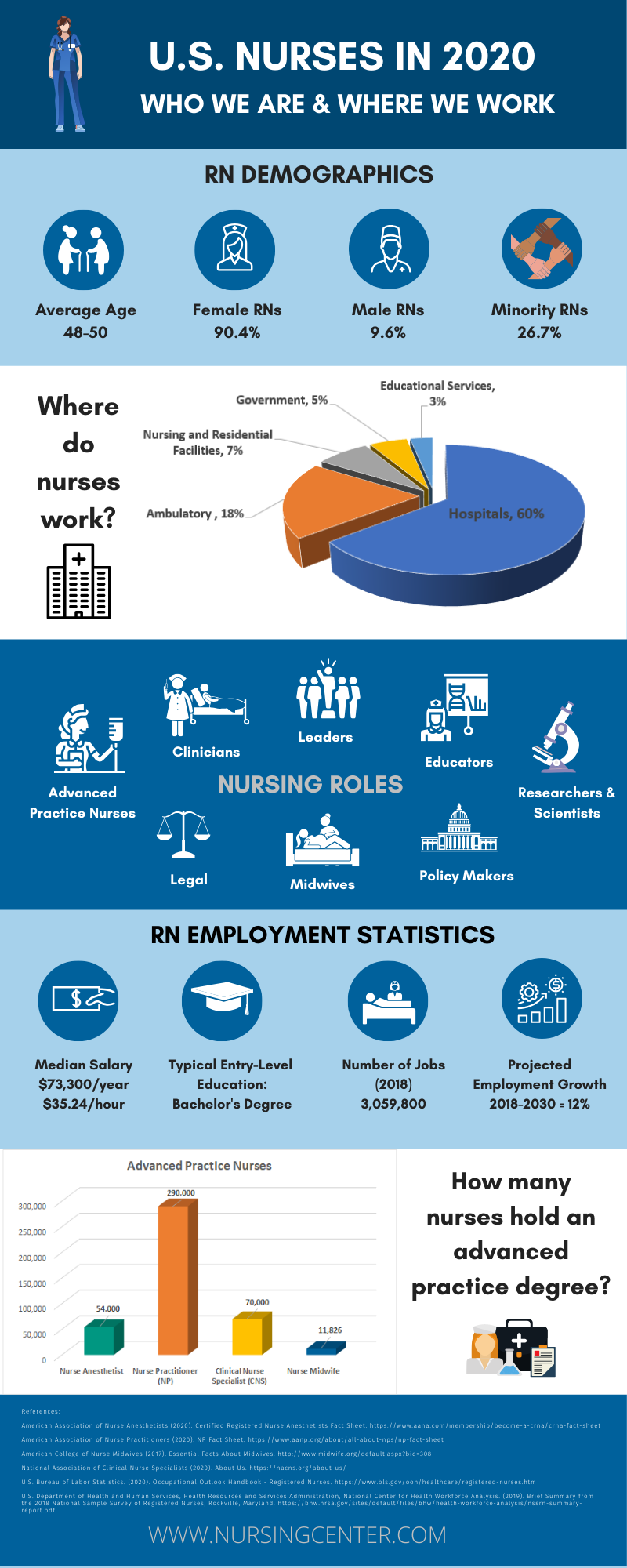
According to Lippincott NursingCenter, an online peer-reviewed nursing journal site, there are 4 million registered nurses (RNs) in the US and 60% work in hospitals.
And here, this is just one of many articles, this one from 10 May 2020 documenting the inevitable decision of some nurses having to quit for the sake of their own safety and that of their families early on during the pandemic due to the insufficient safety gear and protocols to protect them adequately in the workplace, and this one from The LA Times, 27 Oct 2020, ‘Among healthcare workers, the toll of COVID-19 falls hardest on nurses’. This one from from The Washington Post from 13 April 2020 brings attention to the Canadian nurses that cross borders everyday to support U.S. hospitals as part of their jobs in our northern states like Michigan.
And here are there internal investigative numbers of COVID-19 cases of healthcare workers per state:
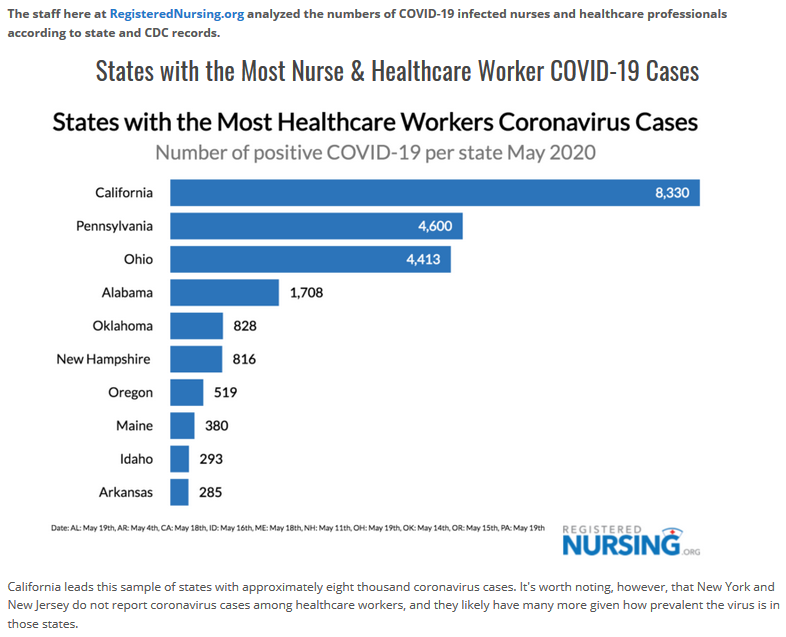
Regardless of the exact or overwhelming data and debates over the numbers, we can be reminded that front-line workers, as nurses and healthcare workers, are not replenishable in the internet age (i.e. it takes years not mere months to become an experienced well-trained nurse or doctor) and now they can be too easily lost to COVID-19 (more than 1,700 health care workers have died documented as of 28 September 2020 since the beginning of this pandemic, less than a year) or to resignations or to trauma.
LAST THOUGHTS
Let’s not forget also the additional findings that COVID-19 causes chronic disease and a whole new group of the infected may become a ‘long-hauler’. According to this Harvard.edu post, 50–80% infected report longer term symptoms beyond normal recovery times. So not only front-line workers but those patients already affected will continue to require healthcare support for much longer than thought.
God forbid any of us contract COVID-19, but I don’t think we would want to find ourselves in a surprising predicament that there are fewer or unavailable healthcare staff to care for us as a patient when we need them the most, legitimately.
It also likewise brings up another simple idea: don’t flout the rules — don’t endanger others recklessly during this pandemic and irresponsibly burden those selfless fighting under degrading conditions to keep so many of us alive.
If you are not yet a Medium member and would like to show your support for me and my content, please consider becoming a member through me, here:
A portion of your membership fee directly supports my efforts in continually writing here but at no additional cost to you and without any changes to your membership — you still get full access to every story on Medium besides mine. But your support would make a real difference for a writer.
Thank you for reading!
© 2020 The Secret Aspirant. All rights reserved.