avatarTim Ward, Mature Flâneur

Free AI web copilot to create summaries, insights and extended knowledge, download it at here

4231

Abstract

to feed England’s ravenous textile mills. The Wellington Te Papa Museum illustrates the impact on New Zealand’s native forest (green, below) in three maps:</p><figure id="d39c"><img src="https://cdn-images-1.readmedium.com/v2/resize:fit:800/1*tQFfo0GuxMXK80K19mPF6Q.jpeg"><figcaption></figcaption></figure><figure id="2150"><img src="https://cdn-images-1.readmedium.com/v2/resize:fit:800/1*stobw90YC-3lS-WV35CiQA.jpeg"><figcaption></figcaption></figure><figure id="416f"><img src="https://cdn-images-1.readmedium.com/v2/resize:fit:800/1*CQrGzAEv7DbVOfPUw4lGQQ.jpeg"><figcaption>Left: 1200 (before arrival of The Māori): 85% natural forest. Center: 1840: 600 years of Māori settlement reduced the natural forest cover to 55%. Right: Today: after 180 years of European settlement, only 25% of natural forest cover remains. My photos from the Wellington Te Papa Museum</figcaption></figure><p id="7654">This change was not easy on the land. The Wellington Te Papa Museum contains excerpts from a book written by a sheep farmer, George Guthrie-Smith, who bought land in the 1880s. Forty years later, he wrote a book, <i>Tutira:</i> <i>The Story of a New Zealand Sheep Station, </i>in which he made prescient,<i> </i>grim predictions about New Zealand’s natural environment. He came to see the breaking of the land as an act of violence: “It is no exaggeration to say that the surface had to be stamped, hammed, hauled, murdered into grass.” He also saw that once converted, the grass would sometimes fail to hold the soil in place, leading to landslips and erosion after heavy rains. I saw some of these ugly land slips myself on the pastured hills near Te Mata:</p><figure id="7e6c"><img src="https://cdn-images-1.readmedium.com/v2/resize:fit:800/1*dsHttJGIsLzmodn0mhkRfA.jpeg"><figcaption>Landslips after a rain. Don’t get too close to the edge!</figcaption></figure><p id="257a">However, Te Mata is also symbolic of the growing conservation awareness of New Zealanders. Much of the area around the peak is now a protected park. On my hike, I noticed whole hillsides being replanted with native seedlings. According to the Te Mata Park Website:</p><p id="c6d7"><i>As a memorial to their father, John Chambers’ sons gifted a 242 acre (99 hectare) reserve on the upper Havelock North hills, including Te Mata Peak, to the people of Hawke’s Bay in perpetuity. A charitable trust was set up for the benefit of all citizens of the provincial district of Hawke’s Bay with the intention of maintaining the land as a recreational reserve. This generous and forward-thinking gift has benefitted not only the people of Hawke’s Bay, but the New Zealand public in general…</i></p><p id="b6f4">After a bit more digging online, I discovered that John Chambers came to Hawke’s Bay in 1854. He bought and leased vast tracts of land to clear for sheep farming, and he wanted the land around Te Mata. According to his biography on a <a href="https://teara.govt.nz/en/biographies/1c12/chambers-john">government website</a>, “Chambers had also been squatting on the west bank of the Tukituki River, on the Te Mata block, an area still in Māori hands; the authorities acquiesced in this illegal occupation for fear of losing a valuable settler…”</p><p id="53a5">Ah, so to be blunt: Chambers stole Te Mata from the Māori tribe that owned it, and the government turned a blind eye. Chambers went on to amass and clear over 18,000 acres for sheep farming, land for which he paid a “minimal price.” He also pioneered methods of preserving meat to ship overseas, and though he was not the one to perfect the process, he played a big role in founding Hawke’s Bay’s meat-freezing trade.</p><p id="b076">New Zealand, remember, was too far way from the rest of the world to export meat. Freezer ships breathed new life into New Zealand sheep farming, which previously could only export wool. Global demand for wool was waning, but the market for meat was booming. Thus the new freezer technology buoyed New Zealand’s economy for many decades to come. By 1970, there were 70 million sheep in New Zealand. That’s about 20 sheep per person! Enough for each resident to have their own flock.</p><p id="c152">New Zealand lamb has become a global premium brand. I know

Options

I’ve thawed many a frozen lamb rack from Trader Joe’s in the past 30 years, and restaurants always point out when the lamb on their menu comes from New Zealand. Today, the country is still the second largest exporter of lamb in the world, behind Australia.</p><p id="9a8c">Nevertheless, as synthetics gradually replaced wool in the 1960s, it hit New Zealand sheep farmers hard. These days, it costs a farmer almost as much to shear a sheep as the price of the fleece on the market. The world has passed peak sheep. In 2023, there are only 26 million sheep on New Zealand — the lowest number in 170 years. According to a recent <a href="https://www.theguardian.com/world/2023/jul/01/new-zealand-falls-out-of-love-with-sheep-farming-as-lucrative-pine-forests-spread">Guardian</a> article, many sheep farmers are getting out of the business. They are selling their land for— guess what? Replanting forests for carbon credits.</p><p id="7486">The New Zealand government is taking seriously it’s net zero emission targets. Methane from sheep and cows make up 50% of the nations greenhouse gases, and replanting farmland with fast-growing pine trees has become a key part of their strategy. Many global companies are also buying up New Zealand farmland to plant trees for carbon credits. As a result, says the Guardian article, NZ farmers are getting six times as much selling their land for reforesting than for agricultural use.</p><p id="650f">There is crazy irony to all this, isn’t there? Early European settlers “murdered” the land to make their fortunes off the backs (and racks) of lambs. 170 years later, sheep are on the way out, and farmers are profiting from turning the land back into forest. Of course, it is not quite so tidy. A good number of those fast growing-pines in the hills above Hawke’s Bay got flooded out by Cyclone Gabrielle in early 2023. They came crashing down the rivers, wiped out bridges, infrastructure, and houses in their way. In addition, according to the Guardian, these fast-growing pines are not native; like any invasive species, they can spread into the remaining native forests, where, unchecked, they will choke out the native trees and take over the landscape. A tree farm is not the same as a natural forest.</p><p id="5bb3">It turns out you can’t simply replant to repent for your sins.</p><figure id="8046"><img src="https://cdn-images-1.readmedium.com/v2/resize:fit:800/1*WV-ZS8dJoChahaNJcoZn9A.jpeg"><figcaption>I don’t blame ewe! (confession: this is photo is of a Scottish sheep, not a New Zealand one).</figcaption></figure><p id="b53d">***</p><p id="75ec">If you would like to read my recent stories on NZ, please click the link below, and you will find them all in order.</p><div id="660b" class="link-block"> <a href="https://timward-changermakers.medium.com/"> <div> <div> <h2>Tim Ward, Mature Flâneur - Medium</h2> <div><h3>Read writing from Tim Ward, Mature Flâneur on Medium. Author, communications expert and publisher of Changemakers…</h3></div> <div><p>timward-changermakers.medium.com</p></div> </div> <div> <div style="background-image: url(https://miro.readmedium.com/v2/resize:fit:320/0*kmjAG6qfPMNcMVhi)"></div> </div> </div> </a> </div><p id="b1fc">If you have not yet hear the news, my new book on “slow travel” is now available! Why not pack it along on your next trip?</p><div id="63bf" class="link-block"> <a href="https://www.collectiveinkbooks.com/changemakers-books/our-books/mature-flaneur-slow-travel-europe"> <div> <div> <h2>Mature Flâneur from Changemakers Books</h2> <div><h3>In the aftermath of the pandemic, author Tim Ward and his wife, Teresa, decided to leave their home and professional…</h3></div> <div><p>www.collectiveinkbooks.com</p></div> </div> <div> <div style="background-image: url(https://miro.readmedium.com/v2/resize:fit:320/0*BD-BX4i9JOuob75G)"></div> </div> </div> </a> </div></article></body>

MATURE FLÂNEUR DOWN UNDER

From Te Mata Peak: The Story of Sheep in New Zealand

Ewe are not to blame.
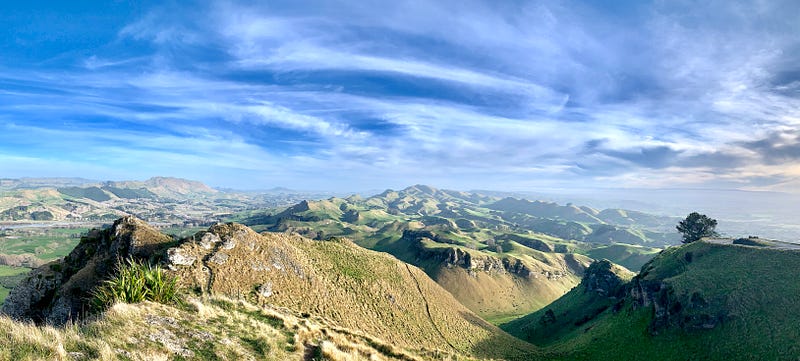
View from the peak of Mount Te Mata. All photos by Tim Ward

Climbing Te Mata Peak was perfect. The sky was clear. The sun was warm. The strong wind cooled the air just enough to keep me from sweating. It only took only an hour to climb from the park trailhead to the summit. And what a staggering view! To the west, grassy green-and-beige hills undulate far into the distant horizon (above). To the east, the long spine of Te Mata stretches out towards Hawke’s Bay on New Zealand’s eastern coast and beyond to the South Pacific.
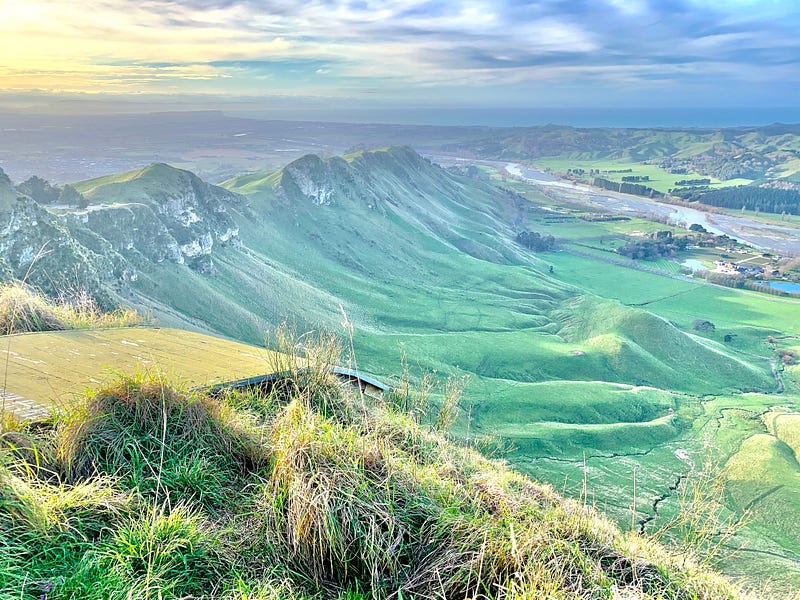
Te Mata stretches out towards Hawke’s Bay. In the foreground, a hang-glider launch ramp. Imagine running off this edge…

The mountain itself is a long, limestone escarpment that has stood firm for millennia against the relentless scrape of glaciers, wind and rain. To the Māori, it is the supine shape of the giant Te Mata, who died for love. Tricked by his lover’s family into trying to swallow the peak, he choked, died, and became the mountain. The hike was recommended by our Napier B&B hosts, Tom and Esther, though with their New Zealand accents, I thought they were telling me to climb Tomato Peak.

Of course, a view so magnificent is meant to be shared, and so, after steeling my nerves for a vertigo-inducing walk, puffing my way up to the very top, I was not totally surprised to see lots of folks up there who had taken the shorter route…from the summit car park (cue my video):

More sobering, however, was the realization that this awesome vista, which looks so much like the wild steppes of Mongolia, is not at all natural. It is man-made. These hills were once forested. But, when settlers “bought” land in the 1800s—either through sales enforced over the objections of the Māori tribal leaders or expropriated outright by the Crown— they cleared the trees and brush and replaced it with pasture for sheep farming, and later, for cattle. Here’s a close-up from the lower center-right of the top photo above:
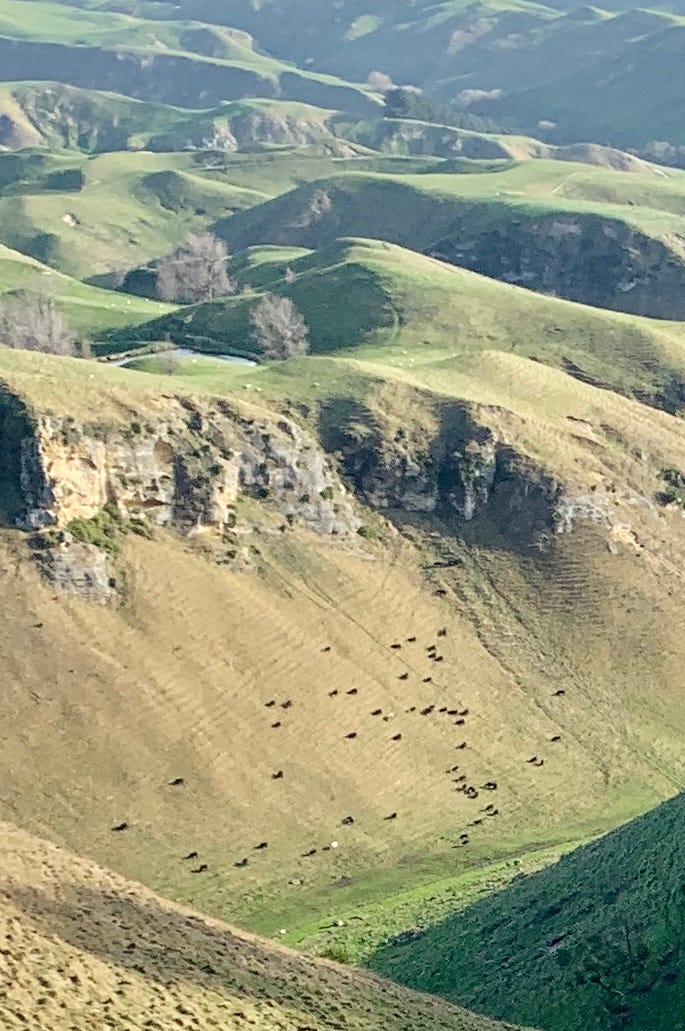
CLose up of the top photo — those dots are sheep and cows.

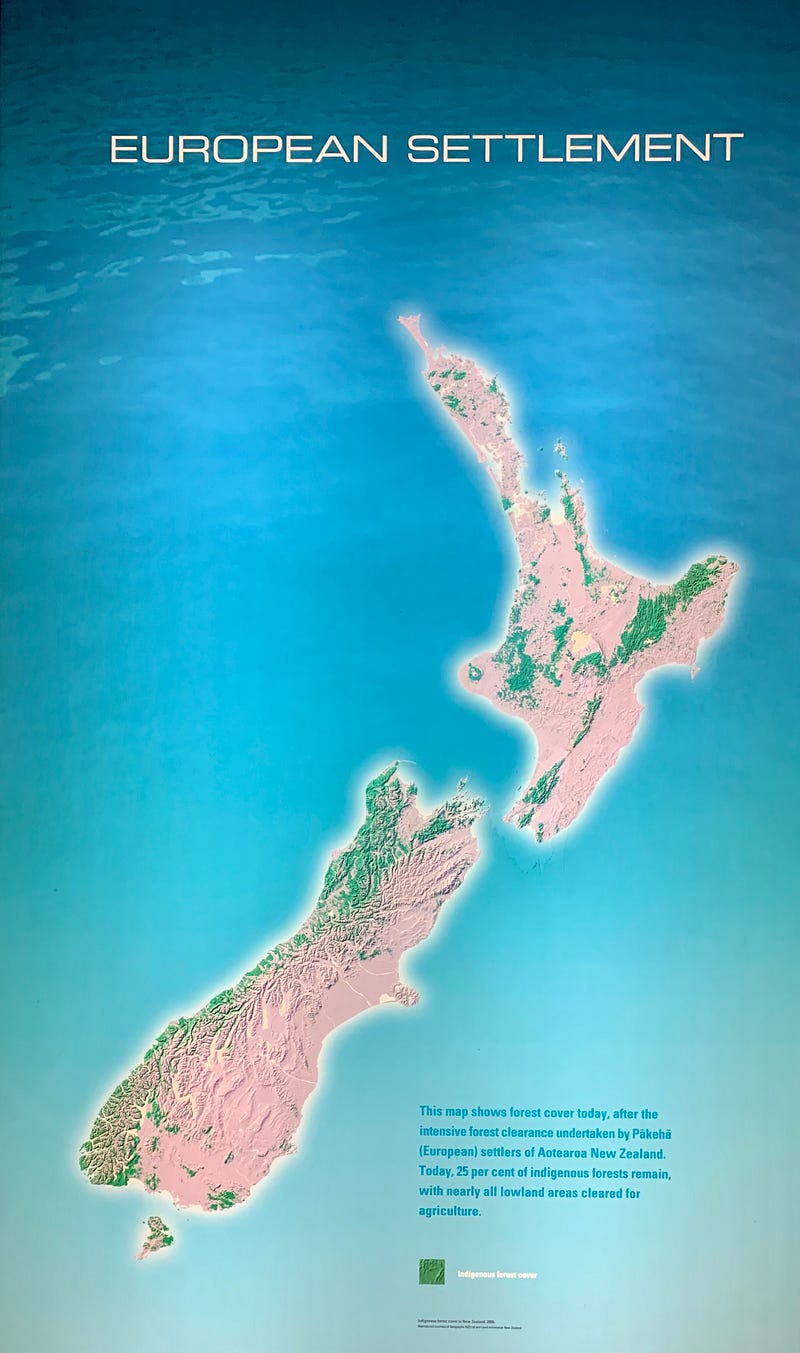
You can see not only the black dots of cattle and the white of sheep, but also the lines on the landscape that make it look like a topographic map. Those are well-worn animal tracks. In the second half of the 1800s and early 1900s, roughly 50% of the entire surface of New Zealand was cleared of trees and converted to grassland by British settlers, most of it for sheep — for wool to feed England’s ravenous textile mills. The Wellington Te Papa Museum illustrates the impact on New Zealand’s native forest (green, below) in three maps:
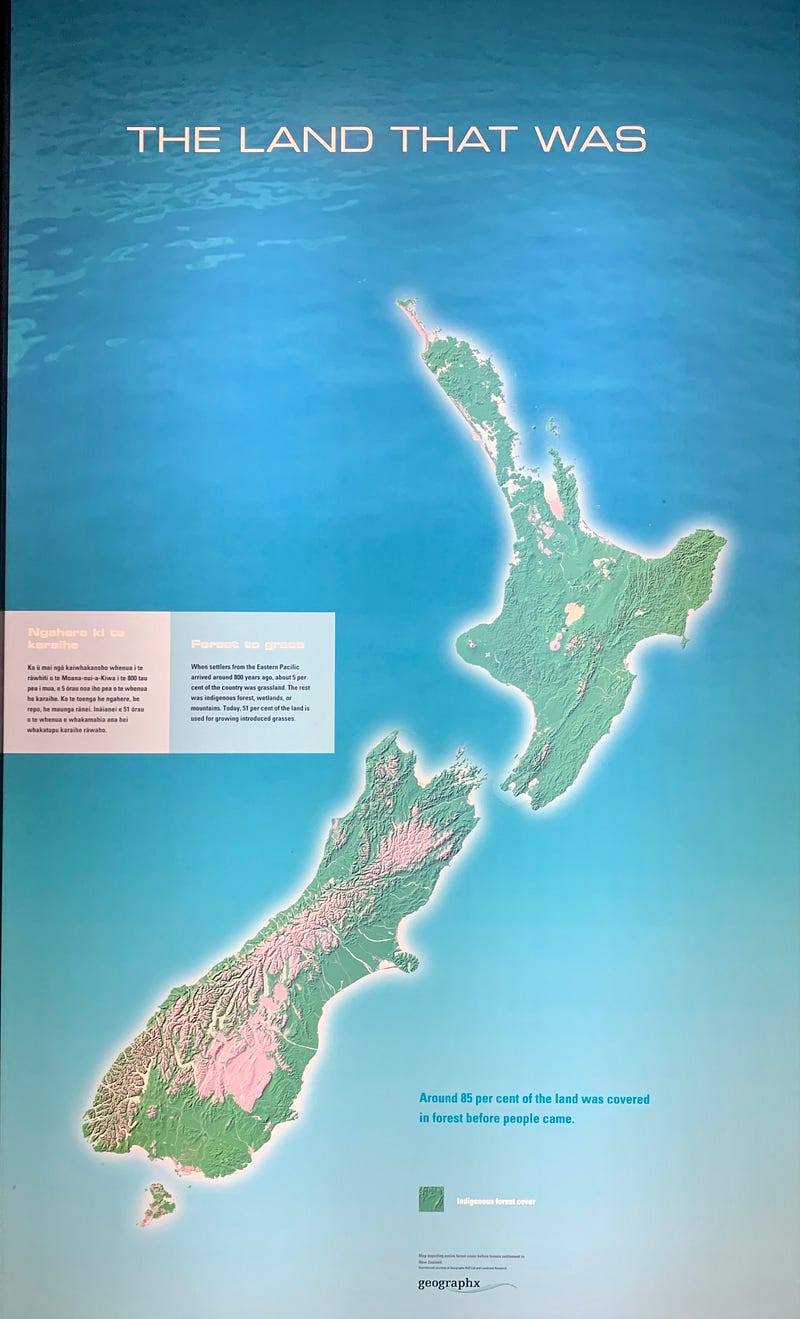
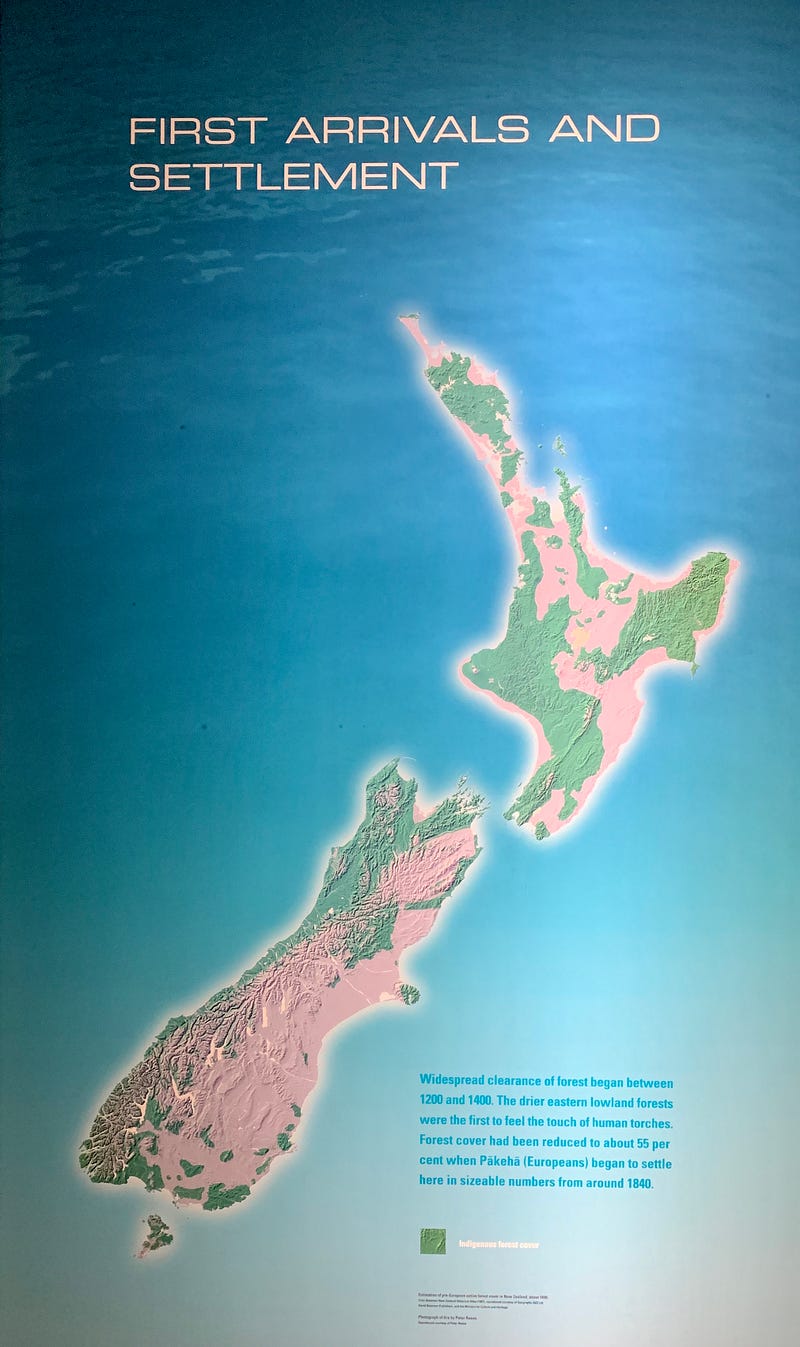
Left: 1200 (before arrival of The Māori): 85% natural forest. Center: 1840: 600 years of Māori settlement reduced the natural forest cover to 55%. Right: Today: after 180 years of European settlement, only 25% of natural forest cover remains. My photos from the Wellington Te Papa Museum

This change was not easy on the land. The Wellington Te Papa Museum contains excerpts from a book written by a sheep farmer, George Guthrie-Smith, who bought land in the 1880s. Forty years later, he wrote a book, Tutira: The Story of a New Zealand Sheep Station, in which he made prescient, grim predictions about New Zealand’s natural environment. He came to see the breaking of the land as an act of violence: “It is no exaggeration to say that the surface had to be stamped, hammed, hauled, murdered into grass.” He also saw that once converted, the grass would sometimes fail to hold the soil in place, leading to landslips and erosion after heavy rains. I saw some of these ugly land slips myself on the pastured hills near Te Mata:
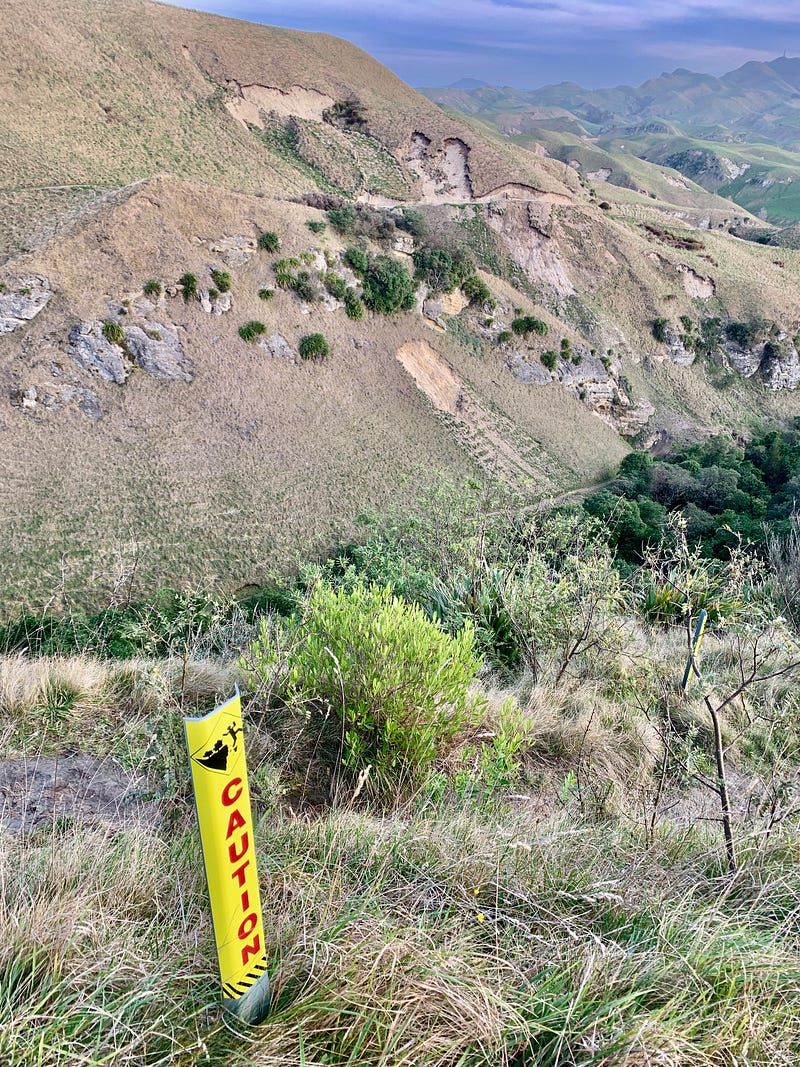
Landslips after a rain. Don’t get too close to the edge!

However, Te Mata is also symbolic of the growing conservation awareness of New Zealanders. Much of the area around the peak is now a protected park. On my hike, I noticed whole hillsides being replanted with native seedlings. According to the Te Mata Park Website:

As a memorial to their father, John Chambers’ sons gifted a 242 acre (99 hectare) reserve on the upper Havelock North hills, including Te Mata Peak, to the people of Hawke’s Bay in perpetuity. A charitable trust was set up for the benefit of all citizens of the provincial district of Hawke’s Bay with the intention of maintaining the land as a recreational reserve. This generous and forward-thinking gift has benefitted not only the people of Hawke’s Bay, but the New Zealand public in general…

After a bit more digging online, I discovered that John Chambers came to Hawke’s Bay in 1854. He bought and leased vast tracts of land to clear for sheep farming, and he wanted the land around Te Mata. According to his biography on a government website, “Chambers had also been squatting on the west bank of the Tukituki River, on the Te Mata block, an area still in Māori hands; the authorities acquiesced in this illegal occupation for fear of losing a valuable settler…”

Ah, so to be blunt: Chambers stole Te Mata from the Māori tribe that owned it, and the government turned a blind eye. Chambers went on to amass and clear over 18,000 acres for sheep farming, land for which he paid a “minimal price.” He also pioneered methods of preserving meat to ship overseas, and though he was not the one to perfect the process, he played a big role in founding Hawke’s Bay’s meat-freezing trade.

New Zealand, remember, was too far way from the rest of the world to export meat. Freezer ships breathed new life into New Zealand sheep farming, which previously could only export wool. Global demand for wool was waning, but the market for meat was booming. Thus the new freezer technology buoyed New Zealand’s economy for many decades to come. By 1970, there were 70 million sheep in New Zealand. That’s about 20 sheep per person! Enough for each resident to have their own flock.

New Zealand lamb has become a global premium brand. I know I’ve thawed many a frozen lamb rack from Trader Joe’s in the past 30 years, and restaurants always point out when the lamb on their menu comes from New Zealand. Today, the country is still the second largest exporter of lamb in the world, behind Australia.

Nevertheless, as synthetics gradually replaced wool in the 1960s, it hit New Zealand sheep farmers hard. These days, it costs a farmer almost as much to shear a sheep as the price of the fleece on the market. The world has passed peak sheep. In 2023, there are only 26 million sheep on New Zealand — the lowest number in 170 years. According to a recent Guardian article, many sheep farmers are getting out of the business. They are selling their land for— guess what? Replanting forests for carbon credits.

The New Zealand government is taking seriously it’s net zero emission targets. Methane from sheep and cows make up 50% of the nations greenhouse gases, and replanting farmland with fast-growing pine trees has become a key part of their strategy. Many global companies are also buying up New Zealand farmland to plant trees for carbon credits. As a result, says the Guardian article, NZ farmers are getting six times as much selling their land for reforesting than for agricultural use.

There is crazy irony to all this, isn’t there? Early European settlers “murdered” the land to make their fortunes off the backs (and racks) of lambs. 170 years later, sheep are on the way out, and farmers are profiting from turning the land back into forest. Of course, it is not quite so tidy. A good number of those fast growing-pines in the hills above Hawke’s Bay got flooded out by Cyclone Gabrielle in early 2023. They came crashing down the rivers, wiped out bridges, infrastructure, and houses in their way. In addition, according to the Guardian, these fast-growing pines are not native; like any invasive species, they can spread into the remaining native forests, where, unchecked, they will choke out the native trees and take over the landscape. A tree farm is not the same as a natural forest.

It turns out you can’t simply replant to repent for your sins.
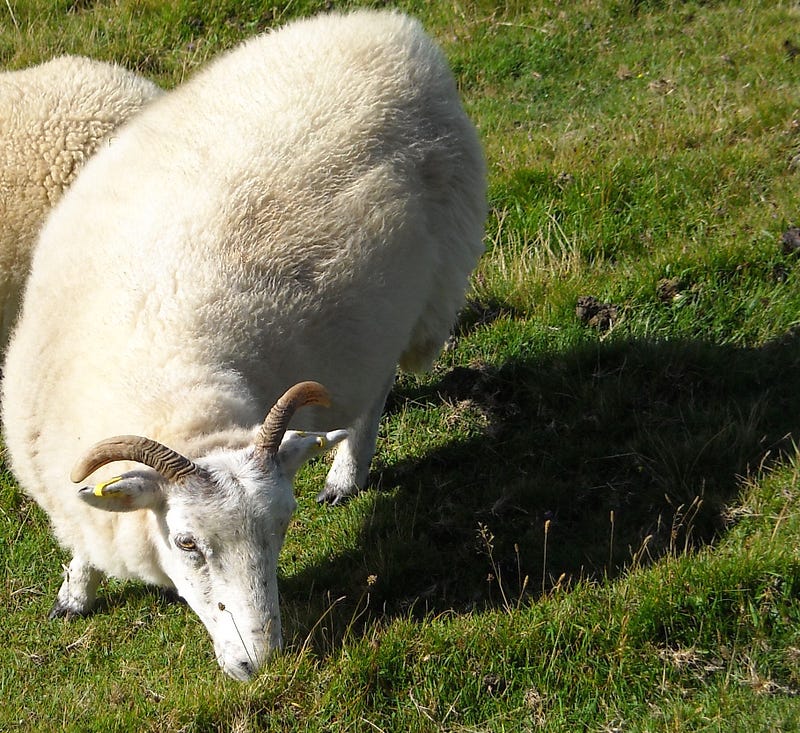
I don’t blame ewe! (confession: this is photo is of a Scottish sheep, not a New Zealand one).

***

If you would like to read my recent stories on NZ, please click the link below, and you will find them all in order.

If you have not yet hear the news, my new book on “slow travel” is now available! Why not pack it along on your next trip?

New Zealand
Globetrotter
Flaneur
Travel
Conservation
Recommended from ReadMedium