
From Shadows to Legacy: Unearthing the Strength of Our Ancestral Past
How I used ancient wisdom to improve my daily life
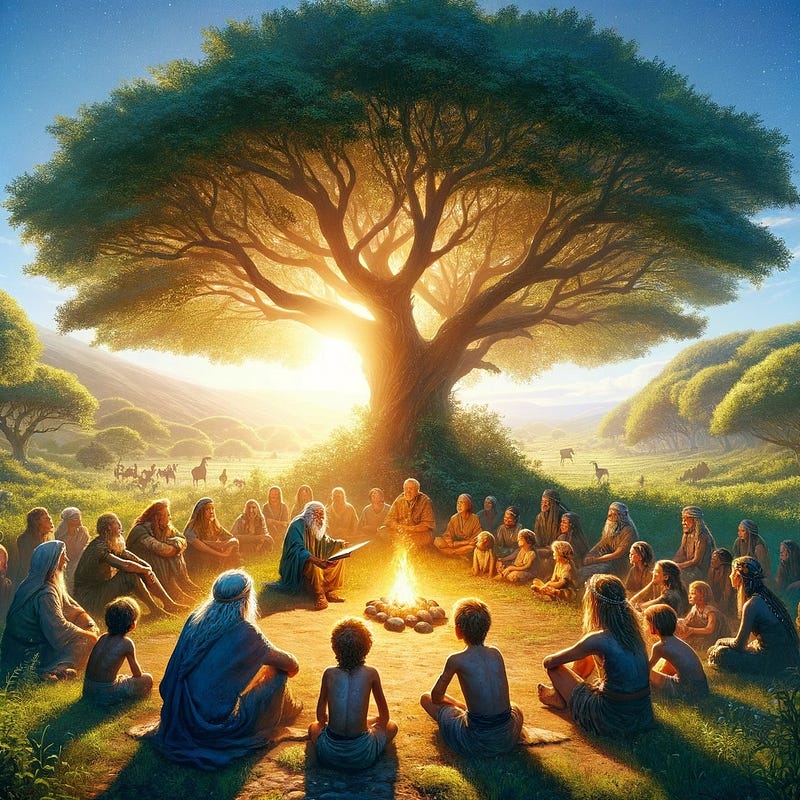
“If you don’t know where you’ve come from, you don’t know where you’re going.”—Maya Angelou
This article is about finding and harnessing the power of our ancestral roots in our everyday lives. These roots are powerful because they hold the tree of our lives.
A little personal history so that you know where I am coming from. Regarding my immediate ancestors, other than my maternal grandmother, I have very little recollection of anyone else. I am of Greek ancestry, with roots in the cities of today’s eastern Turkey and Istanbul. My immediate ancestors came to Greece as refugees in the turbulent times of the early 1900s, mostly with their clothes on their backs.
So forget about records of ancestry. All I know about previous generations is from vague anecdotal descriptions from my maternal grandmother (my maternal grandfather died while I was a baby). The most memorable part is that Annika, her mother, worked as a housekeeper at Dolmabahce Palace. I was told that Annika was also a renowned cook who had a real talent for combining ingredients, spices, aromas, and textures to create the most delectable Turkish dishes.
Annika is the last distant relative I know of.
Regarding my relatives from my father’s side, during the population exchange between Greece and Turkey in the early 1920s, my paternal grandmother took my then-toddler father and moved to Greece. My paternal grandfather, Alexandros, stayed in Turkey with the other son, Dimitrios. Grandfather Alexandros died a few years later. My father and grandmother reunited with Dimitrios a couple of times, but there was always a rift. The family separation was a very traumatic event for all three, each thinking they were abandoned by the others, and so they never talked about the past.
I must admit, though, that being of vague Greek ancestry has its perks; I can fantasize that Aristotle or Socrates were distant ancestors (right, much more likely is that I am a descendant of someone who was a housekeeper to the above).
Part of my family history was lost due to trauma.
Trying to forget, to disconnect from the past, is one way of dealing with it, as my father and grandmother chose to do. I choose to go in the opposite direction, look in the past for healing, for understanding.
We have all been through difficult times that require us to dig deep inside ourselves. Sometimes, we have to dig deeper than ourselves; our past experiences are just not enough. What is there beyond ourselves to gain strength from?
For some, there are friends and family; for others, spirituality and faith. But many do not have supportive family and friends, nor are particularly spiritual. What then? It’s what I call our greater self, our ancestral roots, that connect our body and mind to the forest of humanity.
Although sometimes we feel we have been dropped from outer space on a planet that seems foreign and hard to understand, the truth is very different. We are an integral part of this planet; its evolution is deeply ingrained in our DNA.
We are the latest link in a long chain of individuals, our ancestors. From the color of our eyes and hair to the strength of our immune system, our DNA records how our ancestors were affected by their environment and how they interacted with it. In this way, our ancestors and their life footprint will always be part of us, wherever we go and whatever we do.
So who are they, these ancestors of ours?
Considering that humans appeared about 300K years ago, and a generation is, on average, 25 years, we are talking about 12,000 individuals.
They appear like shadows in the fog of the distant past, walking one after the other. Were they able-bodied or disabled, fearless or phobic, empathic or cruel, happy or depressed? We can’t know. But they are so much more than mere shadows.
They are people who survived very adverse conditions: extreme cold and heat, lack of proper shelter, natural disasters, diseases, hostile animals and tribes, and so much more.
And despite it all, they survived long enough to have children.
They nurtured those children, despite all the obstacles they faced, fed them, protected them, taught them how to survive long enough to have their own children, and so on.
Each one passed the baton of their life's knowledge to the next one. And we are the ones holding the baton now. Like in a relay race, this baton is both a gift and a responsibility. It represents the values, experiences, and life lessons one generation passes to the next and the legacy and memories of ancestors.
When we are overwhelmed, just not strong enough to face the challenges ahead, we need to look at our roots: the 12,000 individuals, the 12,000 fighters, whose fights, struggles, trials, and tribulations did not stop them from contributing to the tree of life.
Sir Isaac Newton famously said, “We are standing on the shoulders of giants,” to describe the cumulative nature of human knowledge.
Besides the few geniuses of the past who contributed to the scientific progress of the human race, our ancestors, in general, were remarkable individuals, unyielding fighters whose sheer will to survive and thrive eventually led to our creation. This is profound and tremendously empowering. I am thankful to each one of them, not just for my life but also for that little piece of knowledge each one added to make the lives of the next generation a bit better.
I so much wish that I knew more about these people.
These people shaped my creation. But, as I said, trauma, wars, and lack of records make it impossible to know more.
And then I thought: Since I will never know who these people were, I will at least try to make my life a bit similar to theirs to understand them better and feel closer to them. The best way to understand and honor someone is to do what they do and put ourselves in their shoes.
Some things I know about my ancestors: they did not have a 401K plan or worry about where they would retire because they did not know whether they would be alive tomorrow.
They were close to nature, to their land, to their animals, to their neighbors, to their community. They were creatures of “community” and the “here and now.” So here are the changes that I am making in my daily life.
Appreciate the “here and now” and share it.
It is astonishing how much time we spend these days in the “then and there” instead of “here and now.”
Let me explain: Imagine a family of four having dinner. We would likely see four individuals staring at their mobile phones. The father is checking his 401K plan, the mother is looking up a recipe for tomorrow’s dinner, the son is watching a football game, and the daughter is talking with friends on social media.
Instead of discussing their day in the “here and now,” each family member is immersed in their own little world. A family with a totally fragmented “here and now” is replaced with four little bubbles of “there and then” worlds above the head of each family member.
Imagine an ancestor of ours being able to observe the scene. He would be dumbfounded. Four people sitting and eating silently, and staring and tapping a weird little mirror-like thing. He would soon reach his conclusion. These people have been bewitched by a powerful witch that lives inside the mirror-like thing. Frankly, he wouldn’t be that far from the truth!
In contrast to us, our ancestors were deeply immersed in their “here and now.”
Our ancestors did not have any other choice.
There were so many dangers that absent-mindedness or ignorance of danger could mean death.
They knew intimately every corner of their land and the plants and animals that lived there.
They understood the celestial patterns for navigation and the weather patterns to predict severe weather.
They distinguished between edible and poisonous plants, which had medicinal use, and when plants were ready to be harvested.
They learned the behavior of animals, their migration and breeding patterns, and could track the presence of an animal for hunting purposes.
Their fun was always collective in the form of dances, food feasts, songs, and rituals. Imagine what they would think if they saw a modern human with a screen in their hands laughing by themselves!
Making fun a collective experience is my starting point.
Together, I will “appreciate and share my here and now.” I invite friends or family to watch a movie together, go for walks or exercise together, and visit a new restaurant. Collective fun builds bonds, creates shared experiences, and, most importantly, creates fond memories and enriches our lives.
I am also making daily communications with friends and family more meaningful. My weekly check-in calls with friends and family are now 20–30 minute calls instead of 10-minute calls. I try to talk about things that matter to me, ask for advice, listen to the other party, and figure out whether they are OK or just pretending to be so.
Psychotherapists would be significantly less busy if we decided to occasionally drop the “I am happy and successful” mask. This would ease the societal burden on our souls of perpetual success and happiness, not to mention youth and beauty.
Like our ancestors, let’s find peace by being one of the group, by just belonging, not by exhausting ourselves trying to be in the top 1 percent of the group.
Listen to nature and be “in awe.”
As a technology and science aficionado, I often use ‘awesome’ to describe a new artificial intelligence or genomics advance.
I don’t recall the last time I used the word ‘awesome’ to describe something in nature. I guess I take Mother Nature for granted, “just there.”
On the other hand, our ancestors were connected with nature in ways that are totally foreign to us today. They appreciated, loved, and respected nature like a mother. And nature is indeed our mother, a profound truth that we somehow do not find that important these days.
It doesn’t take much to connect to nature.
We do not need to take survivalist courses or learn how to track animals. The first step is to be aware of nature’s presence: Forget everything else and listen to the rain, the whisper of the wind, the rustling leaves, the birdsongs, the animal calls.
This is the eternal symphony of life. This is exactly what our ancestors heard during their daily activities while listening to stories around a fire or when closing their eyes to dream or think.
Turn off the lights, sit in front of the fireplace, hold hands with your loved ones, and feel the comfort and safety our ancestors felt when sitting around it.
Listen to the crackling wood, look at the embers’ glow, feel the warmth, and be alive in the “here and now” yet connected in a comforting way to the ones that came before—no more fragmentation. Be part of it all. Fully in the ‘here and now’ and fully aware of nature’s presence, like our ancestors.
And this is the secret to peace of mind we have forgotten today. BE PART OF IT ALL. NOT HAVE IT ALL.
We conquered nature; we conquered other species, but there is no harmony in the new world we have created. It is a fragmented world because the collective mind of the past has been replaced by staunch individualism, ignorance of the past, and indifference to the future.
Let us humble ourselves to feel part of nature like our ancestors, not its king. Then, and only then, can we hear our inner music that leads us to a path of peace with our mother nature and, ultimately, ourselves.
Connect with shared food.
Finally, being a food lover, a favorite way to connect with my ancestors is to enjoy some of their delicacies.
One of Annika’s famous recipes has survived mouth-to-mouth, and I have it. It is a complex eggplant-based dish with many spices and preparations. I have never attempted to make it, but I think the time has come to do so.
It may turn out nothing like Anika’s dish, but I will think of what I’ve learned from my ancient ancestors as I prepare her recipe.