
From Self-Sabotage to Success: A Powerful Mindset Shift Helped Me Quit Instagram
And rethink my entire digital life.
There are only two industries that call their customers “users”: illegal drugs and software. — The Social Dilemma
Before Instagram, I went through a Facebook detox phase. I quit Facebook in 2020.
Quitting Facebook
March 2020 (six months before the chilling “The Social Dilemma” came out):
Silently seething, I was doomscrolling Facebook, having read an incendiary post on NRIs (Non Resident Indians) carrying the coronavirus to India. Everyone was posting with barely concealed rage.
As I fed my cats later that day, I noticed how they flopped about, basking in the waning sunlight. What a contrast from my hateful doomscrolling! In a world that seemed to have lost its bearings, my cats were my anchor.
Over the next few days, I contemplated my role in the world of social media. Surely, I could do better than like and share irate rants?
I wasn’t that addicted to Facebook; I’d been steadily growing weary of it. So when I decided to deactivate it a week later, it was easy to stay off.
It’s been nearly three years since I left Facebook. I haven’t missed it; although I’ve idly wondered since: why was I a regular user for that long?! (I found out the unpleasant answer much later.)
But Facebook Had Bought Instagram!
If Facebook was a cigarette that left a foul aftertaste, Instagram was more like heroin.
I’d been using Insta since the mid 2010s; it used to be a weird, wacky place where you’d upload an oversaturated image of you and your friends, the focus on your circle-of-feet.
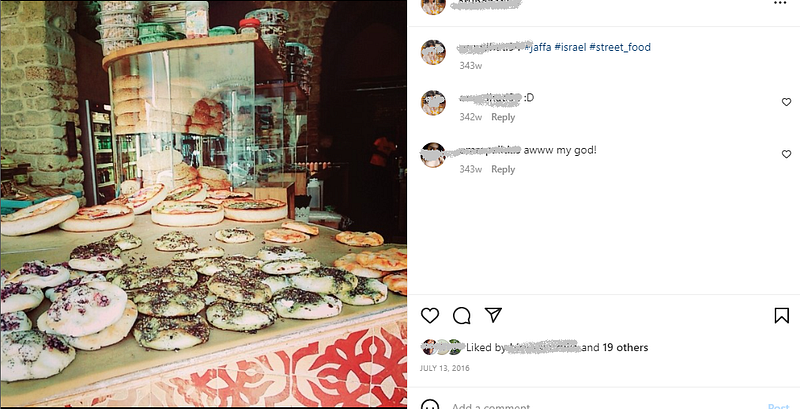
We weren’t really “users” then. We didn’t need a daily dose of mindless scrolling, we were content to upload an obviously edited photo once in a blue moon, and forget about the app.
But Facebook had acquired Instagram by 2012, and come 2020, Insta was about to get jacked with steroids.
“Instagram spent much of the past eight years fighting to maintain its independence from Facebook. In 2020, the fight was over.”— The Verge
The idea was to make you scroll longer, to make you look at ads.
Once you had scrolled through whatever food photo your neighbour had uploaded, you were presented a series of algorithm-approved posts from unknown creators. For men, these were skimpy-swimwear models. For a woman like me, the posts were tailored to my liking — cute animals, picturesque locales.
There was no “That’s it folks! Come back tomorrow.”
Then the explore button was added, to recommend content based on your likes. Next, the messaging feature. After that, the integration with Facebook messenger.
Then, I believe, is when Instagram officially acquired hardcore drug status.
They added reels.
Why an Instagram Detox Mattered
Now, I try to be a glass-half-full kind of person. I have discovered incredible creators: Dean Nicholson, who bikes around the world, his cat Nala perched atop his shoulder. Zack Pinsent, who tailors “bespoke period clothing for men and women with historical accuracy”. Or the amazing Neha Bhat, a therapist and educator who talks about healing childhood trauma.
Before reels, I’d follow creators’ posts, scroll a few photos, and close the application.
After I discovered the reels button, I started spending countless hours numbly scrolling. I was falling behind on tasks, and more alarmingly, I was using reel-scrolling to avoid uncomfortable thoughts. My sleep was in shambles, and the information overload was affecting my mental health.
Here’s an excerpt from an article explaining the psychology used by TikTok creators:
…..they said that TikTok is similar to gambling. We get the dopamine from a few good videos, then have a lull of excitement with a couple of videos that don’t relate; then we are boosted with another pleasant video. They compared the app to a slot machine; you get the constant highs and lows. The anticipation alone is exciting to us both physically and mentally.
(The chilling documentary, The Social Dilemma, sums up these perils beautifully — I’d highly recommend a watch!)
The reason why Instagram is dangerous, is that it appears harmless.
So, if Facebook is the crass, foul-mouthed guy you immediately avoid, Twitter the persistent salesman trying very hard to sell you his latest self-help course, Instagram is the gorgeous blonde in a perfectly tailored suit, who’ll insidiously strut into your life and make it all about her. If you try to leave her, she’ll pout and show you a beautiful locale and whisper sweet nothings.
She’s irresistible.
She’s also an energy vampire.
The Gaslighting
Meta knows.
According to a September 2021 report in the Wall Street Journal, internal presentations in 2019/2020 discussed the effect Instagram had on young people and teenagers. Some excerpts are mentioned below:
- Thirty-two percent of teen girls said that when they felt bad about their bodies, Instagram made them feel worse, one slide said.
- Teens blame Instagram for increases in the rate of anxiety and depression. This reaction was unprompted and consistent across all groups.
- Among teens who reported suicidal thoughts, 13% of British users and 6% of American users traced the desire to kill themselves to Instagram.
In public, they have downplayed the damage done by their platforms, time and time again. Here’s what Mark Zuckerberg said at a congressional hearing in 2021: “The research that we’ve seen is that using social apps to connect with other people can have positive mental-health benefits.”
The truth is, as Cal Newport brilliantly explains in his book, Digital Minimalism: Big Tech is shelling out billions to keep us hooked to our screens. After all, this is the “attention economy” — more eyeballs, more ads, more business. It’s David vs Goliath, except Goliath has a staggering market cap of $562 billion.
Coming To Terms With Addiction
After coming to terms with the perils of too-much-scrolling, I’d made up my mind to get off the platform.
Which was easier said than done.
A typical cycle looked like this:
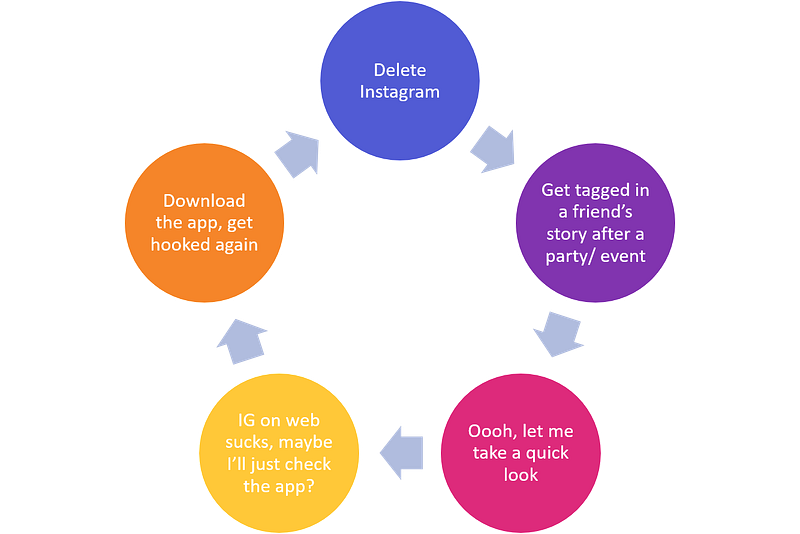
I was hooked. Every time I reinstalled the app I got bombarded with reels showing Henry Cavill in Superman-esque glory, too, for good measure. Insta knows Superman is my, err, Kryptonite. 🥺
Finally, I Found a Solution
Last year, I picked up Digital Minimalism by Cal Newport and boy, was it a life-changing read!
Cal says that we are in a “lopsided arms race” — I think it was important for me to accept this; that it is a deliberate construct by tech giants, not an individual failure to be present and employ my time meaningfully. Upon reading and re-reading the book, I realised my cycle of guilt and scrolling could only be mitigated with scientifically proven techniques and deep introspection.
Obviously, this brilliant book has many gems, but I’ll only focus on the parts that helped me kick my Instagram “habit”.
Step 1: Declutter
Define the apps which you can delete from your phone without disrupting your life. For example, I have a habit of obsessively checking my mail, which I don’t need to. So along with social media apps, my mail app had to go too. Netflix? Delete. LinkedIn? Delete. Anything that doesn’t actually play a significant role in my day to day, had to go. (This exercise was eye-opening; I could have deleted every app except phone and SMS. I didn’t though.)
Step 2: Take one month off
During this period, I quit Instagram cold turkey. Cal recommends keeping the list of “banned” apps in a visible place. My trick was announcing to all my friends that I’d deactivated all social media for a month so that there’d be an additional barrier to logging in during that time frame.
Cal also suggests filling your life with activities that are meaningful and involve some form of mental/physical labour, and acquainting yourself with old hobbies again, to fill in this period of “detox”.
This should be a time of reflection, when you decode the “why” and the “how”. For instance:
Find your why: Why do I use Instagram? To appreciate the content of certain creators like <insert examples>.
Set your rules: Here were mine (to be implemented after the detox):
- Only open the web version
- Do not click on stories, reels, or the explore button. View posts only
- Set a specific time of day to check the website
- Aggressively mute content that does not align with your why.
The same process can be repeated for LinkedIn, Twitter, Netflix, even games.
My friend and fellow reader, Alamgir Baidya, sums up another key finding in his Goodreads review:
…streaming apps and video games may not strictly fall under the social media apps bracket, but the exact mechanism is at play. I used to stream Premier League (English football) highlights on the Hotstar mobile app in the “in-between” moments several times a day — e.g. my commute to and back from work. The same was true for the Netflix mobile app. My weekly streaming consumption is much lower now. I still watch Netflix on alternate nights, for an hour or so, over a monitor. For football on Hotstar, it’s just live matches on weekends now. You won’t be able to suddenly let go of things you passionately enjoy, but you can regain control.
Step 3: Reintroduce social media mindfully
After a month, I carefully re-introduced Instagram and the other suite of platforms (for which I set clear rules).
I saw a change in my consumption of social media; not only am I clearer on my purpose behind the usage, I am no longer as drawn to these apps as I used to be. I still do not have the Insta app; when required, I log in through a web browser and take care to log out each time (hack: uncheck the “remember me” option to increase the friction of usage. If you use Apple Keychain, delete the saved Insta password too!)
Closing Thoughts
I want to emphasize that social media has far-reaching positive effects as well. Instagram for Business has helped small businesses to set up online shops and promote their brand, and get connected to the right clientele.
Tech giants have enormous data reserves which they can (and do!) put to good use.
The takeaway is to use social media in a minimalist fashion: to pick and choose aspects of technology that align with your purpose.
For instance, Cal says that you can view WhatsApp as a tool to text a friend to schedule a meetup, a means to deepen a connection. As a means to hold conversations? Probably best avoided. What works for me: I keep notifications off, check messages at specified times of the day, and respond to them in batches.
There is a beautiful mindset shift that occurred too. Not only was I able to re-ignite my love of monumental books, exercise more, and feel less overwhelmed, I started prioritising more community-driven activities. I went on heritage walks, art classes, and attended social gatherings with joy (early-twenties-me thought social events were a waste of time).
I’d highly, highly recommend a full-fledged socials detox to simply observe the experience of a mindful existence. Contemplate: what gives you joy? How would you want to socialise with people outside the digital world?
And always remember: whatever you do, don’t click on reels featuring Henry Cavill. ;)


