
A REFLECTIVE GALLEGGIANTE
From Paradise to Paradise — Part 3
The last Persian sunset
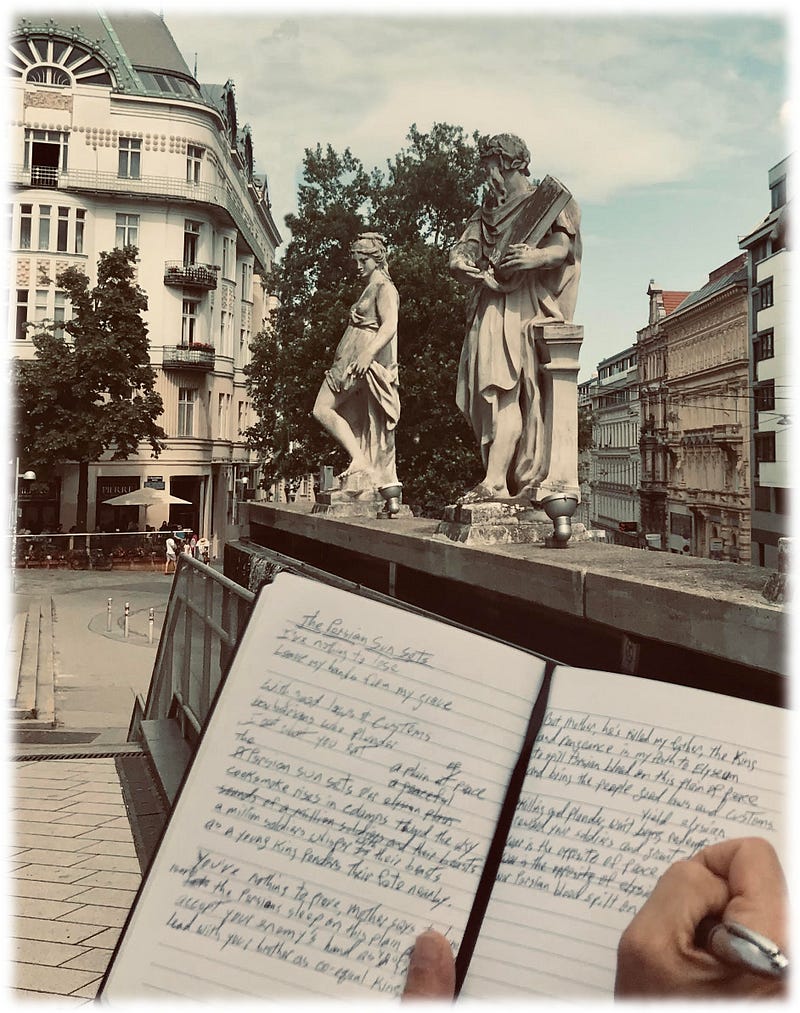
The Persian sun sets o’er a plain of peace cook smoke rises in columns toward the sky a million soldiers whisper with their beasts as a young king ponders their fate nearby.
You’ve nothing to prove, Mother says to him let the Persians sleep on this plain of peace accept your enemy’s hand as your friend lead with your brother as co-equal kings.
But Mother, he’s killed my father, the king and vengeance is my path to Elysium to spill Persian blood on this plain for peace and bring the people good laws and customs.
War is the opposite of peace, my son reward your soldiers and grant them release killing and plunder won’t yield elysian nor Persian blood spilt on this plain of peace.
In 331 BC, Alexander the Great met King Darius III of Persia on the flat plains of Gaugamela. Having lost his father to assassination, Alexander captured Darius’ mother in a previous battle and took her into his confidence, even calling her “Mother.” Darius made a generous offer of peace, including co-leadership of their combined empires, to avoid the battle.
Though vastly outnumbered and facing nearly certain defeat, Alexander ultimately decided to attack. With brilliant strategic moves, he defeated Darius’ enormous army (battle elephants and all) and ended the 200-year-old Persian empire.
A galleggiante is a poetry form with four 4-line stanzas using an abab rhyming scheme. One line in each stanza is a partially-repeating refrain that either begins at the top and falls to the bottom (a “sinker”) or vice versa (a “floater”). The word galleggiante means “floating” in Italian.
Thanks to Paper Poetry for inviting me to write this poetry series with the theme Elysian, meaning beautiful or creative; divinely inspired; peaceful and perfect. The ancient Greeks believed a perfect, peaceful place called the Elysian Plains, or Elysium, would be the final resting place for the souls of the heroic and the virtuous.
Stay tuned for the next in the Elysian series: From Paradise to Paradise — Part 4
Jim Dutton © 2022
If you enjoyed this poem and wish to read more, please visit my Poetry, Science Fiction, and Fiction lists. And if you are not already a Medium member, you can get access to all of my work, and many, many others through my referral membership link.
PS: Editorial Note : Paper poetry conducts themed poetry series every month. This month’s theme is of Greek origin, Elysian: If you want to be a part of this, kindly read this.


