
From Outside the Singularity
Or, Portrait of a Dying Marriage
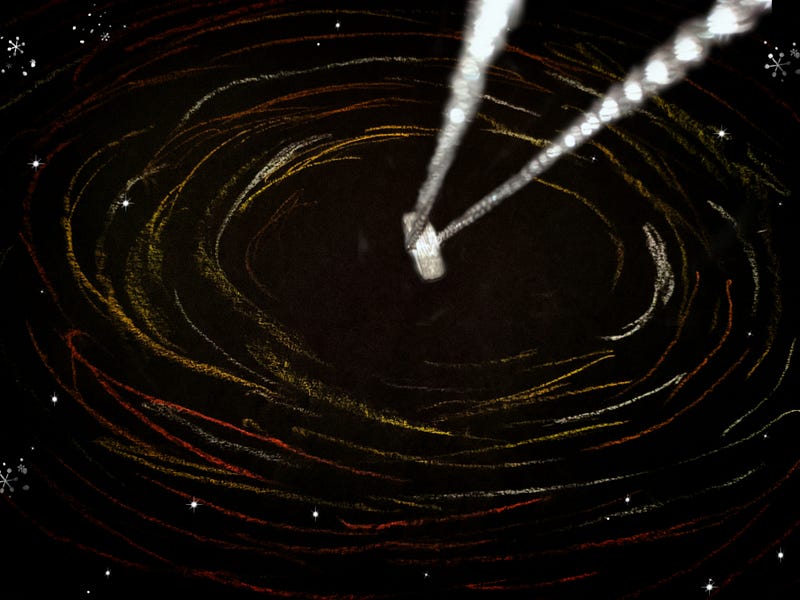
A black hole begins life with death. It starts when a star — it has to be a massive one, a star that already has a tremendous amount of gravitational pull — reaches the end of its life cycle.
It hits the last sixteenth of a tank of helium and hydrogen and whatever else it has to burn; and instead of just carrying on until it fizzles out, it expends a huge amount of energy as it rushes to burn that last bit of fuel more or less all at once. Well, relative to its millions-of-years lifespan, anyway.
The huge burst of energy and light that hurtles across the Universe when this happens is called a supernova. All stars eventually die, but only the biggest ones make supernovas. Now, I’m not an expert on the physics of how to go from supernova to black hole, but I have a decent layman’s understanding of the process.
Along with all this energy and light that is fired through the vacuum of space during a supernova, remember, is the matter that makes up the star. There is an immense gravitational force still at the center of it. This gravitational pull can sometimes be so strong that instead of exploding, pushing all this matter and stuff away from its center, the star may actually implode, using that gravity to pull all that matter into itself.
This will create a very small, extremely dense ball of matter called a neutron star. I read somewhere that if you could get one and carry it to Earth it would be so heavy that it would simply sink through the Earth almost to the other side, going back and forth like a pendulum until it came to rest directly in the center. Theoretically.
Sometimes the gravitational force of a neutron star is so strong that it doesn’t stop at pulling in and compressing its own matter and energy. Instead of slowing down, chilling out, the gravity of the neutron star gets stronger and stronger, it wants more and more. It pulls and pulls at everything around it. Once it becomes so strong that light itself — which literally has no mass and ordinarily shouldn’t be affected by gravity at all — can no longer escape the gravitational force put out by a neutron star, then it becomes a black hole.
There is nothing that can satisfy the insatiable appetite of a black hole. No matter how much it pulls in, it remains empty.
Here’s an interesting thing about black holes: they have what is called an event horizon — the edge of the black hole, a sort of in-between zone where light can no longer escape but the gravity isn’t quite strong enough to actually pull it in yet. It’s almost like the outer crust of a black hole. Physicists will sometimes use the event horizon of a black hole to illustrate relativity.
Imagine there were two people and a hippo floating in outer space some ways off from a black hole. (I think the thought experiment uses a hippo; it might be an elephant. I’m not sure why exactly.) One of these space adventurers decides to jump onto the back of the hippo and ride into the black hole to find out what is really on the other side of the Singularity. You are the guy watching this idiot.
As he reaches the event horizon, the guy and his hippo start getting sucked into the black hole. The pressure becomes immense. You can see as the guy and the hippo begin to compress, all the matter that makes them exist stretching out and squeezing together until you can’t tell the guy and the hippo apart. And still they keep compressing. In probably the blink of an eye, they are past the event horizon and they are compressed in a point of such infinite density that you couldn’t even see them under a microscope. This point is the Singularity.
Needless to say, they are dead.
If you were the guy on the hippo, however, it would look a little different to you. Time would slow and stretch as you hit the event horizon because of the force of gravity. You would look around and marvel at the light frozen in space, trying to escape its imminent demise. I imagine the pressure on you, compressing you into yourself and pulling you into itself, would be rather like the hot water in a lobster pot; it would take you a long time to notice it because of how gradually it would seem to come about. By the time you noticed it, in fact, you might be just about dead already.
Then you would probably panic, and experience immeasurable pain, and it might seem to last a very long time because of what gravity does to the space-time continuum in that spot. And then you would get past the event horizon, and you’d be dead long before you could report any of your observations on what goes on inside the Singularity.
To the outside observer in this scenario, the destruction of the guy on the hippo is obvious; he could see it coming from a mile away. He probably yelled after the guy on the hippo what a fool he was as he galloped off into the event horizon.
To the guy on the hippo, though, it just makes sense to go into the black hole. He has an absolutely false sense of safety. It seems like a great idea, amazing, beautiful, even as gravity is already starting to destroy him.
He isn’t capable of seeing that he is being destroyed until it is too late - it is a force that he can’t escape.