
From Meth to “All the World’s a Stage”
Slammed: a Memoir — Chapter 14 Part 4
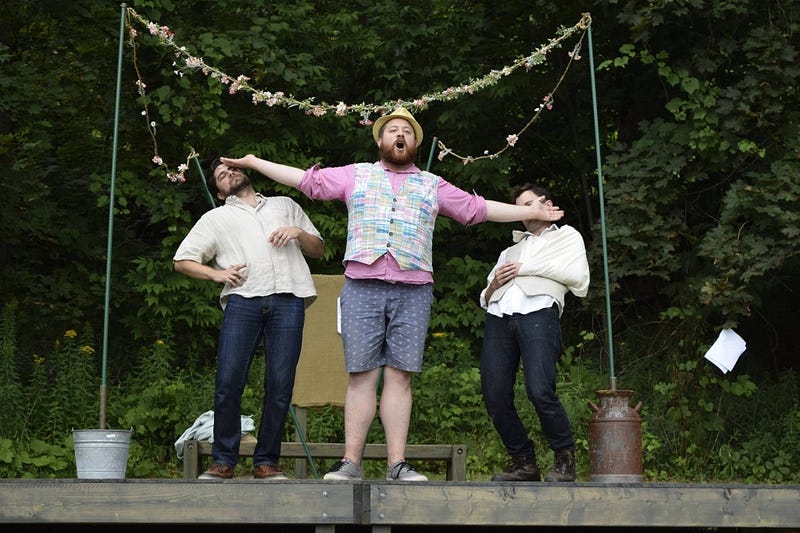
The dressing room was an unused space below a trio of shops in Sharon Springs. The floorboards above us creaked as weekend visitors perused sundresses and turquoise jewelry, fragrant soaps and body lotions, tasteful bundles of dried lavender, and other such country knickknacks.
It was as cool as a stone undercroft. A blessing as the August sun had the temp above 80. A bit warm for outdoor theater, but doable.
It was nearly 1pm. After this meeting, we would be at places for our final performance of As You Like It.
We stood in a circle as a company one final time. I stumbled through some words. “Thank you for coming on this journey with me” or something to that effect. But mostly I just marveled at this group of beautiful people.
Alex, who had been Ophelia to my Hamlet in grad school, had short, jet-black hair, fair skin, and a strong alto voice. She was my first and only choice for Rosalind. Her characters were always incredibly nuanced, waxing between curiosity, concern, and astonishment. Plus she’s incredibly funny, never afraid to go big with her character choices.
When I called her about the show I was in the middle of fundraising. “I wish I could contribute, John. I really do,” she said, incorrectly guessing my reason for calling. “It’s such a great play and I’m so happy you’re doing it.”
“No, Alex, I’m not calling you for a donation. I’m calling to ask if you’d play Rosalind.”
Her response was an explosive “Oh my God!” I laughed as she continued. “Really? You’re not kidding? I would love to!”
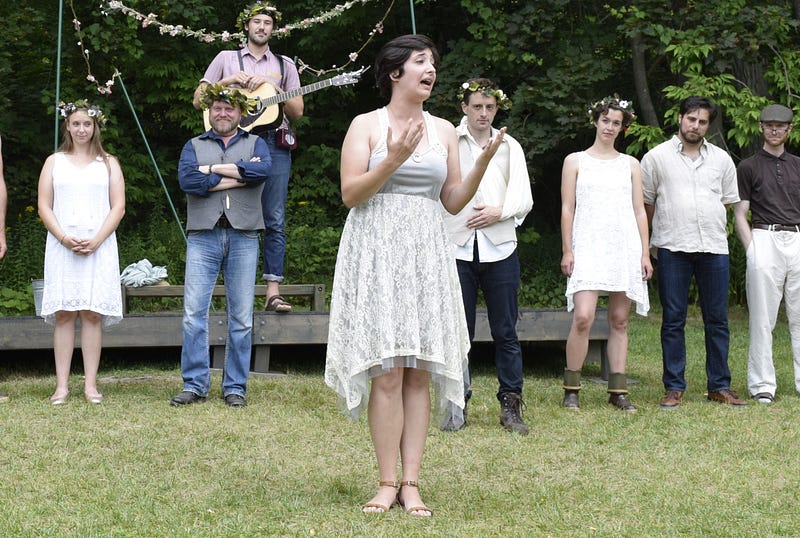
Trey was my Touchstone. A little over six foot, he was a young bear with a beard like copper in the right sunlight. When we met in the first year of grad school — most of the cast was from my grad school class — we discovered we were palindromes: I was 32, he was 23. My birthday was July 13, his was July 31st. I called him “Baby Gay” and he called me “Papa Mo.”
I may have been “Papa,” but Trey — at nearly the same age as when I started using meth — had a level of groundedness and maturity I doubted I had even in my early 30s. There was no one else I could have seen as Touchstone.
Actually, I didn’t know how I saw Touchstone, the clown and comic relief of the play. His monologues were thick with dated bawdy references, dick jokes that were written for the 16th-century ears of the groundlings (the cheap seats). I couldn’t make heads or tails of a lot of it.
As a baby producer, I felt that I needed to have all the answers to every conceivable question and situation that might arise before we even had our first read through. And I believed I very much did… except for Touchstone.
What I came to learn was that good producers and good directors hire actors who are problem solvers. And Trey was a problem solver. He took text I couldn’t wrap my head around and turned it into some of the funniest and most touching parts of the show.
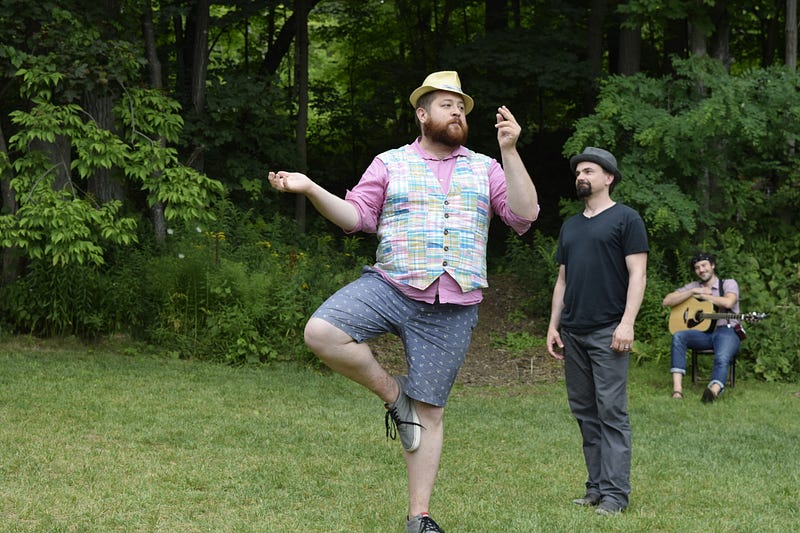
It was Trey along with Jim who anchored my entire reasoning for producing the show.
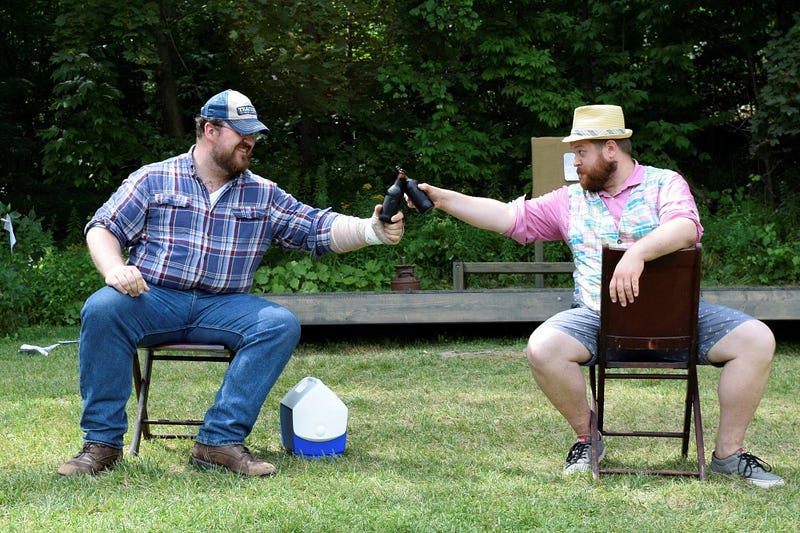
Jim played Corin, a shepherd. Jim was as thick and solid as a barrel. He’d been Claudius, Hamlet’s Uncle to my Hamlet (despite being several years younger than me). When Hamlet has the opportunity to kill Claudius but second guesses himself, I joked that it was because I literally could not get my hands around his neck to strangle him because it was just that thick.
Jim, for all his size, was also incredibly gentle as a person and an actor. He was never given to exaggeration or overperforming. In him, you hardly ever saw the actor before the character he played. When he put on his jeans, flannel shirt, and ball cap to play Corin, he looked — and more importantly sounded — like he just hopped off a tractor.
It was the scene between Touchstone and Corin that gave the spark to take on this crazy project that was now nearly at an end. When I first had the idea, I was still reeling from the shock that was the 2016 election. I was obsessed with the chasm between urban and country voters. I wanted to fix it, I wanted to heal it in some way, and this scene between a courtier and shepherd about the vast differences in their worlds yet still able to find in each other a friend appeared to be the balm I was looking for.
At every show, our audience was a mixture of, as I saw it, courtiers in exile like Touchstone and local shepherds like Corin. I would watch as best I could from off-stage every time we reached Act 3 Scene 2.
TOUCHSTONE
Why, if thou never wast at court, thou
never saw’st good manners; if thou never saw’st
good manners, then thy manners must be wicked,
and wickedness is sin, and sin is damnation. Thou
art in a parlous state, shepherd.
CORIN
Not a whit, Touchstone. Those that are good
manners at the court are as ridiculous in the
country as the behavior of the country is most
mockable at the court. You told me you salute not at
the court but you kiss your hands. That courtesy
would be uncleanly if courtiers were shepherds.
TOUCHSTONE
Instance, briefly. Come, instance.
CORIN
Why, we are still handling our ewes, and their
fells, you know, are greasy.
The audience laughed and nodded in agreement with every back and forth. For all the increasing hyperpolarization and tribalization, for a brief moment in time, 21st-century Courtiers and 21st-century shepherds shared a moment of peace seeing their lives reflected in 16th-century text.
There were Ryan and Greg, both of whom I had a little talent crush on. One of the best parts of being a producer is getting to hire good actors just to watch them work. Through no fault of their own — as divas they were not — I often felt like, as a musical theater actor, I wasn’t quite cool enough to hang out with these “real” actors.
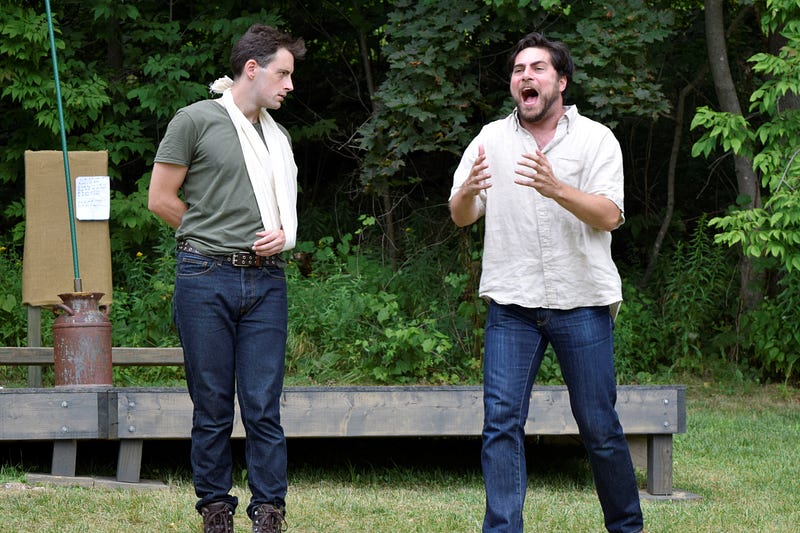
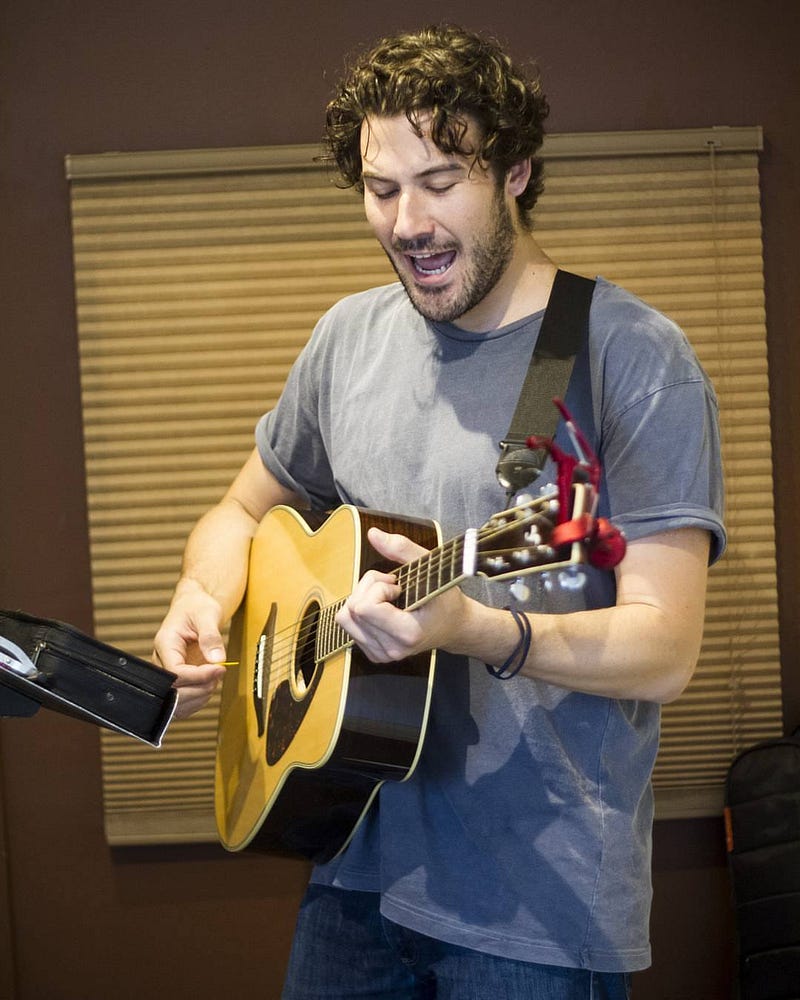
There was Paul, our bard. Handsome and tall as a tree, Paul was a gift from the theater gods. As You Like It, like many of Shakespeare’s plays, contains a fair bit of music in the form of song lyrics. We thought we would have to hire someone to write the music and, separately, hire someone to play the bard, Amiens, to sing. Then along comes Paul who we hired to do both. The talent in this long-limbed actor was astounding. For each song he gave us several options, every single one of them capturing the country, folk, Appalachian feel beyond anything I had even begun to imagine. Thanks to Paul, our show had its own unique sound.
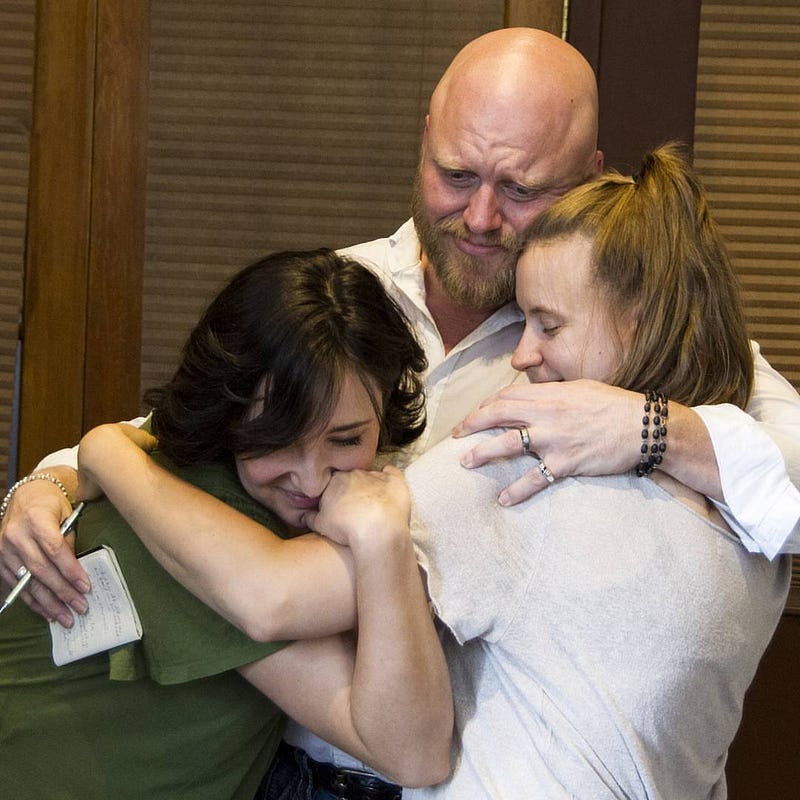
There was Ilan, who brought a touching frailty to Adam; Wolf, who brought surprising wisdom to Celia; and Travis and Val, who brought their warm-hearted kindness to their roles of Silvius and Phoebe even as Val smacked Travis over the head with a bouquet of flowers every show.
Gene, who was Warbucks on the Annie tour, was my Duke Senior. He had been the one who held me as I wept like a traumatized child when I reached my breaking point in San Francisco. In bringing the gravitas of Warbucks to Duke Senior, he was also a connecting thread, a witness. He was there when I was at my most broken. Now he was here at what I hoped would be my healing.
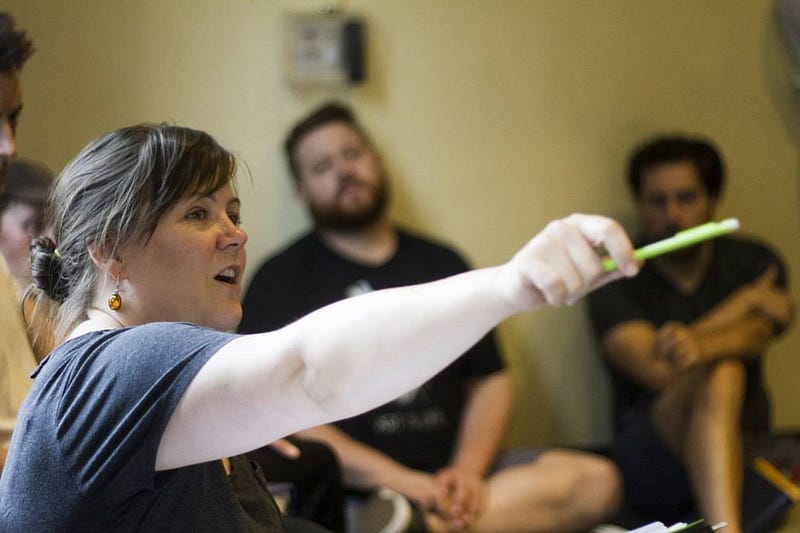
Kelly, our director, was not there. She left us the day after we opened, her job complete, as is common. Usually, it’s the director’s vision that gets realized as their job is about the story and picture as a whole, its themes, its commentary, its target audience. But in this case Kelly was hired to realize my vision. She’ll be the first to tell you “This wasn’t my As You LIke It. This was John’s As You Like It,” as she had her own love and vision for the play. Still, she came aboard and brought a wonderful, questioning playfulness to our rehearsals, letting the actors inform her about the characters which she molded into the bucolic story I envisioned. A creative process lightyears removed from the “yell at you until you do it the way I told you to do it” process that was Annie.
My husband Michael and I had worked tirelessly over the previous few months fundraising, organizing, holding auditions and hiring, finding rehearsal space, figuring out travel logistics, all the things that I watched Dexter and Laura do for several years with Springfield Rep. While they handled a summer season of multiple shows at once, I wasn’t sure if I had what it took to put up a single show.
But just like Daniel from The Karate Kid, all the years I’d spent in the theater, all the plays and musicals, all the rehearsal studios and tech weeks, and being around all the logistics of putting on a show from a very early age were my “wax on, wax off.” Even one show was a shit ton of work, but the complicated logistics of it all was almost second nature. I did in fact, at least on a small scale, know how to be a producer.
After the trauma, bullying, and disappointment of Annie, I wasn’t sure if I even wanted to be an actor anymore. It seemed all my dreams of theater had amounted to nothing but depression and tears.
Now, after the last four weeks watching these wonderful artists work, collectively creating a beautiful story of exile from the only place you ever thought you belonged only to finally find your own voice in the forest, I finally began to mend.
While in Corin and Touchstone I saw the people of Sharon Springs, and while I connected deeply with Jaques, who I played, investing in my own melancholy brought on by the collapse of my career and the loss of my father, in the end I saw myself in Rosalind. Running away from the city in exile, fleeing to the country, pretending to be someone. Only to discover I was still me. I still had a voice. I still had passion. I was still the little boy excited to go onstage in my monkey helmet to tell all the people how I loved swinging through the trees.
I was still an actor.
I thanked the company, coaxing a few laughs and a few sniffles out of them, before declaring, “Have a great last show. Break a leg!”
Alison, Gene’s wife who agreed to be a last minute stage manager for me (a detail I surprisingly overlooked), wiping tears from her eyes, called “Places.”
“Thank you places!” the company responded.
We made our way out to the park to tell our final audience the “new news at the new court.”
Brimstone Creek Productions, which we created to produce As You Like It, would produce another show the following year, an Oscar Wilde retrospective. After that it would fade into the sunset. There had been a hope that maybe BCP could be another Springfield Rep, perhaps over the years growing large enough to give the nearby Glimmerglass Opera a run for its money, but it wasn’t meant to be. Sharon Springs was only meant to come into our lives for a season. Eventually, we would end up selling the house and moving further east into New England.
That summer I began to heal. As You Like It confirmed for me I was still an artist. I just don’t fit into the New York City theater industrial complex, and that’s ok. By no means does that make me any less of an actor, an artist, a teller of stories.
My future was no less uncertain. Only now I knew there was a future, even if I couldn’t see it. I need only put one foot in front of the other. When I finally walked away from meth, I couldn’t see the future then either. I could only trust that it was there and walk toward it.
At a glance, my life doesn’t look like much of a success story. I don’t have that Hollywood ending for you where I make my Broadway debut or anything like that. And lord knows there ain’t any success stories in my bank account.
But mine is an interesting story, at least to me. So interesting that, deep in the throes of meth, I took a notebook with me on the subway one day and started writing. “Well, here I am.” There’s a certain joy in finding yourself interesting.
My 20s were a struggle. The tale of a lighthearted, naive boy, a nuclear reactor of energy, violently thrust into the wrong story of addiction, trauma, disease, and recovery. A story of having to fall down the rabbit hole in order to grow up.
My 30s were the fracture between the theater business as it is and the kind of actor I needed to be. Overcast days of depression, believing I was too weak, too sensitive, too damaged to be a successful artist, leading to an awakening. I was an artist. I am an artist. A damn good one too. NYC just wasn’t my medium.
My 40s so far have been about finding a place to call home and people to call my friends. Can I find the joy and community that I once had as a child, when the stage wasn’t a business or a ladder, but a home?
There are trials ahead, for sure. For all I’ve been through, there may even be tribulations that dwarf everything in my journey thus far.
But I’ll get through,
If past is prologue.
In the meantime, I hope one day
I can hop onstage
And tell you how much I love
Swinging through the trees.
Chapter Guide
A lot of heart, time, and work goes into each piece. One way you can support me is by signing up for a $5/month Medium Membership. Use this link and I’ll get a percentage of your subscription fee. Huzzah for supporting artists!


