
From Meth Addict to Hamlet, Prince of Denmark
Slammed: a Memoir — Chapter 12 Part 4
Note: Unless you’re familiar with the exercise described below, I do not recommend attempting it without an experienced teacher or guide.
In the fall of 2010, four and a half years clean from meth, I started my first year of grad school at the New School for Drama in NYC.
A couple weeks in, we learned techniques designed to help us relax, connect with ourselves, and prepare to rehearse. Half of my acting class sat slumped like rag dolls in chairs staggered throughout the room while the other half observed.
Our teacher Marcia was a short — five foot even if she was an inch — older woman with curly strawberry blond hair. Though she wasn’t a smoker, she had a smoker’s voice with a New York lilt. “Relax, deep breath, and release on a full sound. ‘Ahhhhh.’”
I let out an “Ahhhhh,” as did my classmates. I felt the sound vibrate in my chest as our “Ahhhhhs” created a dissonant chord.
“Speak your thoughts. What’s actually going on? ‘I’m tired. I don’t want to be here. I skipped breakfast.’ Speak your thoughts. Relax.” She leaned into the word “relax” like it was her version of chanting the Buddhist “Om.”
I heard my classmates begin to mumble around me, but I remained silent. There were no thoughts in my head. Nothing. As if my brain was out to lunch, like when someone asks you how your weekend was and you all of a sudden can’t remember having a weekend.
I held my breath.
“Breathe, John. Breathe. ‘Ahhhhh.’”
“Ahhhhh.”
“Speak your thoughts.”
I hesitated, still blank.
“John, relax. Speak your thoughts.”
Confused, I just started speaking. “There’s nothing in my head. I’m blank. I have no thoughts.”
“Good, good. Keep going. ‘Ahhhhh.’ Simon. No. from your chest. ‘Ahhhhh.’”
I’d heard a number of students in the other acting class got quite emotional, some even cried, when they learned this exercise. As I sat there, slumped, releasing my “Ahhhhs,” I wondered (not speaking these thoughts out loud) how this made people cry. All I felt was slightly ridiculous.
After we’d been Ahhhhh-ing and relaxing for a while, Marcia gave us an adjustment. “If you think you’re ok working as you are, stay with it. If you’d like to try a different position, I want you to lie on the floor.”
I stood up and put my chair off to the side as did several others before lying down on the cold linoleum floor.
“Good. Now, I want you to throw each limb with with a ‘Ha.’” She demonstrated standing up. She threw an arm. “Ha.” The other arm. “Ha.” She kicked one leg. “Ha.” Then the other. “Ha. Then release on a full sound. ‘Ahhhhh.’”
I did as instructed, still confused. I threw my limbs. I released on a full sound. I repeated this several times.
Then…
“Ha. Ha. Ha. Ha. Ahhhhh…!”
I choked.
Something in me,
In my core,
Cracked open.
A dam burst.
A sob escaped.
I clasp a hand over my mouth.
I couldn’t stop.
It wouldn’t stop.
It wouldn’t be stopped.
I cried. Hard.
My sobs exploded into the room, thrashing, guttural.
I rolled onto my side and into the fetal position.
I covered my head with my arms as if protecting myself from incoming blows.
My sobs became keening.
Marcia was by my side. “Good, John. Good, keep breathing. Breath.”
The rest of the class had come to stop as I lay on the floor in full meltdown.
Not being able to help herself, Marcia joyfully exclaimed to the class, “Listen to the sounds!” Then continued to coach me back. “That’s good John. Breathe. Deep breaths.” She turned to another student. “Tracy, will you get John a glass of water?”
After a few minutes, I calmed and Marcia kindly told me I was finished for the day. “Good work.”
I was exhausted.
While the other half of the class had their turn, I sat, spent, marveling at the event I just had.
I hadn’t cried like that since…I couldn’t remember.
I’d been emotional. I’d been sad. Tears had been shed from time to time. But nothing like what had just happened.
The only times I’d cried like that were both the result of a meth induced psychotic episode, so those didn’t really count.
But nothing before that…
Or after.
In fact — without a psychotic break being involved — I hadn’t really had a good cathartic cry the entire time I was using meth or at any time since I stopped.
The weird thing was I wasn’t crying about something. There was no idea or thought or image in my mind. It was primal. My body just took over. It was an emptying, a release. Now I was exhausted, but lighter. So much lighter.
Even after four years since I stopped using meth, all those experiences, all that trauma, they were still living in me. I was holding onto all of it as if it was all trapped in a titanium vice hidden deep in my core.
Until the “Ahhhhh” shook loose the lock holding that vice shut. Once opened, like Pandora’s Box, it vomited out all the horrors. Everything trapped in my muscles, in my organs, in my sinews, in my core, till all that was left was an exhausted hope.
That memory, that trauma, it wasn’t gone, not at all.
But it became so much easier to carry.
I never had a meltdown like that doing this exercise again, thank goodness. That amount of catharsis every time would have been beyond debilitating. After that first experience, releasing on a full sound simply connected me to myself and how I was really feeling in that moment so that I could start each rehearsal from a place of emotional honesty.
But, holy fuck, was I a lot more emotionally vulnerable and available. Now I could cry about anything. A warm-hearted Christmas commercial would come on TV and Michael would hear me sniffing.
“Really? It’s a coffee commercial.”
“Shut up! I’m paying for feelings!”
Cracking open that emotional vulnerability and availability was a huge step forward on my grad school journey to become a better actor, and I was lucky that it happened so quickly.
But it would be finding my authenticity as an actor that would prove to be the biggest challenge.
As a hyperactive child, I would turn “on” in any social situation. School, home, at the mall, didn’t matter. I would always start performing. Dad would gently admonish me countless times. “John, quit being silly.”
But I couldn’t quit. I couldn’t stop. It was as if every time I was in a room with more than one person, an electrical current would run through me turning everything I did up to 11.
So, since I couldn’t stop performing, theater became the conduit through which I channeled my boundless energy.
Theater, specifically musical theater, seemed to be the perfect profession for a hyperactive stuck at 11 who never stopped performing. It led me to NYC, to AMDA, and into a fairly successful professional musical theater career until meth took over.
I could confidently say I was an accomplished performer.
But now I wanted to be a real actor.
There are plenty of people working in musical theater who aren’t actors, just as there are plenty who aren’t dancers and even those who aren’t singers. But every single one of them, from the belters to the tappers to the jazz handers, they are all entertainers.
They are all performers.
That’s what I was: a performer. I relied on it. It’s what got me hired.
But right from the very first class at the New School for Drama, I was being told to “stop performing.”
See, very few characters, be it on stage or screen, are actors or performers. They’re just people. They’re cops, moms, scientists, janitors, college students, etc.
Every character I had played up to that point, they were always performers because I was always performing. I was always performing because I was always “on.” And I was always on because I was a hyperactive. Every time I got on stage or even up in front of class, my adrenalin would hit, my energy would spike, and everything was at 11 or beyond.
I would see myself in Robin Williams. The level of extreme energy he had naturally — even after he got off the coke — be it in interviews or doing stand up, is the kind of energy I’m talking about. Though he wielded his energy like a master, I still saw myself as a performer in the same vein as him.
But then you watch Good Will Hunting and you see how he was able to put that energy away, how he was able to take on a character that wasn’t a performer. You see how he was also a wonderful actor capable of all levels of energy.
That was the ability I lacked. I didn’t know how to turn it off. I didn’t know how to stop performing.
Breaking down the “performer” wall started with Marcia in year one.
It was my turn for scene work. I tried to take a moment to find the character, but my adrenaline spiked. My thoughts became manic. That energy that I had relied on for most of my performing life was getting in my way. I started the scene, doing it the same way I’d done it hundreds of times before.
Marcia stopped me. “No. No, you’re saying the way you think it should sound.”
But that’s how I’d always done it. That was my acting: Delivering lines with rigidly memorized inflection as if they were written notes of a song.
Second year was even more challenging.
“Stop doing a voice.”
I was up in front of class doing a classical monologue from some Greek play. Our teacher was Stephen, a hyper-intelligent director who was unnervingly tall. Bachelors from Harvard, Masters from Yale, he intimidated the absolute fuck out of me, which drove me crazy because he was also younger than me.
“Voice?” I asked
“Yeah, you’re doing this… voice. Like, because it’s classical it should be…” he gestured indicating the “voice” I was apparently putting on. “You are not an actor in a Greek play. You are a person who wants something from another person and you’re using your words to try to get it.”
He hit me with his mantra. “Do it like a person.”
I tried it again, entirely insecure about anything that was coming out of my mouth…until the entire class laughed. Not at me, but with me. I tell ya, nothing picks up my mood like getting an entire room to laugh.
I finished the monologue and looked at the teacher. He sat, legs crossed, holding his hand to the side of his face like he was trying to figure out a math problem.
“John, you…you are very good at placing the performance.” He gestured like he was placing an ornament on a tree. “You are very capable of constructing the idea of what you think the character should be, how they should act, how they should speak. You’re even able to pepper in nuances which gives it three dimensions. It is quite often perfect.
“And because it’s perfect, it’s not real. And if it’s not real, it’s not believable.”
Well, at least I’m good at doing it the wrong way?
Intellectually I understood what he and Marcia before him were asking me to do. I knew the problem was that I was “on.” The thing was, as a hyperactive, I had never been truly “off.”
Later during 2nd year, I was working in front of the class, this time with Julie as our teacher. She was kind though surprisingly ferocious when she needed a point to get across. She was short, like Marcia, with a red bob and always carried a thermos of ginger tea which she would sip throughout class.
I was standing trying to work through a monologue from The Seagull.
Julie stopped me. “How about this? Grab a chair. Sit down.”
I hesitated for a moment, thinking the character wouldn’t sit, but then did as she asked.
I started again.
“Less, John. Do less.”
I tried again.
“Less.”
“Julie, I honestly don’t know what that means.” I wouldn’t say I snapped at her, but my frustration was plain.
She thought for a moment, taking a sip of her ginger tea.
“John.” She put down her tea and looked me dead in the eye. With the warmth of Mr. Rogers, she said, “I want you to trust yourself. I want you to trust that you are enough.”
I leaned my head back. I’d heard this before. A lot. In fact, I was kind of tired of hearing it.
She continued. “You know the text, you understand the character, the circumstances, you’ve done your homework. Now just let the character speak.”
“But how do I do that? I thought that’s what I was doing.”
“Just say the words. Speak the text. Do less. You are enough.”
I took a deep breath.
I let it out.
I did the monologue, keeping my mind clear of all thoughts almost out of spite.
I felt like I wasn’t doing anything.
There was a kind of silence, a stillness in me.
Perhaps even…an ease.
I finished and looked around. All my classmates sat staring at me, on the edge of their seats, totally engaged.
“How was that, guys? Better?”
The class erupted in approval. “Yeah. So much better. I was enthralled,” and other such compliments.
“John, how was that for you?”
I broke down crying.
“Ok,” Julie said, “tell me what’s going on right now?”
“It’s just…” I wiped the tears from my face with a frustrated hand. “It’s just…I didn’t feel like I was doing anything. Like, nothing was going on.”
“Exactly! It was just you. Just you sitting in a chair saying words, and it was thrilling.
“John, you are an entertainer. And you’re really good at it. It’s sustained you till now and it will continue to be one of your strengths.
“But here, in this class, with this work, I’m asking you to put aside the entertainer. I don’t want to be entertained. We…”
She gestured to the class …
“don’t want to be entertained. We want to be voyeurs into this character’s private moments. And when you trust yourself like you just did, you let us in and allow us to see something truly beautiful.
“Does that make sense?”
I sniffed and gave a light hearted “I guess” which got a laugh from the room.
After class I realized I finally knew what “off” felt like.
In a way, I’d been treating my acting the way I’d treated my singing. I love to sing in rooms with a lot of ring, where the sound continues to reverberate off the walls. When the room is dead, I sing unnecessarily harder because I’m trying to hear myself instead of trusting my ability to sing.
In a very similar way, I was acting and watching myself act at the same time.
This was the difference between my being “on” and “off.” In order to be “off,” to find ease, I had to stop watching myself act and, hard as it was, trust that I was enough.
With this clear conception of being at ease, being “off,” I began to see what being “on” really was.
It’s my fight or flight response. It’s my way of being in control. For whatever reason — call it social anxiety if you like — my involuntary response to any social situation was to rev up, to turn “on,” to entertain, to hold attention. If I had attention, if I made you laugh, even if I annoyed you, then I was in control.
Yet, even though I now knew the difference, turning “off” was anything but easy. It was like learning to write with my non-dominant hand. I felt clumsy, uncertain, absolutely not in control.
I was out of my comfort zone, and that’s where growth happens.
Our third and final year was the culmination of our acting training for many of us as we would be taught by Ron Leibmen. To some he’s remembered from the movie Norma Rae with Sally Field. To many, he’s Rachel’s dad on Friends. To me, he was the man who won the Tony for playing Roy Cohn in the original Broadway production of Angels in America.
Way back in Catholic high school, every student had to do a “senior religion project,” a research paper on a topic of our choosing subject to approval. I wrote about the religious influence in Angels in America. Now, twice a week, I was sitting in a room with a man who had brought one of those characters to life.
It doesn’t seem fair to my other teachers to idolize Ron like this. I’d already grown so much as an actor because of all of their guidance. But Ron was just one of those actors, high class yet blue collar, like Brian Dennehy, James Earl Jones, Gene Hackman, or Brian Cranston, pillars of power and strength who embodied characters littered with flaws and vulnerability.
He wasn’t mean, not in the slightest, but he was straightforward.
Classmates Ryan and Jim were about five minutes into their scene when Ron stopped them
“There’s a lot of acting going on.” At any given time, this was his core note. It’s point being you shouldn’t see the acting. You shouldn’t see the actor working.
“Right now, what you’re doing is you’re bullshitting. Bullshitting your way through the scene. Sorry. Don’t get me wrong, you’re entertaining enough that you can actually get away with bullshit. And, let’s face it, they got away with it on Broadway, too. But the choice is yours. You can get away with it, or you can be an artist.”
He asked Ryan and Jim some questions about the characters and their circumstances.
“I ask you these questions because I don’t know. You know better than me because you’re playing the character. But you need to ask these question, you need to explore, so you can find out what fuck is going on underneath the words.”
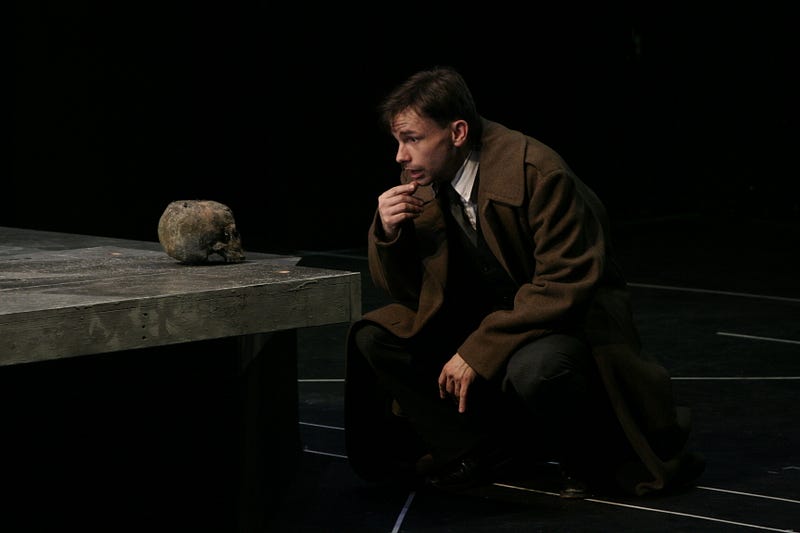
During that fall semester, I had the opportunity to play Hamlet. Like the Hamlet. “To be or not to be” Hamlet. Fucking Hamlet! I’d had the fantasy of playing Hamlet in grad school when I first started auditioning for them. I’ve had countless fantasies in my life, but this was the first one that actually came true! Who the hell needs to play Bobby in Crazy for You. I’m mother fucking Hamlet!
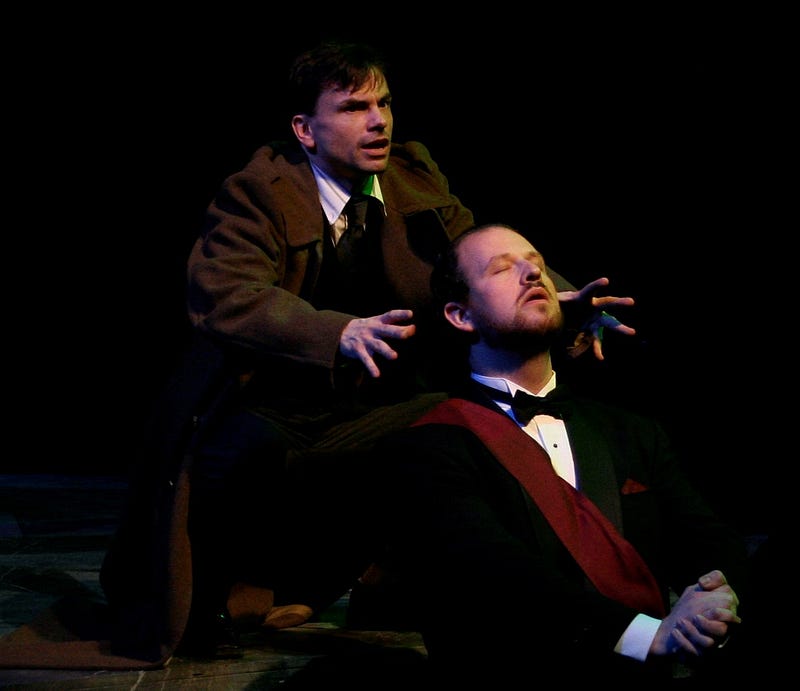
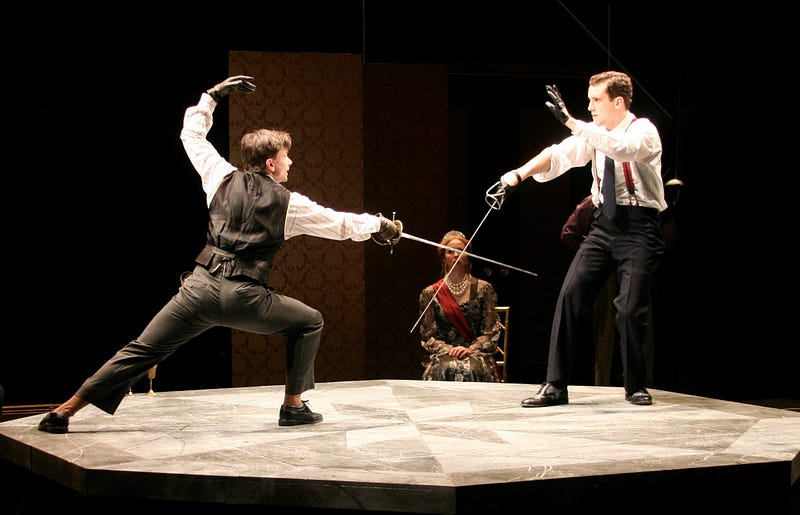
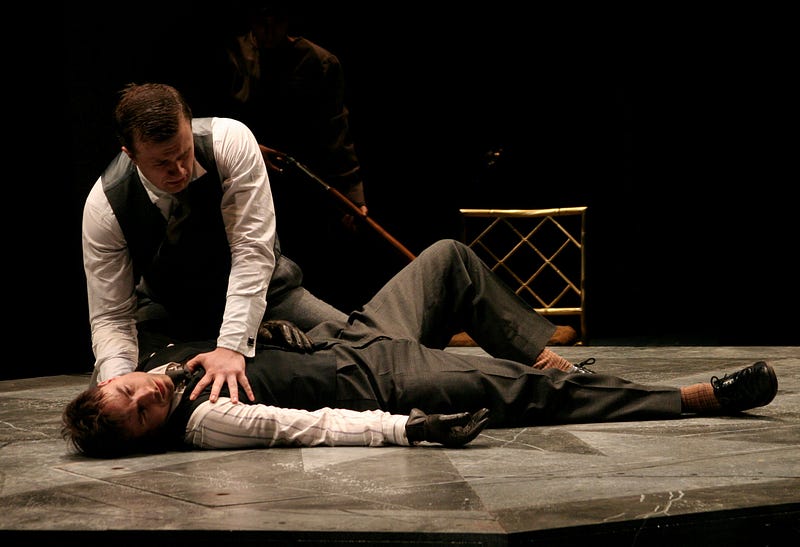
Now, it was an academic production, which meant casting was limited to only our class of albeit very talented actors. I was older than Claudius, Hamlet’s uncle, by I think a good seven or so years and Gertrude, Hamlet’s mother, and I were the same age. But, hey, you work with what you got.
As Hamlet had several monologues given directly to the audience, I always knew who was watching. At one performance, there was Ron!
I was working my ass off as the most manic Hamlet you can imagine, and I was so excited for him to see it.
We reached the end with a sword fight between me and Laertes. At the end of the fight, Leartes is facing upstage when I “slash” him in the stomach. Injured, he stumbles off. When he moved, I was looking right at the audience, right where Ron…was sitting.
He’d left.
I don’t know when he left, but he wasn’t there anymore.
I shook it off and finished the performance, but my heart was a little broken.
He never brought up Hamlet in class or offered any feedback. I also didn’t ask for any. I knew it was imperfect, but I was proud of the work I’d put in, and I wasn’t ready to be told my baby was ugly after just giving birth.
Still, I felt I now had something to prove to Ron.
My scene partner, Grace, and I had been working together all year, having done two scenes from Danny and the Deep Blue Sea, a contemporary play. The work we’d done had been hard, wonderful, and beautifully imperfect.
We had time to bring one more scene into class. We decided to aim for the stars and do Act 1 Scene 2 from Richard III between Richard and Anne. It is a beast of a scene and long to boot. We worked and rehearsed our asses off as we were only going to have the one chance to present in class.
The day came and we were going first. We stood outside the classroom getting into the zone when Ron arrived.
“Ah, so it’s Richard first, is it? Ok. It’s a long scene, so I may stop you. We may not have time to get through all of it.”
We agreed. That was normal. No one ever got through an entire scene without stopping.
He went in. We waited for the class to settle.
I breathed. I reminded myself that I was interesting enough. I didn’t need to perform. It wasn’t about me. It was about Anne.
We entered and began.
And did the entire scene.
Without stopping!
I remember, as I worked my way through Richard’s monologue at the end, I had found that ease that had been so elusive and antithetical to my entire experience before grad school. It had taken so much work to find even this little bit of ease, but I had found it, so it was possible.
When we’d finished, he complimented us, then waxed nostalgic, telling the class about how it was playing Richard III he had discovered that he wanted to be an actor, tears welling in his eyes.
I looked at Grace and we both made an internal squeal.
We’d made Ron cry.
We’d won Grad School!
In the end, was grad school the worst financial decision I’ve ever made?
Yes. Yes, it was.
The amount of loans I’ll be carrying around for the rest of my life is simply obscene.
Was grad school the best creative decision of my life? Also yes.
The program was not without its flaws, not by a long shot.
But at the end of those three hard years, I was an actor.
I’m still a performer. I always will be.
But now, I am also an actor.
If I do say so myself, a damn good actor.
It was with this confidence that I started putting myself out there and began to climb that show business ladder once again.
Next Chapter
Chapter Guide
A lot of heart, time, and work goes into each piece. One way you can support me is by signing up for a $5/month Medium Membership. Use this link and I’ll get a percentage of your subscription fee. Huzzah for supporting artists!


