
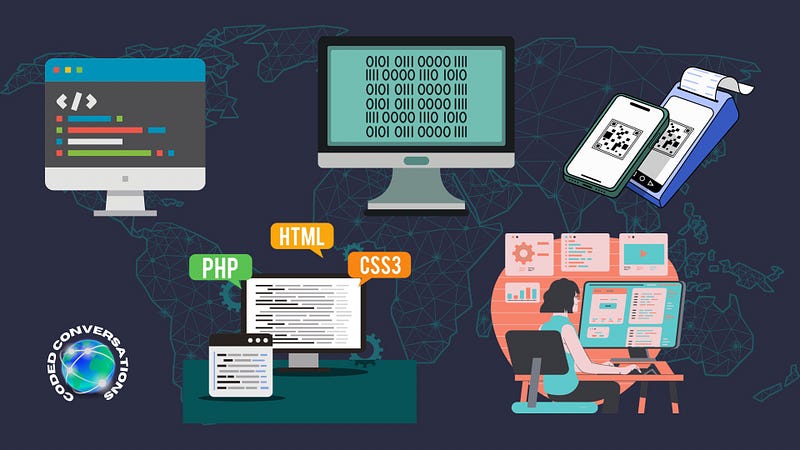
From Human Thoughts to Binary Digits: The Art of Programming Languages 🧠💻🔍
Exploring the Fascinating Journey from High-Level Code to Binary Instructions
🖥️ Visit Our Website 🖥️
Just as humans rely on diverse languages to express their myriad thoughts and emotions, computers, our modern-day digital companions, navigate the world of ones and zeros, interpreting our intentions through the lens of programming languages. This journey from human language to computer understanding is not just intriguing but pivotal in the realm of technology.
Programming Languages: The Bridge Between Humans and Machines
Programming languages, much like Python, Java, or C++, are the architects of this bridge. They are meticulously structured systems, comprising commands, syntax, and rules. These languages enable us, the programmers and techies, to draft instructions in a format that computers can not only understand but also execute efficiently.
Imagine you’re crafting a masterpiece, a symphony of code, where every note, every stroke, is a command leading towards a grand finale — a fully functional software application.
The Binary World: A Computer’s DNA
At their core, computers operate in a binary realm — an austere landscape of 1s and 0s. This binary code is the DNA of computer operations, representing two fundamental states: on (1) and off (0). In quantum computing the states can be in between like flickering on [1] and off [0]. The complexity and beauty of every application, every game, every digital interaction you’ve ever had, distill down to these elemental binary operations.
Visualize this as an intricate dance of light switches, each flick representing a decision, a command in the grand choreography that is computer processing.
Translating Human Ingenuity into Machine Language
When you write code in a high-level language like Python, it embarks on a transformative journey. This code must be translated into the machine language (binary code) so that the computer’s processor can interpret and execute it. This translation occurs through two primary processes:
- Compilation: Think of it as an author writing a novel. The entire story (code) is written, edited, and then published (compiled) as a complete book (executable file) before any reader (computer) gets to see it.
- Interpretation: Here, the story is told live, improvised. The code is translated on-the-fly, line by line, as it executes, linked to a playwright revising the script while the performance is underway.
High-Level Languages: Simplifying Complexity
High-level programming languages are the magicians of the tech world. They simplify the inherent complexity of binary code, making it more accessible for us to give instructions to computers. These languages employ structures somewhat similar to human language — like loops, conditions, functions — but with a rigidity and precision that leaves no room for ambiguity.
Consider the act of asking someone to brew a cup of coffee. In human language, this might involve a simple request. In computer language, this would be a precise, step-by-step algorithm, leaving no detail to chance.
Beyond Code: The Diverse World of Human-Computer Interaction
The conversation between humans and computers extends beyond the realms of programming. Computers also understand human inputs through interfaces like graphical user interfaces (GUIs), voice recognition, and touch. These inputs, whether a swipe on a screen or a spoken command, are translated into a language that computers can process and respond to.
This is linked to learning a foreign language to communicate with someone from a different country. The effort it takes to understand and be understood is mirrored in the way computers interpret our diverse forms of communication.
In this dance of digits and syntax, we find the beauty of technology. Each programming language offers a unique lens to view and interact with the digital world. They’re not just tools for building software; they’re gateways to new realms of possibility. In the grand scheme of things, understanding how computers interpret our codes is crucial for anyone venturing into the realms of cybersecurity, data analysis, or even quantum computing.
Now, let’s shift gears to a short, funny story that encapsulates this world of programming and computers.
A Programming Parable: The Tale of the Caffeinated Computer
Once in a tech-savvy town, there was a computer named Byte. Byte was a diligent machine, always crunching numbers and running codes. One day, its programmer, Ada, decided to experiment. She connected Byte to a coffee machine, programming it to take a digital sip every time it completed a task.
As Byte worked, it ‘drank’ coffee, and something miraculous happened. It began processing faster, solving complex algorithms in milliseconds. News of the caffeinated computer spread like wildfire.
However, there was a twist. Too much coffee led Byte to start misinterpreting codes. It turned Ada’s ‘Hello World’ into ‘Hello Whirled’, spinning the computer screen like a merry-go-round.
The town laughed and learned a valuable lesson: too much of a good thing, even for computers, can lead to hilariously unexpected outcomes.
In this tale, just as in our discussion, we find a blend of humor, technology, and a pinch of wisdom. It’s a reminder that in the fast-evolving world of computing, sometimes taking a step back to enjoy the lighter side can be just as enlightening.
If you enjoyed this don’t forget to give a clap, share with your peers, and leave your thoughts in the comments. Let’s search the future of computing together!


