
From Galileo to Bernoulli: The Evolution of the Brachistochrone Curve
A Path from Challenge to Discovery
The Brachistochrone problem is a classic problem in physics that involves finding the path that a particle must take between two points in order to minimize its travel time, subject to certain constraints. The curve’s name comes from the Greek words “brachistos,” meaning shortest or quickest, and “chronos,” meaning time. It was first proposed by Johann Bernoulli in Acta Eruditorum in June of 1696 as a challenge to the mathematical community.
Johann Bernoulli (1655–1705) was a Swiss mathematician and physicist whose work revolutionized the field of mathematics in the late 17th and early 18th centuries. He was born into a family of mathematicians and scientists, and from a young age, he showed a remarkable aptitude for mathematics. Over the course of his career, Bernoulli made many important contributions, including the discovery of the solution to the Brachistochrone problem, the development of the calculus of variations, and the discovery of the Bernoulli principle in hydrodynamics, which describes the relationship between fluid pressure and fluid velocity.
The Challenge
Bernoulli introduced the problem of brachistochrone as,
“I, Johann Bernoulli, address the most brilliant mathematicians in the world. Nothing is more attractive to intelligent people than an honest, challenging problem, whose possible solution will bestow fame and remain as a lasting monument. Following the example set by Pascal, Fermat, etc., I hope to gain the gratitude of the whole scientific community by placing before the finest mathematicians of our time a problem which will test their methods and the strength of their intellect. If someone communicates to me the solution of the proposed problem, I shall publicly declare him worthy of praise.”
Bernoulli gave a deadline of six months for receiving solutions, but none were received within that time frame. Following this, Leibniz made a public request to extend the deadline to one and a half years.
Several mathematicians attempted to solve the problem, including Jakob Bernoulli, Isaac Newton, Guillaume de l’Hôpital, Ehrenfried Walther von Tschirnhaus, and Gottfried Leibniz.
Bernoulli sent that problem to Newton through a letter. Newton spent an entire night solving it and sent the solution anonymously through the next post. After reading the solution, Bernoulli recognized Newton as the author, stating that he could “recognize a lion from his claw mark”.
Bernoulli was amazed by Newton’s remarkable ability, as he had taken two weeks to solve the problem while Newton had managed to solve it in just a single night.
The solution to the Brachistochrone problem challenged some of the greatest mathematicians of the time and ultimately led to the development of the calculus of variations.
The Problem
The problem was as follows: Given two points in a vertical plane, what is the shape of the curve along which a particle will travel in the shortest possible time under the influence of gravity, assuming that the particle starts from rest and the only force acting on it is gravity?
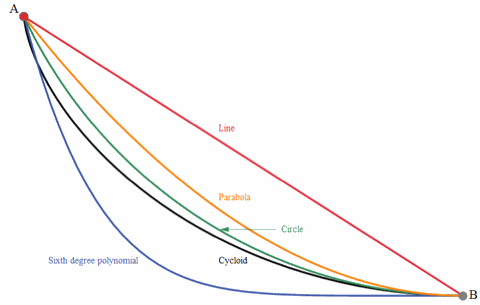
At first, many mathematicians believed that the solution was a straight line, but Johann Bernoulli was convinced that there must be a more interesting and elegant solution. He spent a bunch of time working on the problem and finally discovered the correct solution, which he published in a letter to the mathematician Gottfried Leibniz (1646–1716) in 1696.
The challenge in solving the Brachistochrone problem was twofold: first, it required a deep understanding of calculus, a field that was still in its infancy at the time. Second, it required the mathematicians to correctly apply the boundary conditions, which ensured that the particle would start and end at the correct positions with the correct velocities.
Galileo’s Solution
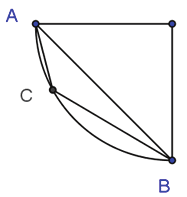
In 1638, Galileo attempted to address a similar problem as brachistochrone in his work “Discourse on two new sciences”. He found that the quickest path for a mass falling from A to B was a circular path, rather than a straight line as shown in Fig. 1. This was proven through geometric reasoning, showing that the path ACB was faster than the straight line.
Galileo acknowledged that his deduction may be flawed and recognized the need for more advanced mathematical techniques to tackle the problem.
Bernoulli’s Solution
Bernoulli used Fermat’s principle of least time, which states that light takes the path that requires the least amount of time to travel between two points.
To solve the brachistochrone problem, he compared the motion of a mechanical particle to that of a light beam and used the analogy to find the path of the fastest descent. He imagined the light beam moving through a medium with a non-uniform refractive index and showed that this was consistent with Snell’s law of refraction. By finding a conserved quantity along the path and solving the differential equation, Bernoulli ultimately derived the equation for the cycloid (which is the curve traced out by a point on the circumference of a rolling circle).
Bernoulli showed that the cycloid is the curve along which a particle will travel in the shortest possible time under the given conditions, and he went on to use this result to develop a new branch of mathematics known as the calculus of variations that deals with finding the function that optimizes a certain functional which is a mapping from a space of functions to the real numbers.
Applications of Brachistochrone Curve
The Brachistochrone problem is now considered a classic problem in physics and mathematics, and its solution is studied in a wide range of optimization problems in many different fields, including physics, mathematics, engineering, and computer science.
For example, the cycloid can be used to design the most efficient amusement park rides and roller coaster tracks between two points, as the track can be designed to follow the path of the cycloid in order to minimize the ride time and maximize the thrills. In addition, the cycloid has been used to design the optimal flight path for spacecraft reentry, as well as to model the motion of light in curved spacetime in general relativity.
In summary, the Brachistochrone Curve is still an important topic in mathematics today because of its historical significance, its practical applications, its beauty, and its connections to other areas of mathematics.
Thank you for reading this story and see you again. Feel free to leave a comment if you have any thoughts, feedback, or suggestions about it!
If you like my work and wanna support me then please sign up to become a medium member using this link it will cost $5 per month only, and a portion of your fee supports us writers and keeps us creating amazing content. Or else, you can buy me a coffee ☕️. If you do so, thank you a million times. 🙂