
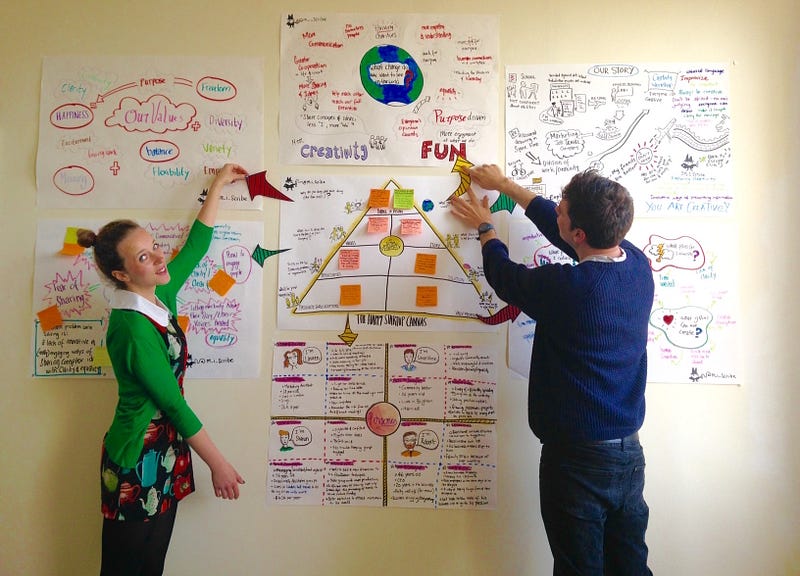
From Dreaming to Doing: Our Startup Journey
A little over 6 months ago Ieva and I were sitting in the mountains of Sichuan province, China planning our next move. We had been in China for a few years doing marketing for Beijing based travel companies and were about to take the plunge and return to Europe. Over the past few months we had come up with a bazillion ideas of what we would do when we got to the UK. Set up a vegan café, start a business importing bamboo goods, a studio making up cycled furniture… the list continues. But gradually we began to narrow them down and focused in on our joint passion for using visuals to connect people.
A few months prior to this we had been introduced to the power of graphic facilitation and visual storytelling by our wonderful friend, Narayan Silva — and had been readily incorporating it into our workplace meetings, personal agendas and shopping lists ever since. The power of using simple creative techniques was overwhelming to us. It levelled the playing field, allowing managers and employees work side by side more readily, and was really helping everyone (including us) in the office understand ideas with clarity and gain confidence in themselves and their abilities.
So as we handed in our notices at work, said goodbye to our lovely apartment and stable wage, we headed off for a final sojourn around South West China before returning to Europe, (more specifically Brighton, UK) and taking the leap to try and set up our own business.
Luckily for us, Brighton is full of entrepreneurs and people following their dreams, so in those times of desperation and doubt there are plenty of people to offer advice. We soon came across the Happy Startup School and their support has been amazing over the past few months. So naturally, when we heard about the Happy Startup Canvas e-course we jumped at the chance.
We have been slowly building up our business, M.I.Scribe, since we got to Brighton, primarily working as Graphic Recorders for meetings and events around the city (and even a few in Lithuania!). So far things have been going well but there have definitely been gaps in our business model and areas that needed to be clarified. At least a part of what we were doing seemed to be based on what we thought we should be doing, rather than what we really wanted to do.
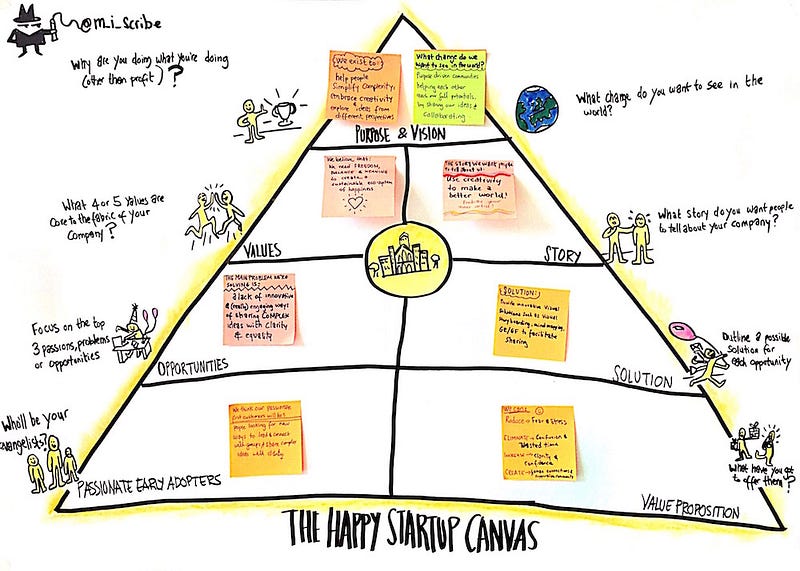
We exist to:
Help people simplify complexity, embrace creativity and explore ideas from new perspectives.
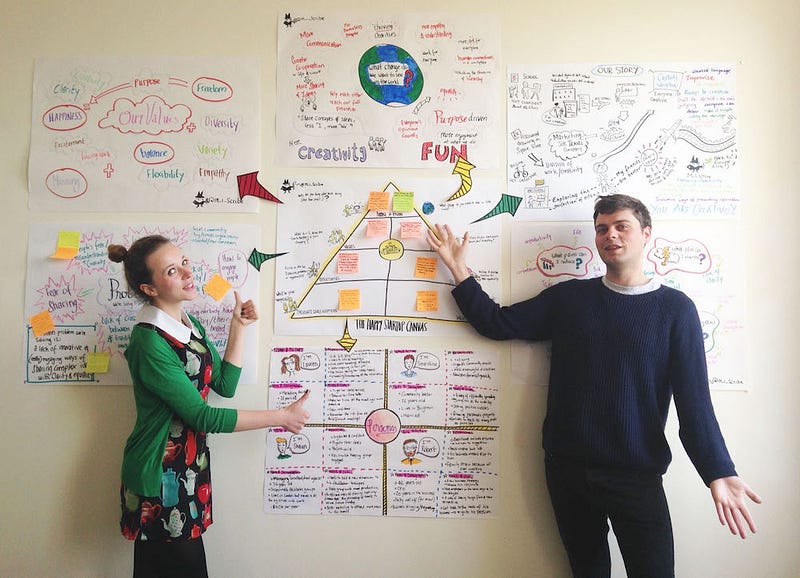
The Happy Canvas course helped us to take a step back and evaluate our underlying core beliefs and set out a foundation based on values. I think that was the hardest part - to try and distance ourselves from what we were doing already, and focus on the why.
The course made us question ourselves, our motives and see new perspectives, in a supportive community of fellow dreamers. We found that once we had explored our core values, things began to flow more easily.
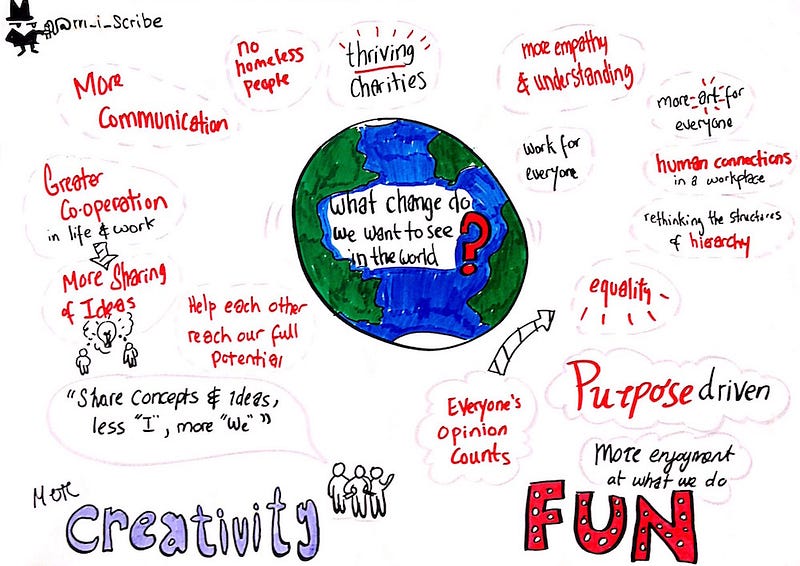
The change we want to see in the world is:
Purpose driven communities helping each other reach our full potentials. A greater focus on sharing of ideas and collaboration.
By challenging ourselves to focus on our values and the changes we want to see in the world we could more easily see the problem areas that really affected our world outlook on a human level. Through a number of brainstorming sessions we picked out the recurring themes that kept popping up. Themes of equality, freedom, and probably most importantly collaboration.
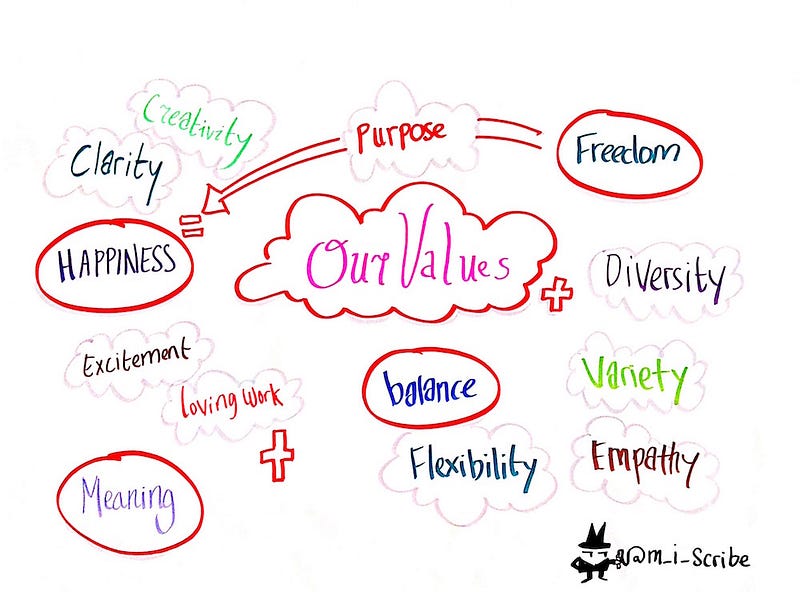
We believe that:
we need freedom, balance and meaning to create a sustainable ecosystem of happiness.
The concepts of freedom and balance came up time and time again as we discussed the foundations of what we believed.
At the heart of all of this was meaning. The key to building up our business is to focus on making a positive change and creating something that will give people and projects purpose.
If we can build freedom, balance and meaning as the underlying foundations of what we do, then we hope to have a stronger of chance of maintaining our current enthusiasm and drive and start making positive waves.
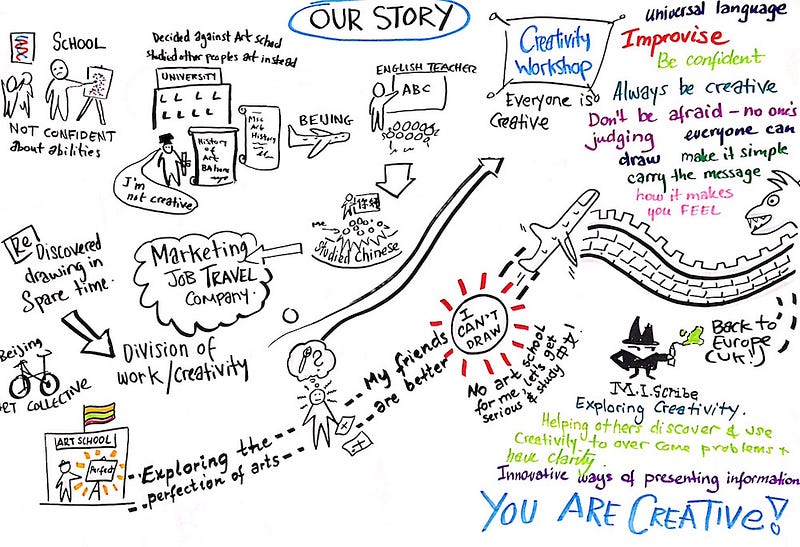
The story we want to tell about us:
Use creativity to make a better world. Embrace your inner artist!
It was useful to go right back to the beginning of our journey and map out the key points along the way. Both of us had experienced a lack of confidence when it came to expressing ourselves creatively and very much saw creativity as an ‘after work’ activity.
For both of us it took a eureka moment to realise that far from being separate, they key to us for successful businesses, and for a greater chance of happiness, is to merge the two and nurture your creative side. This doesn’t mean to be an artist in the sense of a Van Gogh or Picasso — but to shed your inhibitions and bring some colour into the world. Throw out your lined paper, grab a bright pink sharpie and let your thoughts flow!
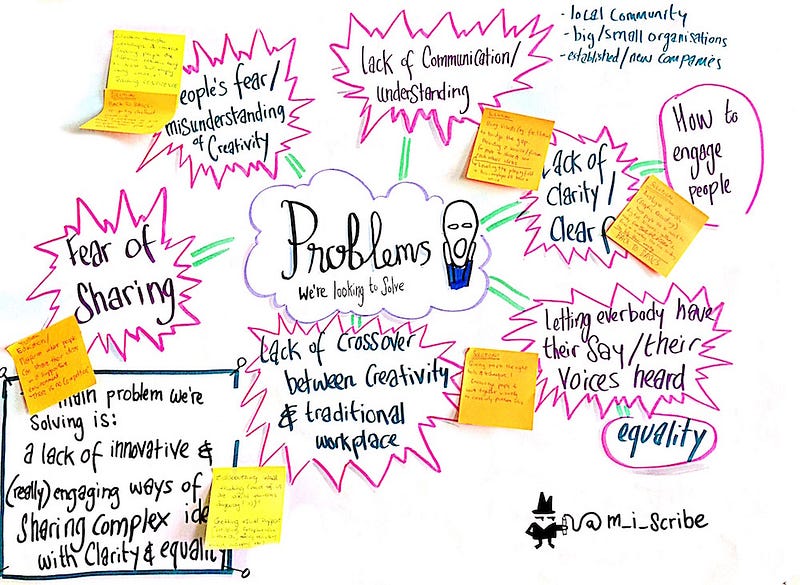
The main problem we’re solving is:
a lack of innovative and (really) engaging ways of sharing complex ideas with clarity and equality.
Similarly, when challenged to look at the problems we were actually trying to directly solve — we got out our pens and paper for another creative brainstorming session. A lot of the ideas here were closely linked to our former explorations into the changes we want to see in the world. As we captured our thoughts on the paper a strong theme of fear and confusion emerged. We feel there is a tendency for people to fear the sharing of ideas. We have grown up in a world where the idea of ownership is strong, and we fear having our ideas stolen. We want to explore a world where sharing and asking questions in a supportive community is the norm, and where working together, rather than hoarding ideas, we can all build a better world.
The other problem we see is that as the world of technology marches on, we are bombarded with information. We are connected but disengaged. We spend all day looking at a screen in some form or another, be it the television, a laptop screen, a smart phone etc, to the point that we need something really disruptive to capture our attention and keep us engaged.
Our proposed solution is:
To provide innovative visual solutions (graphic recording/facilitation, mind mapping, storyboarding etc) to help people share ideas, achieve clarity and engage with each other.
To come up with solutions to these problems we sought out our trusty Post-It notes. While it’s relatively easy to list off problems we want to change, it’s definitely harder to come up with the solutions. But as we were reminded throughout the course, the ideas and solutions we come up with here are really just Plan A. These are the foundations and building blocks of a process which should be constantly revised and reevaluated. Over the next few weeks and months we will slowly refine and redefine them.
We believe that by getting people to take a break from technology and getting them to experiment with pen and paper, can open up a whole new stream of possibilities. We can reconnect to our long lost creativity to explore new avenues and develop innovative discussions and creative conversations.
While once upon a time pen and paper where common place tools, nowadays people are more likely to do all their thinking digitally. We want to show that taking some time out from the screen and ‘going analogue’ can jolt people out of their usual routines and help them to engage more thoroughly.
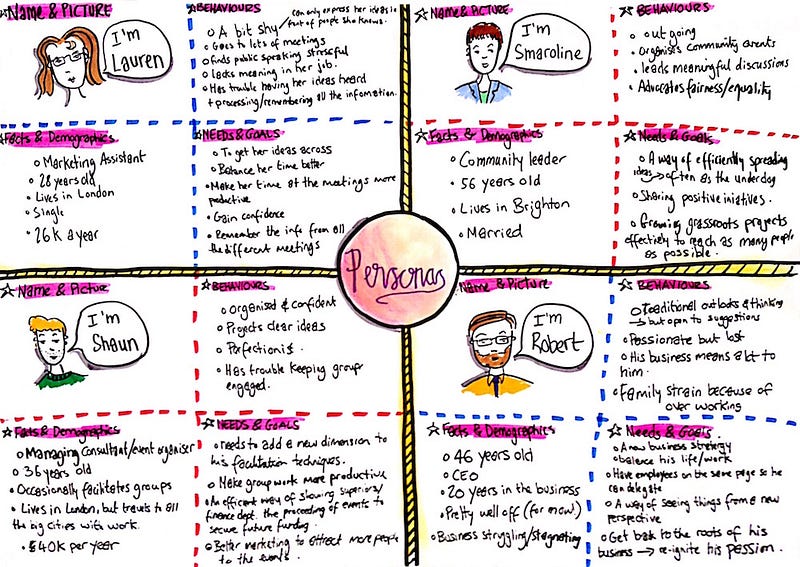
We think our passionate first customers will be:
People looking for new ways to lead and connect with groups, where large amounts of information, diverse concepts and ideas need to be discussed and shared.
Out of the whole course, initially we found coming up with the personas of our first customers to be the most daunting. To go from the abstract concept of ‘people’ and ‘customers’ to actually defining them into an individual with a name, face and backstory felt frightening. However, as the task unfolded it began to take on a life of it’s own and really open up our minds. So feeling like Hollywood screenwriters we embraced the task — drawing in all the aspects we had come up with over the previous days and morphing them into ‘real’ people with wants, needs and problems to overcome.
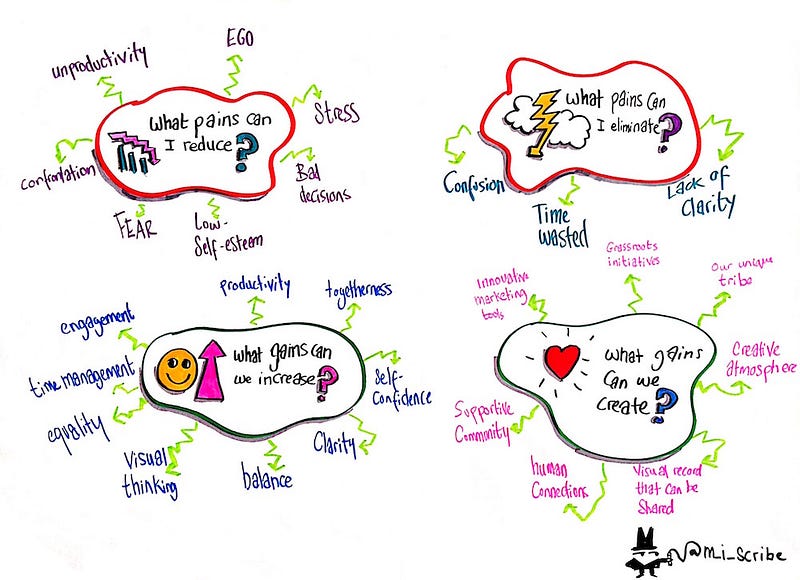
We can:
- Reduce → Fear and stress
- Eliminate → Confusion and wasted time
- Increase → Clarity and confidence
- Create → Human connections and supportive communities
By the time we got to the final task we were really seeing the value in what we had achieved over the past few days. We were able to bring together everything we had produced so far and see how these things could be applied to eliminating and reducing people’s pains, while increasing and creating valuable gains for them.
Summary:
One of the most positive things to come out of doing this course, was creating the opportunity for Ieva and I to sit down together for half and hour to an hour each day and actually come up with ideas together, on the same piece of paper. Not with sporadic emails and text messages, and vague plans over the dinner table of what to do at a later date, but actual face-to-face, constructive collaboration on a daily basis, something we will definitely try and keep as a habit from now on.
We also reconfirmed our desire to collaborate with groups and communities driving positive change in the world. We are strong believers in the power of individuals to get together and create change. Over the next few weeks (and months!), we will focus on connecting with the change makers in our communities and experiment with how we can work alongside them to facilitate projects and help to implement change.
“Just start starting things”
We have taken away lots of things from the Happy Canvas course, but if we could only take one piece of wisdom it would be Sanderson Jones’ advice from the Lesson 6 video to ‘just start starting things’.
We have started. We are at the beginning of an exciting journey. We are sure we will make mistakes, have times of doubt and moments of madness.
But also we will hopefully experience highs, develop strong human connections that create meaning for us and others around us.
Check out our website to find out a little bit more about what were are doing at M.I.Scribe and find us on Twitter to see how our journey unfolds — and head over to the Happy Startup School to take their 10 day e-course.


