
From Design to Writing: Know the Rules to Break the Rules
+ 2 books I’d definitely recommend you read for perfecting your grammar and building your vocabulary.

Disclaimer: That’s not true every time.
Rules are like roads. You use them but you don’t always have to.
You can drive through fields, desert, hills, and courtesy of a Range Rover ad, on the stairs as well.
Well, that was only for cars. Take a bicycle and be creative.
But to do so you need to know how to drive (or ride, in the case of a bicycle). Right?
If I were to put it, with a little exaggeration, it’d be:
“Rules are made to be broken.”
All of us know that, right?
Why This Notion?
I use to think, for instance, concerning grammar, that who needs to remember all those rules? Isn’t knowing how to speak fluently enough?
Who needs to know all that nitty-gritty details of phobias, Oxford comma, ‘its or it’s,’ or that crazy big vocabulary?
But only yesterday I purchased two books—one about grammar and other about vocabulary.
But why? First of all, let me give you some context.
This YouTube Video on Design
Some days ago, I was watching a YouTube video about graphics and logos, and design in general. He was talking about some books and resources that had a big impact on his design career.
He’s self-taught so I thought he’d have a pretty good knowledge of resources available out there on the internet.
He first talks about this book called Steal Like An Artist, which I’ve already heard enough about. Then he moves on to the second book, which was about grid and design. It was basically a rule book for different types of grids and how to use them.
In the process of explaining, he says: “Know the rules to break the rules.”
Not every time to break them—but to know when you should, in order to be creative and stand out from the crowd.
His point seemed quite logical to me.
I Took It In the Sense of Writing
I thought it’s kinda true for writing as well. Don’t you think?
I’ve heard many debating around the topic of having knowledge of grammar or vocabulary. Have been a part of many, too.
We’d argue that vocabulary or grammar is not as important as the core idea or message you want to convey.
But where went the presentation part?
We’d not think of that. We want to sound smart. And to sound smart, we want to sound philosophical. Down-to-earth explanations and point-of-views are boring, to say the least.
And because smartness wins the debate, most of the time, we arrive at the conclusion that knowing the rules is not that important.
Before and In the Process of Writing Online
I skipped most of my grammar lessons, to be honest. And if I attended, I’d not take it that seriously.
Given that English isn’t my mother tongue and I loved literature, that wasn’t a good match.
But from the time I’ve started writing on Medium (which, by the way, is not that long ago), I’ve got a constant feeling that I should know the rules.
I sometimes get confused or other times not sure if what I’ve written is grammatically correct. Basically, it’s the ‘if-it-sounds-good-then-go-with-it’ thing.
And now I think is the best time (and high time) for me to get a little bit more familiar with the rules of grammar.
“Ill-fitting grammar are like ill-fitting shoes. You can get used to it for a bit, but then one day your toes fall off and you can’t walk to the bathroom.” —Jasper Fforde
Not to mention these two things that I consider myself lucky for:
- This realization came on time, if not early because I’m just 15 and I presently have one of the biggest leverage—time.
- Apart from writing, knowing the rules makes you confident—more so if it’s not your first language, as is the case with me.
Those Books...
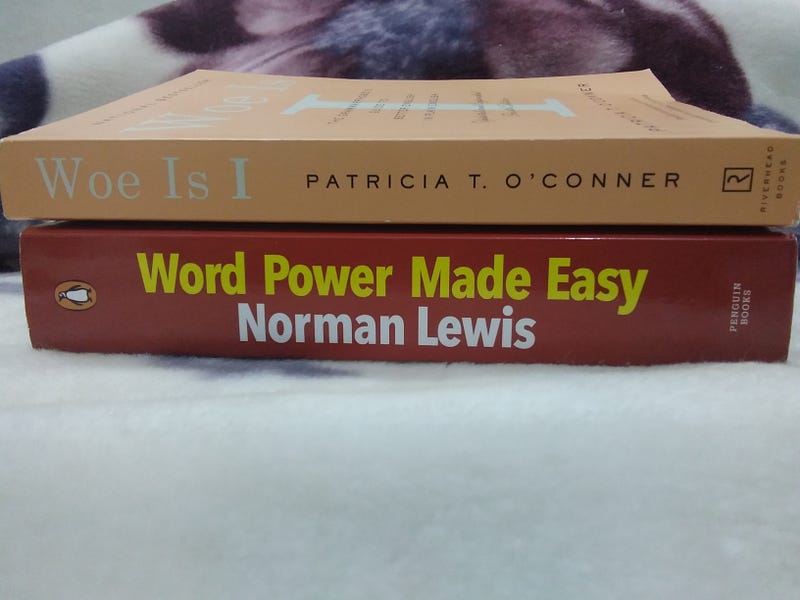
The two books that I’ve purchased are:
1. Woe Is I: The Grammarphobe’s Guide To Better English In Plain English by Patricia T. O’Conner.
I’ve not completed the book yet but from what I’ve read thus far I can tell you one thing: it’s one of the funniest and most engaging books on grammar you’ll ever read.
For instance, there’s a chapter on a comma that’s titled ‘Comma Sutra,’ a topic clarifying the difference between the use of ‘which’ and ‘that’ that’s titled ‘Which Craft,’ and a topic named ‘Where there’s a will; there’s a would’ (you can easily guess what this topic might be about).
Overall, you’ll even enjoy reading the stuff you already know. Noobs and pros, please go for this one.
2. Word Power Made Easy: The Complete Handbook For Building a Superior Vocabulary by Norman Lewis.
It’s an extensive book (560 pages) that includes concepts of grammar, vocabulary, pronunciation guide and more. It even has ample of practice papers you can try your hands on.
It can act as your go-to resource for almost all things English. You can hone your grammar and vocabulary skills by going through exercises given in the book.
Final Thoughts
You’ll frequently come across advice like—
“Always write short sentences,” or “Don’t start a sentence with ‘and’ or ‘but.’”
But unless you know the rules, you might be having problems in deciding which option is best for the situation you’re in.
To put it simply: It’s worth the effort to know the rules of the game you’re playing—here rules of grammar—not only/always to break them but also to take your writing skills to the next level and to speak confidently.
Plus, it’s no big deal to occasionally break the rules, is it? 😉
“Every English poet should master the rules of grammar before he attempts to bend or break them.” —Robert Graves
Hope you liked this article. To receive the best of my Medium stories direct in your inbox, please subscribe here.
Until next time, byeeee! 👋❤️☺️✨


