
From Denial to Acceptance: How We’re Mourning the Rise of AI
The five stages of loss and how we cope with technological change
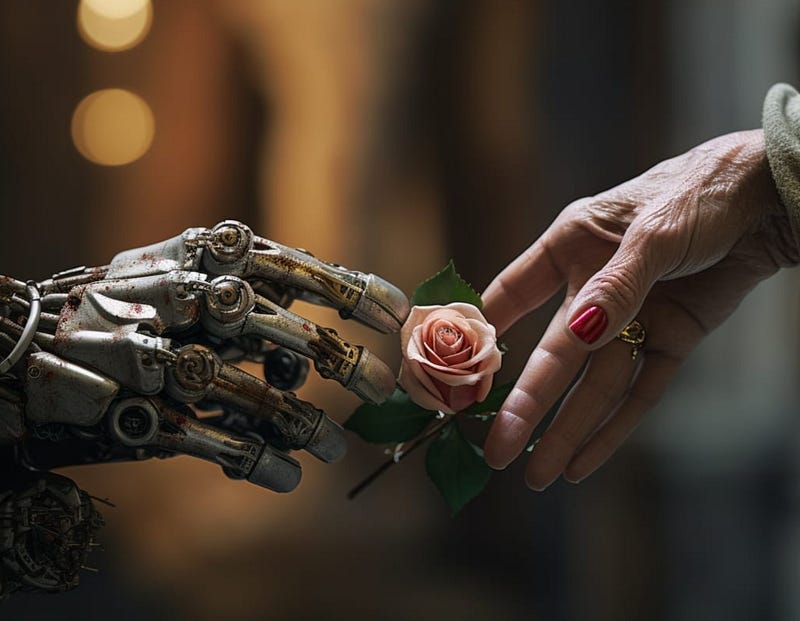
Is the idea of an AI-driven future causing you sleepless nights?
We’re griving the loss of the human touch, of genuine human creations and interactions.
It turns out, our brains might process every loss just like they do the loss of a loved one — though on different levels.
The grief process, a psychological rollercoaster originally mapped out by Elisabeth Kübler-Ross, describes the emotional journey through denial, anger, bargaining, depression, and acceptance.
Traditionally linked to personal loss and bereavement, this process isn’t just for coping with the departure of dear Aunt Gertrude.
It has a curious knack for sneaking into other areas of our lives, like the loss of our job, a relationship, an opportunity, our beloved childhood toy, our first car — maybe. So it would be fair to say it also applies to the loss of the human touch and to adapting to the whirlwind advent of AI.
Maybe, this parallelism with the stages of grief is my desperate attempt to introduce a human dimension to a bittersweet, automated reality. But I’m pretty sure that behind many glowing screens and smart devices, there’s a human soul doing their best to adapt and make sense of it all.
Maybe, some people downplay the significance of AI, convinced it’s not a big deal, either because they don’t know much of it or because they’re in…
Denial
Denial kicks in first; it’s the ‘AI is just a fancy calculator’ phase. Many underestimate AI’s colossal potential, casting it off as a high-tech toy rather than a game-changer.
At this stage, people still ignore how AI might impact their lives. It’s either due to not really understanding what AI can do, or maybe, not wanting to.
Once it dawns on us, the fear and sense of unfairness might lead to a profound, deep-rooted feeling of…
Anger
A natural response to a perceived threat. People pointing fingers at AI makers, companies jumping on the AI bandwagon, sometimes even the tech itself.
It boils down to the fear of being left behind, of losing control.
Plus, there’s a whole can of worms about privacy and doing the right thing, ethically speaking.
We might advocate for the banning of AI and view its users with contempt, treating them like traitors.
Eventually, as we come to understand that AI is here to stay, we begin to wonder if perhaps, by acting wisely, we might mitigate any negative outcomes. This leads us to the phase of…
Bargaining
It’s the “Let’s make a deal with the future” phase.
- “What if I learn Python overnight? Will that keep me in the game?”
- “If we put AI on a leash, will it sit and stay?”
- “What if I just ignore AI? Maybe then everything stays the same?”
- “If I focus on AI’s benefits, then the negative aspects won’t seem that bad?”
- “If I hug AI, will it hug me back?”
These examples illustrate a common theme in the bargaining stage: to find a way to live with AI by our side, without feeling like it’s taking over.
Sometimes these ideas might indeed be effective or beneficial, but in the context of grieving, they’re just our way of not feeling totally swamped by reality, a coping mechanism to deal with the anxiety and uncertainty brought about by rapid technological change.
There’s a tendency to linger over these bargaining thoughts.
Yet, with the growing realization of what lies ahead, we might increasingly grapple with…
Depression
Here’s where the mood dims. The realization that AI isn’t just a passing cloud but more of a climate change can dampen some spirits — and maybe permanently infuriate a few, or even uplift them.
This is when it hits that maybe we can’t just bend everything to our will. This involves grieving over what we’ve left behind while adapting to the emerging realities — the following step.
We mourn the old ways.
This stage might spark concerns about the loss of humanity in arts, the depersonalization of services, and the perceived coldness of an AI-driven world.
By internalizing the challenges and considering them from diverse viewpoints, we gradually come to a state of…
Acceptance
It’s where societies and individuals dust off their knees and start exploring this new landscape. Acceptance here isn’t about giving AI a standing ovation — though of course some might. It’s more a nod to its existence and the role it’s going to play.
We’re learning to come to terms with its presence and what it might bring to the table.
In this stage, there may be attempts to develop adaptive strategies amidst the AI transformation. Calls for regulation, ethical guidelines, and finding ways where AI and human skills can complement each other.
This is a constructive stage.
It’s not about stopping the AI wave anymore; it’s about learning to surf it.
We’re making AI-assisted lemonade out of lemons — finding new jobs, new hobbies, and maybe, just maybe, a new perspective on what it means to be human in a society shared with algorithms.
Using the grief stages to analyze the way we react to AI helps us map out the emotional journey we’re all on — and it’s not like we can opt out.
It’s about finding better ways to help everyone get on board with this shift, making it easier to understand resistance to AI and guiding more empathetic and effective strategies for smoothing out the transition.
This doesn’t imply that everyone has faced negative feelings from AI’s rise; indeed, many have benefited from it early on, timely anticipating its potential.
However, some have found personal gain at the expense of broader cultural values, sometimes even misusing AI.
Non-linear nature of the grief process
It’s important to recognize that the stages of grief are not strictly linear or one-directional.
Individuals and societies can move back and forth between stages, experience multiple stages simultaneously, or skip stages entirely.
Dealing with the advent of AI feels a lot like going through a messy breakup. It’s not a neat, step-by-step process.
One day, you’re struck by a sense of awe at AI’s capabilities, and soon after, you’re quickly consumed by fear that your boss will fire you because AI is crafting much better content and besides, you had just asked for a raise. You hate AI. Intensely.
Some people are positive AI will save the world. Others believe it will destroy it.
Many can’t stand the thought of living in an AI driven society, missing the days when a real person picked up the phone.
And just like after a breakup, everyone’s moving on at their own pace — even though we might be moving at a sort of ‘average’ pace as a society.
Why the rise of AI as a perceived loss?
The idea of AI as a loss boils down to a simple, human truth: change is hard. Especially disruptive change — or anything that might threaten our place in this world, for that matter.
The perceived ‘loss’ can be multifaceted.
- the loss of traditional jobs due to automation
- the loss of human connection in increasingly virtual interactions
- the loss of human factor in literature, visual arts, marketing, etc.
- a broader sense of loss related to changing societal structures and norms
The rise of AI can be perceived as a loss because it’s like watching a high-speed train zip past while we’re still tying our shoelaces.
It’s fast, it’s efficient, and it’s leaving us questioning our place in a world where machines learn, create, and to a certain degree, behave like us.
This isn’t just about jobs being vacuumed up by unblinking robots; it’s deeper than that. It’s about our identity, our own sense of worth.
It feels like a loss because it’s a mirror that reflects our new place in the world and our evolving role in society, and that’s a tough pill to swallow.
Thanks for reading!