
From Cute To Chaos: Oh Baby Dear!
All In The Deer Family
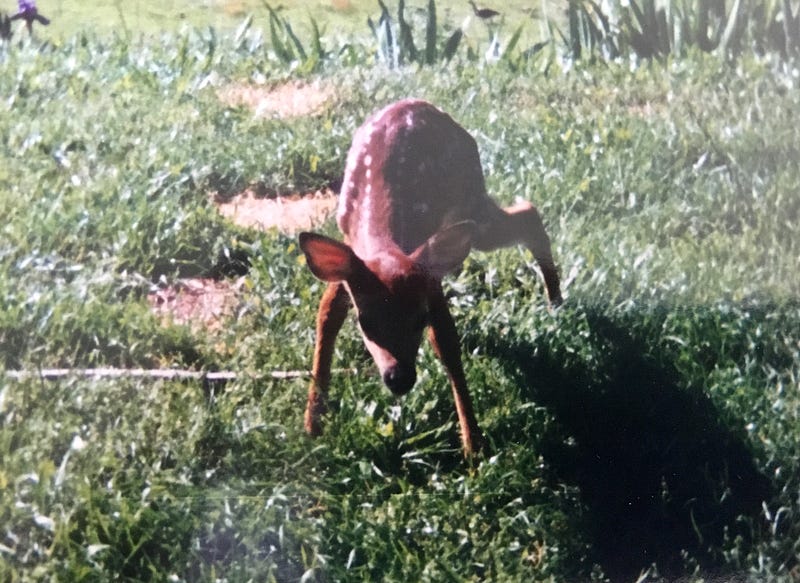
On the way to town my late husband suddenly came to a complete stop in the middle of the road and pointed. Then he leaps out of the truck, leaving the door wide open. That’s when Queenie and I heard him shout back:
“There, by the tree. I think the mother is dead.”
I’m praying another vehicle doesn’t come barreling into us from the downhill curve where we sat. I wasn’t even sure at that point if he was talking about a person or some animal.
Minutes later he comes back carrying a baby deer. Some idiot had shot and killed the mother without regard for the newborn. Didn’t even slaughter the deer for meat.
Now I was “mom” to Baby Dear. Quite frankly, as bad as I felt for this beautiful baby, I was still nursing sore ribs from recently being blindsided by a startled adult deer that had knocked me on my butt, while recently unloading groceries. But cuteness overwhelmed any common sense I had momentarily.
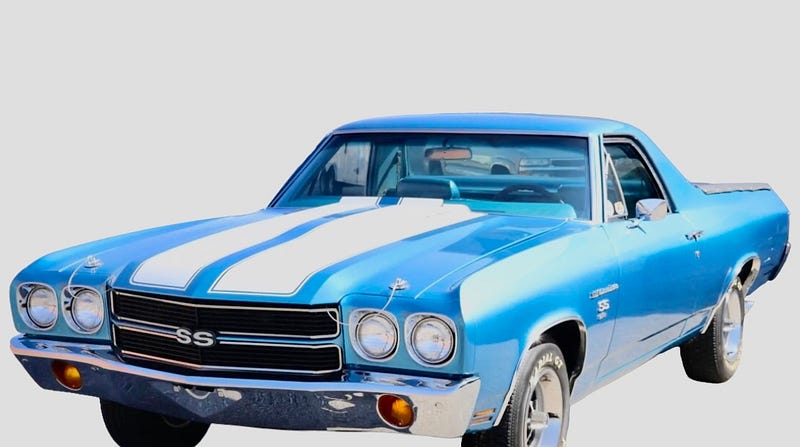
Deer can be a nuisance. That injury happened because my back turned to that young buck, I didn’t see him and the others barreling across the meadow where I parked. They were leaping over and around our El Camino SS as they scattered. I froze. He misgauged his escape. His hooves caught me as he flew by.
At that time, our newly purchased 750 acres had been vacant for years and the deer population was in overdrive. The last thing we needed was a new baby doe. We literally had hundreds of deer wandering around. Beautiful and awe inspiring as they were, but also somewhat a nuisance.
Gardening was impossible until we could get fencing up because they would eat everything to the ground overnight. Bill had just hand-planted over 1000 young trees just the week before, only to find every single sapling eaten to the ground 3 days later.
Little did I know then that some of my new BFF’s fur friends were to be the deer who had possession of our home long before we came upon the scene. Baby Dear had a lot of lessons to teach me. The biggest one was the folly of hand raising a fawn.
There were no cell phone towers in the mountains around us and no landlines at that time. While we had electricity it too was iffy and the DIY wiring of that 1950 block cabin was a constant blown fuse and squirrels in the transformer train wreck — this all meant I had very limited resources to figure out what to feed Baby Dear, or even knowing much about deer as a species.
To the nearest library (47 mountain miles) and to a couple of used bookstores I went. Baby Dear’s childhood with an inexperienced human mom mirrored my own experiences with my first born daughter. There’s a big difference from reading a baby book and actually raising a baby. My first born child was a testament to that reality.
I thought I knew it all. I didn’t. Not with raising my children, nor Baby Dear. There’s a lot to be said of just plain ol’ experience. I was in for a lot of surprises.
Feeding A Fawn
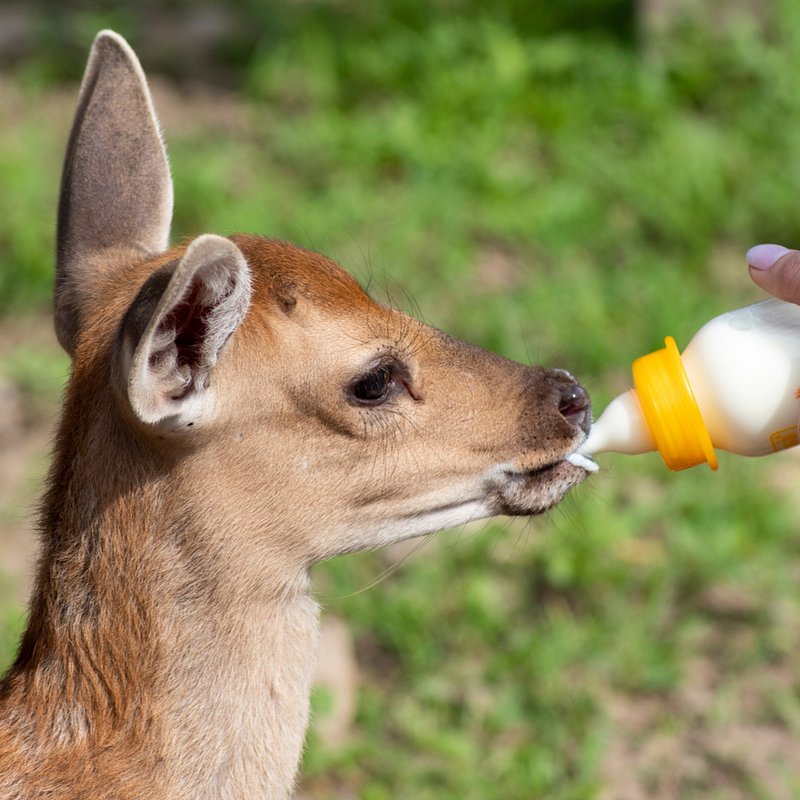
Bottle feeding Baby Dear at first was pure delight. What’s not to love about a tiny deer nursing on a baby bottle? That worked real well as long as she was being raised inside our small cabin.
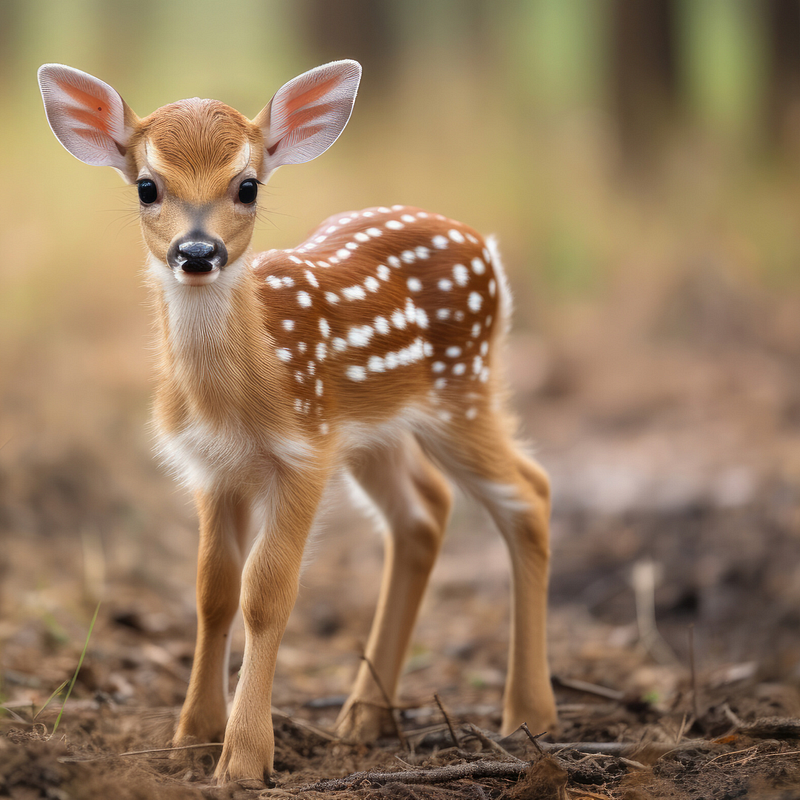
By the time she was living outdoors, having a hungry sometimes hangry juvenile deer kicking your storm door till you came with her bottle, wasn’t quite so adorable.
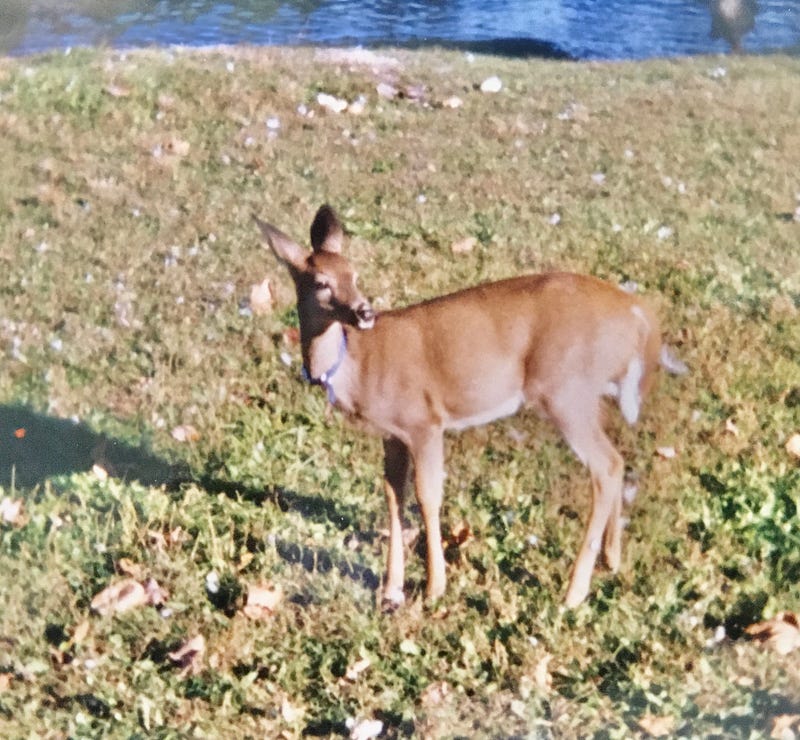
Once she was grown, going to town had a new element of worry. Bad enough dealing with washed out, snowed in, fallen tree blockages, and sketchy neighbors — just look in your rear view mirror at the Baby Dear trying to catch up with the truck following you to the highway. No way to turn around and her life in danger with known deer hunters gun happy.
I unwittingly put Baby Dear in danger by raising her as a pet. She had no natural fear of humans. One neighbor shot her in the leg. It healed, she learned, but still . . . there was no way to protect her.
Baby Dear’s Family Of Deer
Aside from our daily communion with nature orphaned Baby Dear that I hand raised, I made it my business to learn about the deer family. They are an interesting family unit that might hold some surprises for you.
One of the things I found interesting is the knowledge that what we call elk, are not really elk and they are actually a kind of deer. Another surprise is that moose are also deer.
Baby Dear’s Distant Cousins Who Aren’t Deer
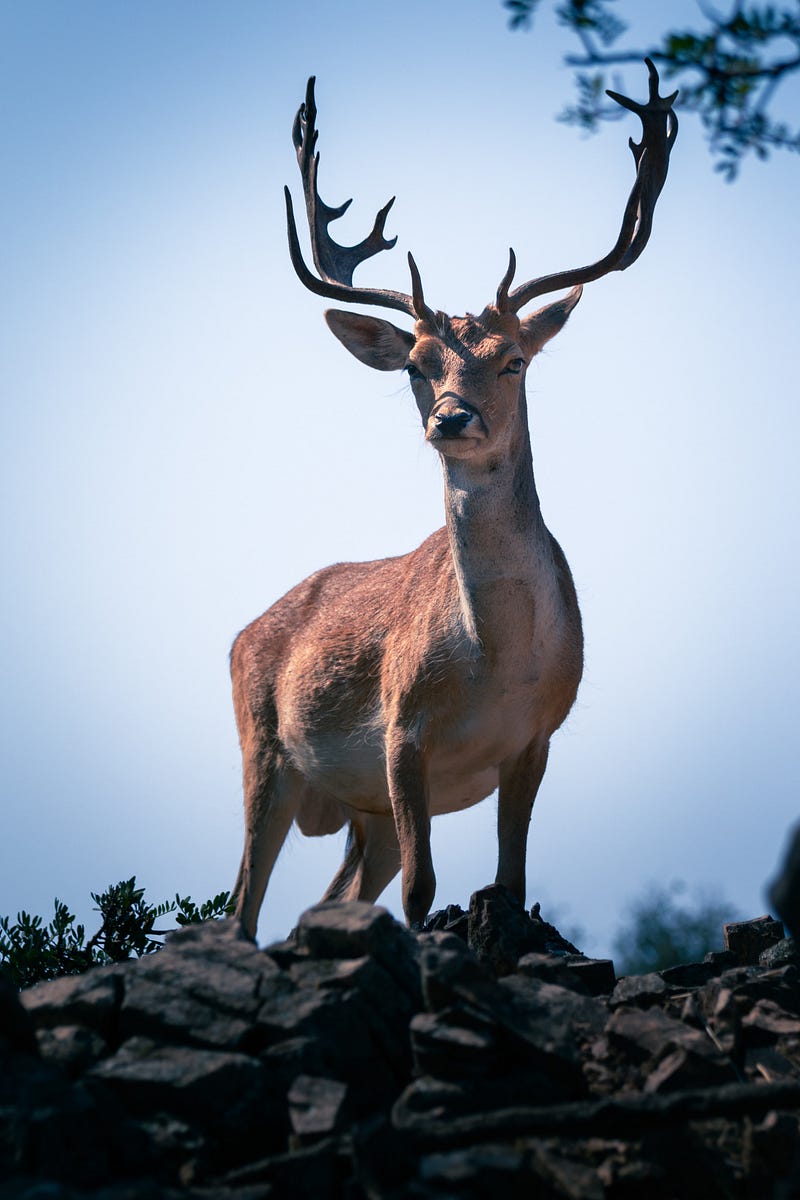
Deer and antelopes are similar in many ways but they aren’t in the same family. Deer belong to the Cervidae family, while antelopes belong to the Bovidae family. This means that antelopes are more closely related to cattle, sheep, and goats than they are to deer.
Horns And Antlers Is What It Is All About
The greatest difference between deer and their cousins is their horns and antlers. The horns of their cousins (Bovidae) are made of the same materials as their hooves, fingernails, toenails and hair. that is, they are the hardened outer of the skin.
The horn grows over a bony core which is part of the skull, and is retained throughout life. After death this sheath, or horn, may be easily removed from the core. The old-fashioned powder horn is a cow’s horn so removed. In most cases both the male and the female of the Bovidae carry horns, but there are many exceptions to this rule.
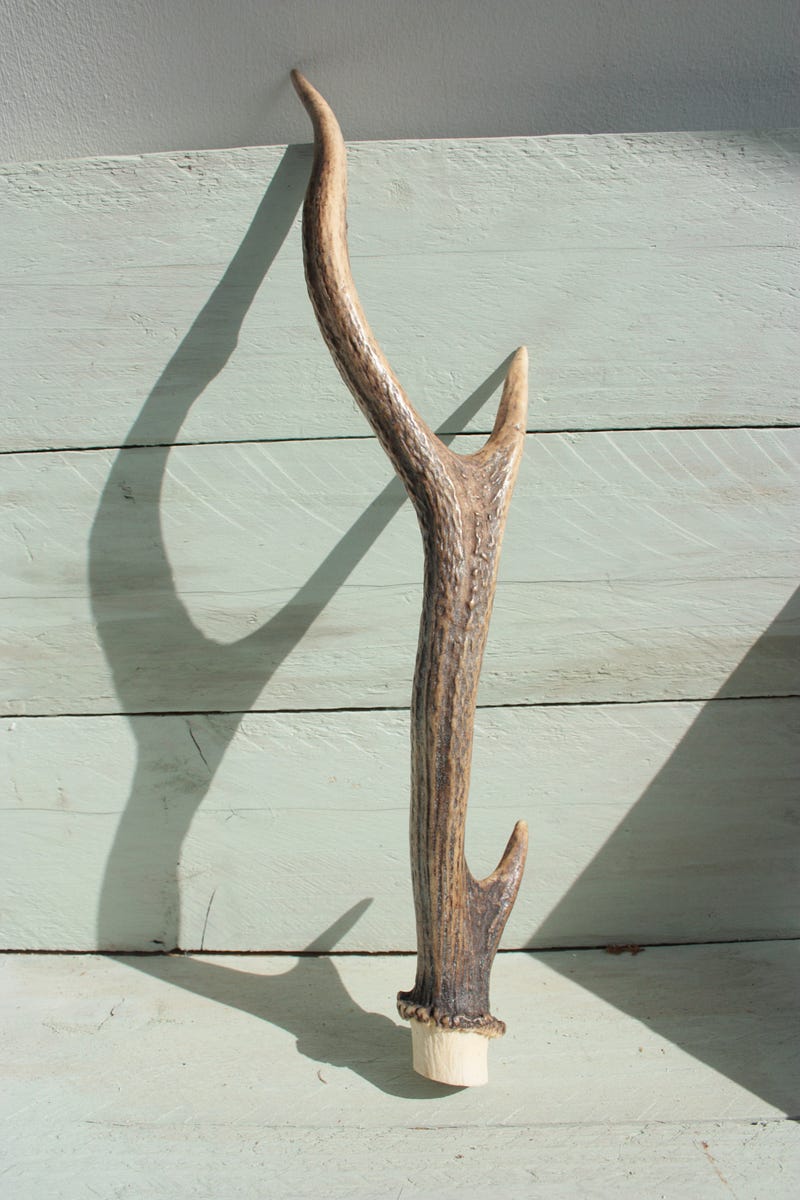
While the “horns” of the deer are called antlers and are true bones. They are shed and regrow periodically, generally once a year, and are carried by the male only. An exception to this is the Caribou and the Reindeer, in which species of the females also carry antlers.
The growth of a deer’s antlers is one of the wonders of nature. In northern latitudes, either in late fall or early winter, the antlers break off from their pedicles, or sockets, which are full of blood vessels. They are very tender and the animal is very careful not to hurt them.
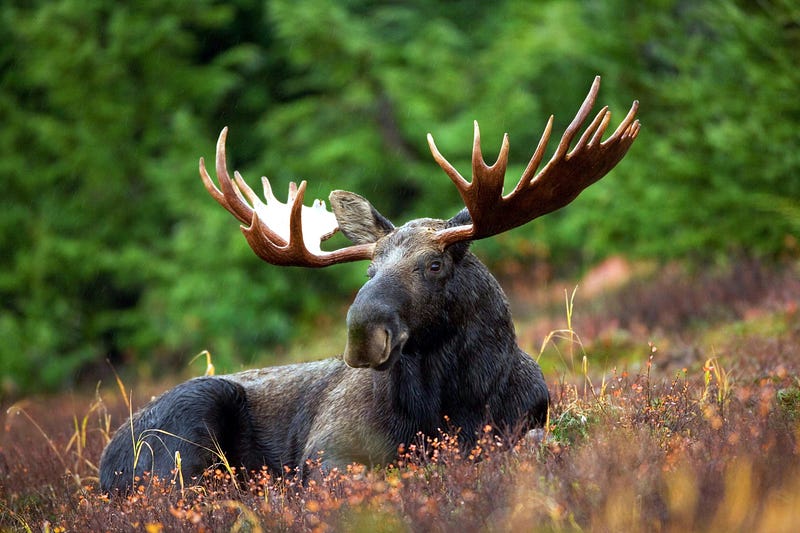
Within these knobs a bony structure forms. This grows rapidly and soon the antler takes shape, still covered with velvet and filled with blood vessels.
For large deer, such as the Moose, this growth continues for months, but by late summer or early fall the center hardens, the blood leaves the velvet, and the velvet dries and peels off, leaving the new antler hard and firm, and the owner full of confidence.
Kinds of Deer In North America
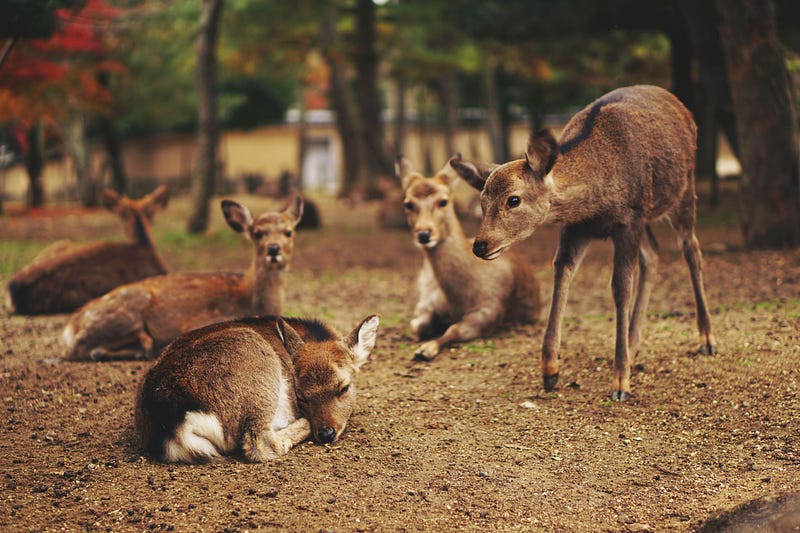
The antlers of the different kinds of deer vary greatly, and it is often by the type of antler that a deer variety can be most easily recognized. There are several kinds of deer in North America. They are:
White-tailed deer (Odocoileus virginianus): Baby Dear’s immediately family are the most common. Her family are scattered from the US, to Canada and Mexico. You can identify them by their white bellies and tails.
Mule deer (Odocoileus hemionus): You’ll only see Baby Dear’s cousins the Mule deer in the western United States and Canada. You can identify them by their larger ears and a black-tipped tail.
Black-tailed deer (Odocoileus columbianus): Another cousin of Baby Dear are the Black-tailed deer are found in the Pacific Northwest and California. You can tell them apart from the mule deer because they are smaller and their tail is completely black, not just tipped.
Caribou (Rangifer tarandus): You may be surprised that the Caribou in the Arctic and subarctic regions of North America are also Baby Dear’s cousins. You’ll also be a little confused because both the males and females have antlers unlike White-tailed deer and Mule deer.
Moose (Alces alces): Baby Dear’s giant sized cousins the Moose are the largest deer species in North America. They are unmistakable once you ever see one, especially the males who have humongous palmate shaped antlers.
The Cousins Of The Cousins (Subspecies)
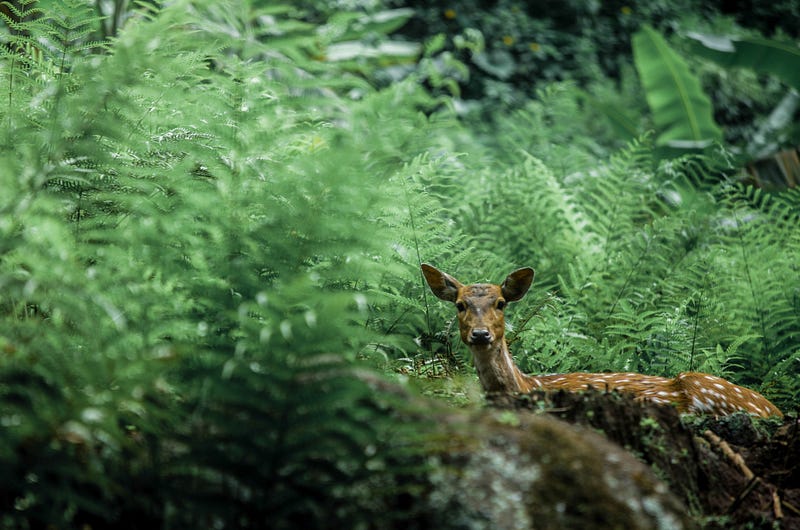
Sitka Deer (Odocoileus hemionus sitkensis): Are cousins of Baby Dear’s black-tailed deer cousins. You’ll find them only in coastal Alaska and British Columbia. You’ll notice they are smaller, they love to swim, and love to change their fur wardrobe from red-brown in the warmer months to gray-brown in the winter.
Coues Deer (Odocoileus virginianus couesi): Are cousins close cousin of Baby Dear’s family only found in is a subspecies southwestern United States and Mexico. They too are smaller, and change their coats from red-brown to gray-brown similar to the Sitka Deer cousins.
Fourteen Close White-tail Deer Cousins
Key Deer (Odocoileus virginianus clavium): Are also close cousins to Baby Dear’s family. They are the smallest deer in North America and are only found on Key West islands. Once you see one you’ll never forget their white bellies, black nose, and tiny size. They are Endangered!
Blackbeard Island (Odocoileus virginianus nigrobarbatus): Another Baby Dear close cousin is only found in the Blackbeard Island National Wildlife Refuge off North Carolina.
Hilton Head Island White-tailed Deer (Odocoileus virginianus hiltonensis): Baby Deer close cousin who is only found on Hilton Head Island, South Carolina.
Hunting Island White-tailed Deer (Odocoileus virginianus venatoris): Baby Deer’s close cousin who is only found on Hunting Island State Park off the coast of South Carolina.
Bulls Island White-tailed Deer (Odocoileus virginianus osceolai): Baby Dear’s close cousin who is only found on Bulls Island National Wildlife Refuge off the cost of South Carolina.
Other Close Baby Dear White-Tailed Cousins: Columbia black-tailed deer (Odocoileus virginianus columbianus); Gulf Coast white-tailed deer (Odocoileus virginianus seminolus); Louisiana white-tailed deer (Odocoileus virginianus louisianae); Mexican white-tailed deer (Odocoileus virginianus mexicanus); Newfoundland white-tailed deer (Odocoileus virginianus terraenovae); Northern white-tailed deer (Odocoileus virginianus borealis); Osceola white-tailed deer (Odocoileus virginianus osceola); Sonoran white-tailed deer (Odocoileus virginianus couesi); and Texas white-tailed deer (Odocoileus virginianus texanus).
What I Didn’t Know Then About Making An Orphan A Pet
In my defense, in that time, there were no safe animal sanctuary places to have Baby Dear go live in the state we were in. We did seek help and were turned down by Wildlife authorities, the closest of which were a few hundred miles away.
While we saved Baby Dear’s life initially we didn’t do her any favors, even after we persuaded her to live on her own naturally. Today, it’s illegal in most jurisdictions. Deer are wild animals, they carry diseases that humans can get. Deer can be dangerous if not properly managed.
It was difficult to provide her with proper nutrition, our care did contribute to her smaller than normal size as an adult. We weren’t equipped to teach her things deer can only learn from other deer — like where to find food, how to avoid predators, how to behave around other deer or to fear dogs. By making her too tame we also put her at risk for not walking up to humans whose idea was shooting deer just for the sake of the brag.
“Interfering with Mother nature’s natural order is a big no-no. This was a big issue between myself and my late husband as his heart was a big as he was and he was certain he knew better. Do I regret the experience? Not totally, just wish I knew then what I know now.” — Jerilee Wei © 2023


