
From Broke to Smart
The evolution of smart working from creative necessity and lifestyle choice to corporate need in pandemic times.
“Flexible working is smart working. Screw business as usual. If you trust your people to make their own decisions, they will reward you.” Richard Branson
Today one of my English students told me: “ We are allowed to study in smart working mode 3 times a week.” The way she used the term smart working sounded new to me because I’ve never heard it referred to a sort of “modus operandi” for students.
What she meant was basically attending classes online, performing tests on Zoom or Team, and studying part of the program by herself, all from home.
Smart working for students is a new thing and definitely a byproduct of the COVID-19 pandemic. Yet, smart working is not new at all. However, at least until before the pandemic, it was seen as some sort of offbeat way of working. “Freelancers’ shit.”
Whereas now it’s becoming THE way of working of the new millennium. The pandemic, in fact, has forced both companies and employees to adapt to it. And, so far, it hasn’t been such an easy ride…
As the second wave of COVID-19 strikes the world like a Tsunami, we find ourselves facing new lockdowns, an ever crippling economic crisis, and a new cycle of stay-at-home life.
On the flip side, spending a lot of time home, and the hurdle to find new gigs, gave me time to reflect and observe our present.
In this article, I’ll tell you the story of the evolution of the currently much bragged about smart working. I’ll base this narrative on my experience, which I’m sure is something I share with many of you. In this piece, I’ll try to analyze and retrace the steps of what it took for this way of working (and living) to become the necessary trend it is today.
The Coronavirus completely unsettled our lives in so many ways. One of those is the way we work.
For months now, we’ve been hearing about smart working, working remotely, working from home, and how-to-curate-your-home-office nearly every day. If that’s what you’ve been used to, it feels like an annoying chit chat. But, if you’re not, this is a complex situation that hints at drastic changes and difficult challenges for lots of people and businesses.
To be honest, I’ve been scoffing a bit at all this smart working limelight because, for long-standing smart workers like me, the pandemic has changed close to nothing about our work life and lifestyle in general.
How so?
Because, as I will explain further, us freelancers, remote workers, online or home-based entrepreneurs have been training for this situation— by default I’d say— for at least a decade.
Maybe now you and I are smart, but it hasn’t always been this way…

Once Were Broke…
First, we were broke, then we became trendy, and now we are smart.
Who are we? The independent remote workers squad!
But how did our way of working evolve from broke to smart?
If you are a Xennial like me you probably entered the job market in, or around 2008, the year that kicked off the biggest economic crisis after 1929… How amazing!
I used to live in New York at the time and, as expected, I couldn’t find a decently paid job in the field that I’d mastered in and wanted to work into: Contemporary Art. I won’t spend many words on this but, basically, I realized that the art world hated me as much as I hated the art world. Though, I still loved art; I liked to hang out with artists, and I still wanted to work as a curator. Therefore, at some point, I took the decision to do my own thing, especially given the fact that gallery jobs were shockingly underpaid and the feeling of uncertainty was already part of my daily grind.
I begun throwing my own exhibitions, paid for by yours truly with money coming from a disparate (or desperate!) variety of jobs that had nothing to do with art. This marks the beginning of my career as an independent professional.
I worked as a studio assistant and receptionist in a Meat Packing District’s fashion photography studio. I worked as a secretary in a law firm (knowing jack shit about Law). I worked as a stripper, which, cost-effectiveness wise, is one of the best jobs I’ve had to this day. In between, I would curate exhibitions for different clients.
One thing is for sure: financial and professional insecurity have dominated my work life since the get-go. Neither my own projects nor those “steady” jobs provided me with any type of certainty or feeling of security.
Long story short: In the past decade, I went from independent curator to creative entrepreneur - co-founder of a travel and hospitality company - to freelance writer and digital marketer.
The common factors have always been what basically defines smart working: working from home; working remotely; location independence; flexible work schedule; time management; being online-based and adapting to different clients and work contexts. It was a conscious choice, that I still make every day: more freedom over more security.
Doesn’t it all sound very current?
But see: most of the people who made the same work and lifestyle choice weren’t trying to be smart. We were broke!
We had home offices because we couldn’t afford an actual office. We worked remotely, from home, coffee shops, or co-working spaces for the same reason. Many of us were entrepreneurs with great ideas and empty pockets.
I speak from experience so trust me when I tell you that less than 10 years ago, having a company without an office didn’t look good at all. It didn’t look serious, if not a scam! Being online-based and pretending that our home address was our headquarters was the best we could do to build our own business. Less than 10 years ago, the link between having a career and going to, or having, an office, was still VERY strong.
Working from home and owning a fully web-based business was still frowned upon until the early 2010s.
Take this 2013 statement from Marissa Mayer, CEO of Yahoo at the time, who firmly banned working from home: “It’s not so simple. There are lots of factors that could lead to such a ban, including a culture where remote workers tend to be slacking because of low morale.”
That’s a classic example of how we would be seen during those years: slack and with low morals. But the most common misconception about working remotely was that we were actually not working at all! From my parents to my friends, people thought I was basically jerking off all day. It was not only discouraging but also flat out insanity, given that most of us remote workers worked usually more hours than a 9 to 5 employee. I still wonder how those people thought I was supporting myself in New York…
Did your friends and family actually believe that? I hope not, but I sense they did. Today’s much praised smart working used to be too far from the average idea of a real job. Only making money could prove the contrary… along with a global pandemic.
Due to an air-borne, possibly deadly virus companies and many employees have been forced to understand what working remotely actually entails. And now having experience as a remote worker is a sought-after skill by recruiters.
Only in recent years, the corporate world started competing for our defining skills: Flexibility, adaptability, critical thinking, problem-solving, reliability, communication, organization, dependability, and time — management, among others.
And that’s a fun turn since we developed those skills to break free from the corporate world agenda and choose our own way of life. Being a freelancer, a non-employee remote worker, having your home office, being location independent, having an online-based business, managing your flexible work schedule was a statement type of lifestyle. Essentially, being “smart” used to be an anti-corporate statement.
The Advent of the Digital Nomad
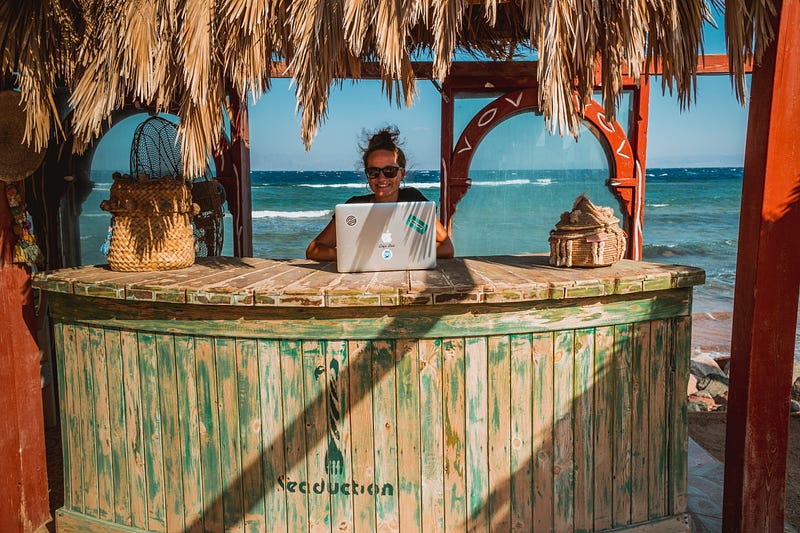
During the first years of the 2010s, through the expansion of startup culture and through socials like Instagram, this kinda bohemian lifestyle started becoming cool.
Looking casual, not being bound to a location, having the freedom to travel while working, and being based wherever you wanted or could, became a new travel and lifestyle trend: the digital nomad.
All of a sudden, pictures of people working from amazing beaches or from treehouses with jungle view started popping out everywhere on social media. Before you knew it, that was the ultimate Millennial dream: do your thing, on your own terms, be your own boss from wherever you wished and however you wanted.
With Millennials being the new workforce, a cultural shift started playing out. Companies began adapting to Millennials’ “smart requests.” That’s how Millennials have reshaped the corporate world and the whole notion of working remotely.
Kinda by chance, I started surfing this wave from the beginning because of my husband and I’s business: the travel and hospitality company I mentioned before.
Though, at some point things got twisted: we were hustling to live that life, to live life on our own terms. It was amazing to be able to work while traveling, being based in different countries for a few months, and then hit the road again. But it wasn’t easy! I took my fair share of “office-for-the-day” pics from Caribbean beaches and world capitals’ hip hotels. Yet, we (my husband and I) would work literally all the time to make sure we had the money to live our nomadic lifestyle.
Nonetheless, the package sold more than its content and a horde of rich Millennials just started living and “working” this way, making it look easy, effortless. And it probably was for some of them. Though I did struggle when I saw how this lifestyle turned out to be portrayed: a choice supported by talent, kinda like “either you have it or you don’t,” when, in fact, it’s supported by privilege and family money.
Going back to our version of digital nomadism: we were entrepreneurs and our business was mainly carried out online. That’s because we had to make a choice: either you spend money in traveling or in an office space. To have both was not an option.
Our homes — or co-working spaces or cafes’ — have always been our offices. For a period of about 4 years, we traveled around to the destinations where our business had a presence: we didn’t spend more than 2 months in the same city or country. When asked: “Where do you live?” we could only answer: “We live where we’re at!”
We’d worked from pretty much everywhere: hotels, airports, rental homes, restaurants, and wherever there was Wifi available. We literally took remote working to the next level: sometimes we were in Europe sorting out clients’ issues in the States or the other way around. We managed our staff in Miami from Barcelona. Once I fixed a broken AC in an apartment in Miami from the bathroom of the notorious DC-10 club in Ibiza!
Those have been great years, but I also remember having financial uncertainty in the back of my mind at all times. Hence, it was not even close to being smooth and simple. Though, through the lenses of the digital nomad, we could finally market an image of success. Act as if was our motto for a while. But in reality, we’d hustle every day to do the job of probably 10 people in 2. We used to have 3 email addresses each so we could play the role of our own assistants and employees.
As I said we never had an office. Then, because it became cool to be location independent and having a mobile office as a digital nomad, we actually stopped wanting one.
We’re Trained for the Current World
Uncertainty. Insecurity. Instability. Precariousness. Those are the only certainties in today’s world.
And who, better than others, have been eating those “delicacies” for breakfast pretty much daily for years? Us, the usual suspects, the once broke remote workers, now cheered as smart, whose lifestyle choice has become what the majority of employees in the Western world have to adapt to due to the pandemic.
We’ve been judged for not having a conventional, secure job and now we might actually thrive in the chaos of the dystopian, strange days we are living in.
Now, before moving on, I’d like to clarify that, if I’ve often linked freelancing to remote working in this article, it’s because that’s my experience and I got into remote working because of freelancing. Although, by no means, the 2 are synonyms, nor can be used interchangeably. Many people who work remotely are employees, and that’s nothing new.
Though, freelancers, more than remote employees, are used to the type of instability — financial and professional — as well as to a certain degree of isolation, which is now spreading out in the education and labor worlds because of COVID.
Steady jobs are no longer secure. People who used to go to the office every day have to work from home. Many of those are freaking out. They miss their office environment, their colleagues, the separation between workplace and home. Even the increased freedom in managing their own time is completely displacing for some people. Working remotely has its challenges and, if you are not used to it, it can be absolutely disruptive.
As an article from Deloitte points out, 20% of their employees who’ve been forced to work from home worry about their mental health due to lack of personal interaction and family life distractions. 16% of them don’t have a designated workspace at home, which is another factor that increases distraction and affects productivity.
And here we go back to one of my initial statements: the pandemic hasn’t changed much in my life as I’m used to financial instability, social uncertainty, and isolation. I’m used to the idea that sometimes I might not make it till the end of the month. I’m used to working from home and being completely web-based. I can create a working space even in a hotel room.
Bottom line: you and I, freelancers and remote workers have been training for the current world without even knowing it.
When it comes to creative entrepreneurship or start-upping the situation is not that different. We can’t afford an office, but at this point who wants one? We don’t wanna wear a suit, and seriously, right now, who cares? We want to be our own bosses, and what would be the alternative if companies are firing people on a massive scale? We’ve been judged for not having a conventional, secure job and now we might actually thrive in the chaos of the dystopian, strange days we are living in.
We are used to living in crisis. We are used to unpredictability and we are able to adapt fast to new economic situations and business scenarios.
Now homie and casual is cool. Not so long ago it was unprofessional. Now we are the smartest ones; before we were the losers.
Remote, independent professionals have been unintentionally preparing for today’s world . As sociologist Zygmunt Bauman would put it: we learned how to move inside the labyrinth, the maze, the matrix of today’s liquid life.
Remote Working Is Here to Stay
In 2018, Richard Branson predicted that “flexible working arrangements will be the norm in the not-so-distant future, and business leaders need to get on board. The opportunity to work at home also makes it possible for employers to retain top workers. Employing remote workers could also slash real estate costs.”
The second wave of COVID-19 is confirming precisely that. Smart working has become a challenging necessity, particularly financial, for businesses around the world. Therefore, smart working is here to stay. Be it because companies cut office spaces’ costs or because of lockdowns and other safety regulations, working remotely has been reshaping the job market with no turning back.
To conclude I’d like to give new remote workers a couple of demystifying tips:
- Pick one spot in your house and make it your workspace. Do not bring work all over the place, it will create confusion with other aspects of your daily life.
- Curate your home office with a style and objects that inspire you and make you feel comfortable, yet productive and focused.
- Work the same amount of hours you’d do at the office. When it would be time to leave the office, you stop working (unless you are paid to work overtime, of course).
- DO NOT spend the day in your pajamas. That’s a myth. Even if you are not leaving the house, wash and dress as if you were to go out. Casual, sure. But get ready for the day. Pajamas days can be fun at first but they inevitably lead to decreased productivity at best, and depression at worst.
- Practice your time management skills: if you work from your home you call the shots, you are in charge of your time. Define a morning routine that gets you up and running and a weekly schedule. Though, make sure it’s flexible, meaning adaptable to how you feel and changeable according to your needs. Trust me, that’s the best part!


