
From 0 to 500 Email Subscribers and My First Sponsor — Here’s How I Did It
The exact steps I followed to grow and monetize my tiny newsletter.

My dream is to make a full income with my newsletter. No algorithms, products to sell, or quest for virality; just me, my loyal readers, and the topics I care about most.
This bold dream turned a wee bit into reality when I found the first sponsor for my tiny audience last week.
You heard it before: Your email list is crucial for your success as an online creator. I agree and I’m here to argue an email list is valuable by itself. It can be so much more than an online marketing tool.
With the right effort, it can become your main platform and income source.
While I’m not there yet, the unparalleled feeling of landing my first newsletter sponsor made me believe in this exciting possibility.
The best part of it? It wasn’t hard to achieve. I built my newsletter on the side for the past year. There were weeks when I didn’t spend time on it at all. It’s a passion project I followed without pressure.
Here’s what you’ll learn in the following paragraphs:
- How to set up an email list from scratch if you don’t want to spend money and don’t have a website;
- How to go from 0 to 100 subscribers;
- How to go from 100 to 500 subscribers;
- How to find possible sponsors and get them to pay you.
This guide is for you if you procrastinate on your email list. You came to the right place if you don’t know how to start, how to get subscribers, and whether the effort will pay off. Let’s go!
How to Set Up An Email List From Scratch
A few years ago you needed at least a landing page and some coding skills to start an email list. The entry barrier was high and kept many away.
Today, there’s no excuse. You can set up an email list within 30 minutes and have several options and platforms to do it. Here are the two simplest options:
Option 1: Use an email marketing service like Mailchimp or ConvertKit
Email marketing services are your go-to options if your newsletter will also serve as an email marketing tool. These services allow you to schedule automation and create sales funnels.
Their basic plans are typically free but you have to upgrade to a paid plan once you reach a certain number of subscribers or emails per month.
At the same time, you can’t make money from publishing alone; monetization of your newsletter is up to you.
While it’s fairly easy to set up your list here it’s not as clear-cut as on Substack (see below).
I use Mailchimp for all my email lists. However, I have multiple lists and use some for email marketing purposes to sell digital products. My content-driven newsletter runs here because I wanted to stay on one platform.
If you want to start a content-driven newsletter and don’t have products to sell, consider option 2:
Option 2: Use Substack
Disclaimer: I haven’t used Substack yet but most content-driven newsletters I subscribed to do, and for good reason.
Substack is a newsletter platform created specifically for emails with inherent value.
If you want to start a newsletter about your passion or expertise this is what I recommend.
Publishing on Substack is free regardless of your number of subscribers and emails.
At the same time, subscribers can pay you for your published content alone so this platform comes with the option to monetize your content. This is Substack’s business model: They deduct a certain percentage from your earnings.
To set up an email list on Substack is easy as pie; it takes less than 30 minutes.
No matter which platform you go with, you need two things before you start with the collection of subscribers:
1. A landing page
The landing page is the business card of your newsletter. Make it compact, solid, and sweet. Here’s the landing page of my Self-Letter. This is the newsletter I talk about in this tutorial.
Describe what you’ll email about, add a photo of you, and say how often you plan to write emails.
Note you don’t need a website or coding skills to set up a landing page. All providers come with an in-built option to create one. I use Mailchimp’s form. It’s not fancy but it does the job.
2. A welcome email
Once people join, send them a kind welcome email to reassure them they came to the right place. This is an automated email every subscriber will receive. It’s an in-built function of all email service providers.
Now that you know how to decide which email platform to use, on to the fun and scary part:
How to Get Your First 100 Email Subscribers
If you came for a secret sauce I have to disappoint you. There’s no magic formula to get your first 100 readers on your list.
You have to do the obvious: Ask your friends and family.
While this seems lame, consider every business and worthwhile endeavor starts with the 3 F-s: friends, family, and fools.
It’s crucial to overcome this inner hurdle. Don’t worry about annoying people. Most of your inner circle will be happy to help you and spread the word.
Think further than your closest friends and parents. Go through your Facebook friends list and other contact lists and ask everyone you’re in remote speaking terms with to join.
Make a list of all possible contacts to ask.
This felt awkward at first but it depends on the framing. I didn’t say this was a business idea and an email list. Instead, I talked about my project and asked if it’s interesting to them.
Almost everyone said yes.
I went with this simple message:
Hi (NAME)!
I’m starting a new project and want to teach people about __________________. Would you be interested in learning more about that?
Rinse and repeat this until you have 100 subscribers. My guess is you have between 500 and 1,000 people you’ve introduced yourself to over your life. You sure as hell can get 100 of them on your list. I’m an introvert and despise asking for favors. If I could do it, you can too.
Don’t think about fancy marketing tactics before reaching 100 subscribers. This is a good test to see if you can persevere and have the willingness to convince people of your idea.
See it this way: If it feels like spamming the people closest to you why should a stranger join?
How to Get from 100 to 500 Email Subscribers: The 7 Methods of Newsletter Growth
In this section, I share all free and paying strategies I used to get subscribers onto any of my email lists.
Don’t try all of them at the same time. Pick the one that appeals to you most and see how it works. Getting subscribers is a trial-and-error process so don’t stress if some strategies bring you negligible results. Move on to the next and learn.
Growth method #1: Cross promotions with other newsletters
Costs: free
Approach other newsletters of similar size and audience. Ask them to promote your newsletter in one of their editions and promote theirs in return.
Growth method #2: Pay other newsletters to feature you
Costs: $50-$200 per edition, depending on size
Instead of featuring them in return, you can also pay other newsletters to feature you.
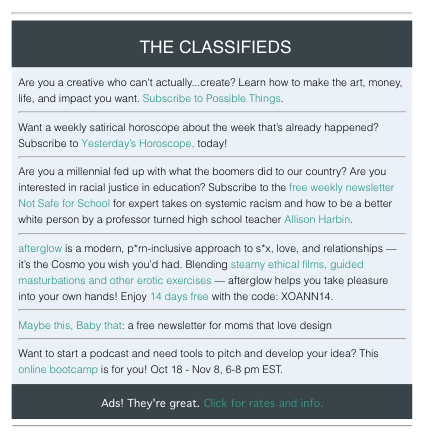
Go through the newsletters you follow and see if they have sponsors or classifieds. If they do, they usually have a link where you can book your spot.
Here’s an example of classifieds from Ann Friedman’s Ann Friedman weekly newsletter:
Growth method #3: Content creation
Costs: free
If you already have an audience on social media or a writing platform — brilliant!
Keep doing what you’re doing and add a call-to-action (CTA) to subscribe to your newsletter to your posts or articles. Make sure your CTA cites the exact value people will get from your newsletter. You can see my CTA below this article.
One successful post or article can bring you an abundance of new subscribers. This article brought me 150+.
Growth method #4: Social media ads
Costs: upwards from $1 per boosted post per day
You can run targeted Facebook or Instagram (Twitter, Pinterest, etc.) ads to reach more people and subscribers.
The promotion of a specific edition or similar content you created elsewhere works better than your newsletter’s landing page. People have to fall in love with your content and crave more to sign up. Pick your most successful piece, add a CTA to its bottom and go for it.
Growth method #5: Create a freebie and promote it
Costs: free or paid, depending on your promotion method
A great way to get people to subscribe is to give away something for free. This can be an ebook, a short video course, or anything else that gives them value.
Make sure your freebie is strongly related to your newsletter (no Amazon vouchers!).
Promote your freebie like everything else: On social media, paid or unpaid, etc.
Growth method #6: Use gated content
Costs: free or paid, depending on how you hide/distribute the gated content
Gated content means some of your work is visible to subscribers only. This works well when you write high-value content and move the cherry on top behind the gate.
If we take this article I could move the exact steps I followed to reach my first sponsor (see below) behind a wall.
You already saw me explain in detail how to reach subscribers. If you’re determined to follow through you’d be willing to give your email address for the remaining steps.
This approach is similar to a freebie but is tied to a specific content piece.
Growth method #7: Facebook groups and Reddit forums
Costs: free
Forums hate self-promotion. Reddit is merciless when it comes to self-promoting users. I nevertheless use Facebook groups and Reddit forums to grow my newsletter and no one banned me.
Why? How?
Be genuinely helpful and sophisticated. Mention your content, freebie, or newsletter when people ask for advice you cover. If you create your own post or open a new thread, give 90% of your content away and use in-text links to drive people to your landing page.
Be on the right side of the fine line between self-promotion and helping people out with your content.
How to Get Your First Sponsor
Once you reached 500 subscribers, congratulate yourself. It’s a big deal! Most newsletters don’t make it to this point.
You have a tangible audience and are ready to allow other brands access to it.
These are the exact steps I followed to get my first sponsor:
Step 1: Find and make a list of potential sponsors
A word of caution: Make it a priority your sponsors are relevant to your audience. Don’t compromise. You want this cooperation to be valuable for your audience and your sponsors. This is about more than the quick exchange of a few bucks.
Once you made this vow, it’s time to search out relevant sponsors. Note sponsoring newsletters is a niche marketing tactic. It’s not like influencer marketing or running Facebook ads. Most companies don’t consider it as a viable strategy.
Therefore, your best bet is to find brands that already sponsor newsletters similar to yours. How? Subscribe to a bunch of such newsletters.
Search Subsctack, have a look at Letterlist, see which newsletters your favorite creators recommend, or see if they have their own.
Dig the archives of the newsletters you found and see who sponsored them. If they’re a good fit, add them to your list of possible sponsors.
I recommend you start with ten possible sponsors you email. This was enough to find my first two sponsors.
2. Find the right person to email
It’s crucial to email the right person who can make the decision to sponsor you. If you’re not sure or only found a general email address, do a little research:
Search for the company on LinkedIn and add keywords like demand generation, growth, or marketing.
Once you have the right person find out their email address with a tool like hunter. You can also guess the email address based on the general email format of the company (e.g. [email protected]).
3. Decide on your pricing
This question seems overwhelming if you have never done this before. It doesn’t have to be.
To decide on my pricing I looked at what other newsletters charged. In the end, I decided to ask for $40 per issue and $160 if they agree to five issues.
This won’t make you rich but is a fair price for a comparatively small audience, as you do this for the first time.
You can charge more for highly specialized newsletters in niche topics.
4. Email the brands and ask for sponsorship
Write a short and sweet email with your inquiry and highlight the benefits of sponsoring you.
Here’s the exact email I wrote to the 10 brands I picked as potential sponsors:
Dear X,
My name is Juli, and I write the Self-Letter, a newsletter for creators and (aspiring) solo entrepreneurs.
In each edition, I share timeless insights on what it means to live a good life, run a business aligned with one’s personal values, and cultivate self-awareness.
I have 500 highly engaged subscribers, and I’m looking for a sponsor who’d be interested in reaching an audience of ambitious solo creators on their journey of personal development. I saw you sponsored X’s newsletter and I was wondering if you’d be interested in a trial sponsorship for 1 issue of the Self-Letter for $40 or 5 issues for $160?
Note for now I want to work with only one sponsor per newsletter, so this rate is for an exclusive sponsorship per edition.
I have an average open rate of 51% and a CTR of 10%.
Thank you very much in advance for your consideration. I look forward to hearing from you.
All my best,
Julia
I received my first positive answer within three hours and my sponsor decided to go with five issues. It felt damn good:

5. Follow up twice
The fortune is in the follow-up. Don’t be shy to ask twice again if they want to sponsor you.
I wait for three days before I follow up.
Make your follow-up email concise; not longer than two sentences. Reply to the original email you sent.
Thanks to following up, I received my second positive answer 4 days later:

This is it. If you follow this process and pick relevant brands I promise you’ll land your first sponsor.
All the While: Quality Is Everything
The niftiest promotion efforts won’t mean a thing if your main focus is something else than to write valuable emails.
While you go through this process, give each newsletter issue your all regardless of your audience size.
Try to send your newsletter regularly but don’t knock yourself up if you miss a few editions.
I value quantity as high as quality in my other output. I handle my email lists differently. When people trust you with their email address I make sure they receive insanely valuable content. Sometimes, this means irregularity.
The same goes for my (future) sponsors. I’ll make sure to make the cooperation rewarding for them and describe their products and services in an appealing way.
Final Thoughts and Summary
The steps I described above aren’t a quick win you can rush through within a week. In fact, I’ve been growing the Self-Letter for over a year. You can do this a lot faster depending on your disposable time.
That said, if you follow the steps above and your work is conscientious you’ll reap the harvest of your efforts.
To give you a final overview and checklist, here’s a summary of the steps:
- Decide on a topic for your newsletter;
- Decide on a newsletter platform;
- Ask your friends, family, and social circle to join until you get to 100 subscribers;
- Follow one or more of the seven newsletter growth methods above to get to 500 subscribers;
- Find and make a list of potential sponsors;
- Email your potential sponsors and follow up with them;
- All the while: Put quality over quantity when it comes to your newsletter.
I started the Self-Letter with zero subscribers. Last week, I reached 500 subscribers and landed my first sponsors. If I can do it, you can do it, too.
If you need more help, join my Self-Letter. It’s a weekly email where I help you learn more about yourself, embrace your creativity, and make money aligned with your values. I look forward to e-meet you!


