
Freedom Songs: The Unifying Role of Music in the Civil Rights Movement
Examining how music helped fuel and nurture the revolutionary spirit during one of America’s darkest moments
Introduction: Reconciling Music, Nominally a Form of Entertainment, With the Civil Rights Struggle
Race is one of those touchy issues, but there is no reason for it to be. Even more than being repulsed by racism, I do not understand racism. The color of one’s skin is a genetic, cosmetic detail that has no intrinsic bearing on one’s talent or personality, like the length of one’s fingers. Some people have shorter fingers, and others have longer. But nobody persecutes the ‘short-finger people.’ Nobody discriminates based on finger length.
So why does skin color cause such division?
Regardless, this article does not aim to make a statement about race in the US today. It is tricky because I am discussing the civil rights movement, the height of which was during the ’50s and ’60s, but America still exists, and so do Black, White, and Brown individuals. I do not mean to pass judgment upon any community's ‘collective character’ in 2024. I hope whatever happened in the past can remain in the past.
Because racism has no place in civilized society.
The Role of Music in a National Movement
In this article, I want to focus instead on one of the positives of the civil rights movement, one that appears incongruous with the ugliness of a mass struggle against oppression: music.
Today, music is seen largely as a form of entertainment. Chart-topping numbers infuse life into parties and spur feverish grooving upon the dance floor. Students listen to lo-fi while preparing assignments. People let their hair down at concerts.
That music might play any serious role in a freedom movement might, therefore, sound improbable. But music is art. And art has always been a potent mode of dissent. There is a reason oppressors burn books and ban satire. The lyrical content, in particular, can turn a song from a recreational artwork to a rallying point for kindred revolutionary spirits. And that is precisely what happened during the civil rights movement.
Music can play a plethora of roles. While some songs inspire couples to hold hands and sway to the beat of their love, other songs move revolutionaries to action. In the case of the civil rights movement, in fact, some songs were so powerful and came to symbolize the equal rights struggle to such an extent they were termed ‘freedom songs’.
In this article, we explore how music roused the courageous to tear apart their shackles.
Meetings and Marches: The Precise Role Music Played in the Civil Rights Movement
One often hears of music unifying the masses. But what does that mean? How does music feed the revolutionary spirit?
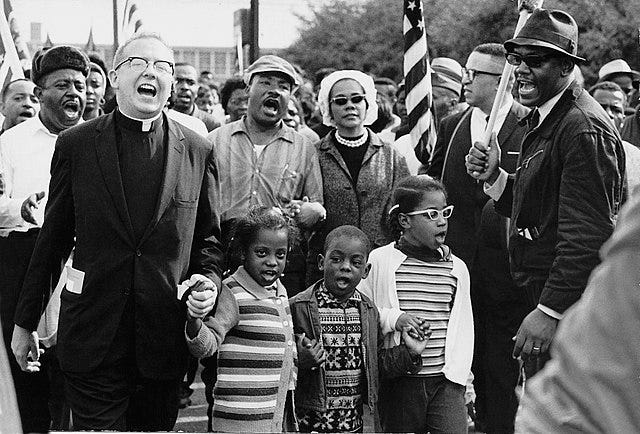
- Marches: In 1965, thousands of protestors, led by Dr. Martin Luther King, undertook a now-iconic five-day, fifty-four-mile march from Selma to Montgomery in their bid for equal voting rights. There is an entire album (Freedom Songs: Selma, Alabama) dedicated to the songs the protestors sang during that march, including several recordings of only their chants and tunes. No music, just the protestors singing.
- Meetings: During the mass congregations where the protestors organized their troops, planned their marches, and prepared their protest material, songs were played and sung. One song that was famous for being played at virtually every such mass meeting was This Little Light of Mine.
- Waiting: Not every moment during the civil rights movement was a moment of action. Some moments were quiet and transitional. Sometimes the protestors waited for members to arrive, sometimes they were in the process of gathering materials and distributing placards at the commencement of a march, sometimes they were talking in the aftermath of a major event. Music played and songs were sung during these moments, simply to pass the time.
- Other Events: Music was also played and freedom songs sung at prayer vigils, freedom rides, in jail, and during similar events. Different songs were sung at different types of events. For instance, there were protest songs, and there were sit-in songs. Some songs conveyed hope for the change the protestors hoped to achieve, some conveyed grief for fallen brothers and sisters, some kept participants motivated throughout an arduous activity.
In short, music was everywhere during the civil rights movement. Songs were typically short, simply worded, and repeatable, with a catchy but powerful chorus. They became mantras, musical weapons wielded by the legions of protestors who ultimately effected the Equal Voting Rights Act of 1965.
The role of music during the Civil Rights Movement can best be summarized in the words of the Library of Congress:
They sang these songs for multiple purposes: to motivate them through long marches, for psychological strength against harassment and brutality, and sometimes to simply pass the time when waiting for something to happen.
Freedom Songs: Music That Unified the Oppressed and Fueled the Revolutionary Spirit
Freedom songs were usually — but not always — borrowed, and sometimes adapted, from traditional church or gospel music. Some pieces of folk music lent themselves perfectly to the civil rights struggle. Others were modified. Sometimes, the melody of the hymn was preserved, but new words were improvised. Freedom songs came in all shapes and sizes.
The important part was their purpose, as explained by Martin Luther King, Jr.:
The freedom songs are playing a strong and vital role in our struggle … They give the people new courage and a sense of unity. I think they keep alive a faith, a radiant hope, in the future, particularly in our most trying hours.
This is complemented by the words of Sam Block, one of the organizers of the Student Nonviolent Coordinating Committee’s (SNCC) first voter registration project in the Mississippi Delta:
I began to see the music itself as an important organizing tool … not only to bring [people] together but also as an organizational glue to hold them together.
The following were the most famous freedom songs:
- ‘We Shall Overcome’: Dubbed the ‘unofficial anthem of the civil rights movement,’ this song was originally titled I’ll Be Alright Someday and was likely used by tobacco workers. Around 1947, the folk singer and activist Pete Seeger changed will to shall and performed the song worldwide. I was astonished that this song was so strongly associated with the civil rights struggle, because as kids used to sing along to the lyrics in school in India. I still remember the chorus. So simple yet so powerful: Deep in my heart, I do believe; we shall overcome some day.
- ‘A Change Is Gonna Come’: Written by the King of Soul, Sam Cooke, this song spoke about Cooke’s struggles as an African-American gentleman in a White-dominated country. The song was chosen for preservation by the Library of Congress and was ranked third on Rolling Stone’s 500 Greatest Songs of All Time.
- ‘We Shall Not Be Moved’: This song was already a staple during the labor movement in the early twentieth century. During the civil rights movement, the tune transitioned from union halls to protest marches. As the title suggests, the song is about remaining firm in one’s convictions and refusing to yield to those who would deny them their rights. As the famous chorus goes: Like a tree planted by the water, I shall not be moved.
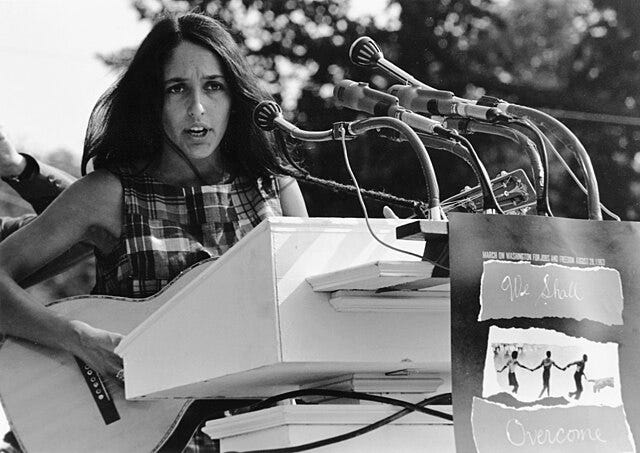
- ‘Oh Freedom’: On the morning before Martin Luther King, Jr.’s legendary I Have a Dream speech, the folk singer and activist Joan Baez sang on the 1963 March on Washington a song that dated back to the age of slavery, when African-Americans declared before they would be a slave, they would be buried in their grave. Baez’s rendition became one of the movement’s trademark songs.
- ‘I Love Everybody’: According to the Southern Christian Leadership Conference’s (SCLC) James Bevel and Andrew Young, this was the most important song of the entire movement. After being attacked and beaten, protestors would retreat to the church and somehow always end up singing this song, often with bleeding backs, sometimes for an hour straight.
There are more. Many, many more. Listening to them now, I feel moved. I have never faced oppression. I have never feared for my life. To think some had to constantly battle tyranny and be treated as less than human just for the color of their skin is… harrowing. But these songs remind me it is in times of strife and struggle that the inherent resilience of humans shines the brightest. These songs are inspiring. Transcendental.
Blues and Jazz: Genres That Defined the Civil Rights Struggle
Several of the freedom songs were either blues or jazz, the difference being blues is more downbeat and melancholic while jazz is livelier and more hopeful. Jazz is often considered a superset of blues. Both were born out of struggle. Although their origins remain apocryphal, both are believed to belong to the same family. About jazz, Martin Luther King, Jr. himself, who called freedom songs the ‘soul of the movement’, had this to say:
Jazz speaks for life … The blues tell the story of life’s difficulties — and, if you think for a moment, you realize that they take the hardest realities of life and put them into music, only to come out with some new hope or sense of triumph. This is triumphant music.
Both jazz and the blues existed before, but during the civil rights movement, especially around the ’50s and ’60s, they gained nationwide popularity. The blues in particular encapsulated struggle. The lyrics spoke of hardships and difficult times. But the core message remained hopeful. And jazz was overtly upbeat. The two became household genres, especially the ones that supported the civil rights movement.
Closing Thoughts: The Continued Importance of the Freedom Songs
I love that February is Black History Month. Not one day. A month. The more I read about the origins of the civil rights movement, the more horrified I grow. Which is the point. Although the people are different now, and we must never allow it to dictate the present, we must never forget history, even when it is ugly. Especially when it is ugly. For it is only by rectifying and never repeating past mistakes that one improves.
The freedom songs continue to be crucial toward preserving America’s collective conscience. Listening to them now gives me chills, especially the chants from the Selma, Alabama album. The word that rises to the forefront of my mind when I hear the protestors’ voices is raw. There is something undeniably pure about hundreds, sometimes thousands, of kindred souls, bellowing battle cries that capture the revolutionary zeitgeist.
As somebody who suffers from clinical depression and two anxiety disorders, I always say every day is Mental Health Day. Along the same lines, every month is Black History Month. Only by being conscious of the past can we create a better future. But the importance of Black History Month cannot be denied. I have felt buoyant whenever I see another article dedicated to the civil rights movement on my feed.
Racism is one of those things I simply do not understand. How does a racist climb into bed at night, tired and exhausted after a long day, sleep for eight hours, and wake up still a racist?
Racism is madness. And madness is transient. People usually sleep it off. Or snap out of it. We have all done things we cannot make sense of later. Several times in the past, I have snapped at somebody and felt bewildered the next day as to why.
How does a person continue to be racist, day after day, year after year? How do people actually fight over the color of one’s skin? I know I am a pacifist anyway, but that makes zero sense to me. And that is why I think the freedom songs must never be forgotten. They must be sung, and they must be chanted until the day racism no longer exists. Until there is no more White community and Black community, only community.
If you enjoy my writing, please consider joining my newsletter for exclusive content and buying me a coffee. I am immensely thankful for all your support.