
Freedom of Association: Rights, Responsibilities, and Limits
Empowering individuals to join or form groups for any legal purpose without government interference.
Freedom of association under the First Amendment of the U.S. Constitution means that you are free to join any club or group that you like. It makes it possible for you to be part of any social club, political party, or other group without fear of getting in trouble. That’s part of what makes a democracy work, because it allows people to come together to talk about their beliefs, plan activities, or work toward common goals.
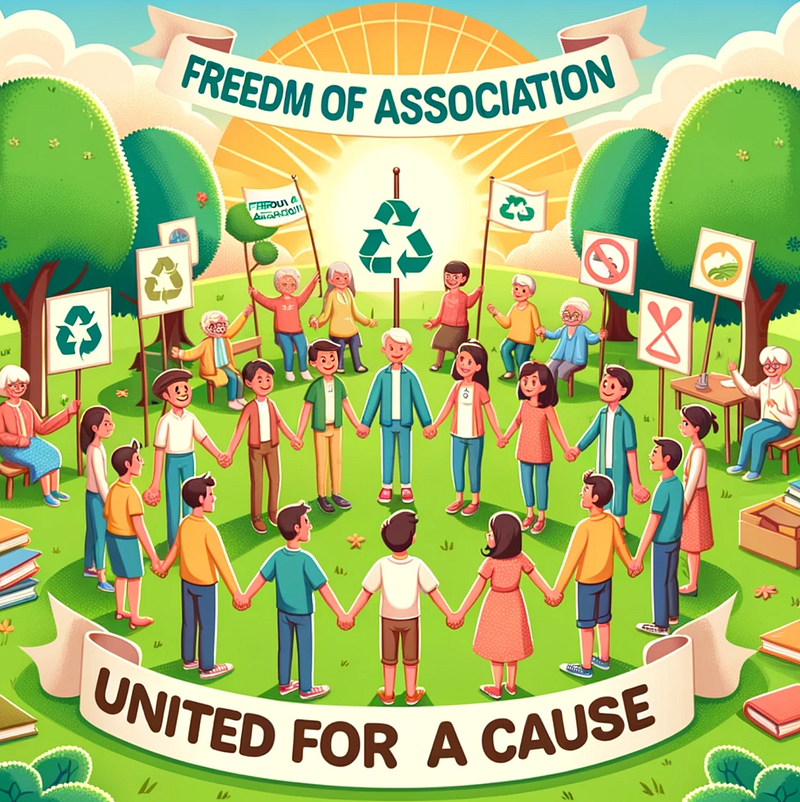
Imagine that you and some friends are really passionate about protecting the environment. So you decide to start a group where you meet once a week to discuss how you can help your community recycle more and use less plastic. Freedom of association allows you to create this group, have meetings, and even organize events to promote recycling without the government stopping you just because they might not like your cause.
This freedom is crucial because it allows diverse initiatives and movements to grow. Whether it’s joining a book club, being part of a political organization, or starting a group to support a cause you believe in, the First Amendment protects your right to do so. As a result, society benefits from a wide range of perspectives and initiatives.
Legal Protections and Boundaries of Group Membership
So, basically this freedom allows you to hang out with, join, or support any group you want. It definitely helps people share ideas, work together on causes they care about, and promote change in society. However, the government does have some rules about this freedom, especially to keep everyone safe and to ensure that groups don’t harm others.
- You Can’t Be Punished for Just Being Part of a Group. Let’s say, you’re part of a chess club that meets in the park every Sunday. Now, suppose someone starts saying the chess club is bad, without any real reason. The government can’t just come in and shut down your club or punish you in certtain way for being a member. For instance, a famous case, Keyishian v. Board of Regents (1967), said that the government can’t deny you a job just because you’re part of a certain group (chess club), unless that group is doing something illegal and you want to help them do those illegal things.
- No Guilt by Association. Let’s say you joined a group because you support its main goal — protecting the environment. But then, a few members of the group start doing illegal things, like vandalizing property to make a point. Even if you’re part of that group, the government can’t punish you just for being a member unless you’re involved in those illegal activities. The Noto v. United States (1961) case made it clear that you can’t be found guilty just because you’re part of a group where some members do bad things.
- Limits to Supporting Certain Organizations. Now there’s a trick. If there’s a group that’s internationally recognized as dangerous or terrorist, the rules change a bit. The government says you can’t help these groups, which can even mean joining them or doing things to support their cause, even if you think you’re just helping in a peaceful part of their work. The case Holder v. Humanitarian Law Project (2010) supported this idea and showed that there are some limits, especially when it comes to groups known for harming others.
Freedom of Association and Discrimination
Freedom of association also allows some private organizations to select their members based on certain criteria. This may include deciding not to include someone because of intimate associations or if including them would go against the group’s main message or purpose. But there are limits, and it’s a complex area that balances individual rights against group freedoms.
For example, the law has sometimes stepped in to say that private clubs must open their doors wider. In Board of Directors, Rotary International v. Rotary Club of Duarte (1987), the Supreme Court ruled that the Rotary Club couldn’t exclude women because it was inconsistent with the club’s activities and messages.
The situation was different in the 2000 case of Boy Scouts of America v. Dale. The Boy Scouts had a policy against including openly gay leaders, and when they removed an assistant scoutmaster because of his sexual orientation, a lawsuit ensued. The Supreme Court ruled that forcing the Boy Scouts to accept homosexual members would violate their freedom of association. This was because the Court viewed the Boy Scouts as a private group with the right to express its own set of moral values, which included specific views on sexuality. The Court believed that forcing the Boy Scouts to violate those values would interfere with the message they wished to promote.
These cases demonstrate that the right to discriminate within private organizations is a sensitive matter. It’s allowed when such discrimination is key to the group’s identity or message. However, the protection is specific: it applies only when forcing a group to include someone would directly contradict the group’s core message. This means that not all forms of discrimination are protected by the First Amendment — only those that are essential for a group to express its beliefs.
Freedom of Association and Privacy
The First Amendment is often associated with freedom of speech and assembly, but it also extends to protecting the privacy of those who donate to or are members of organizations. This aspect of the First Amendment ensures that people can support groups without fear of unnecessary exposure or backlash. However, the Supreme Court has applied this principle with considerable nuance, considering the balance between privacy rights and public interests.
In Shelton v. Tucker (1960) the Supreme Court struck down an Arkansas law that required schoolteachers to annually disclose all organizations to which they belonged. The Court argued that such a requirement was over-broad and violated teachers’ First Amendment rights. It emphasized that any law requiring disclosure of association or membership must meet a very high standard of justification — “strict scrutiny.” This means that the law must be precisely targeted (“narrowly tailored”) to achieve a very important (“compelling”) government interest.
However, the Court has recognized exceptions where the government’s interest is deemed sufficiently compelling, particularly in the area of campaign finance. In Citizens United v. Federal Election Commission (2010), while the Court has struck down many restrictions on campaign spending, it has consistently upheld laws requiring disclosure of who is funding political campaigns. The rationale is that transparency in this area is critical to the functioning of democracy, allowing voters to see who is trying to influence elections and government policy.
Similarly, in Doe v. Reed (2010), the Court upheld a Washington state law requiring the public disclosure of the names of people who signed petitions for ballot initiatives. The decision underscored the principle that transparency in the electoral process is a compelling state interest. However, the Court also acknowledged that there could be specific situations in which disclosure of signers’ names could lead to harassment or intimidation, and suggested that there could be exceptions to this rule if the risks to individuals’ safety or freedom of association were shown to be substantial.
Disclaimer
The information provided in this article is for informational and educational purposes only and is not intended to serve as legal advice or as a substitute for legal counsel. While efforts have been made to ensure the accuracy and completeness of the content herein, it is important to note that legal principles and regulations can vary significantly based on jurisdiction and specific circumstances. Therefore, this article should not be used as a definitive legal resource or as a basis for making legal decisions. Readers are strongly advised to consult with a qualified attorney for advice on legal issues or matters, as each individual case may require detailed and personalized legal analysis.
Reliance solely on the information provided in this article without seeking professional advice from an attorney may lead to unintended legal consequences or misinterpretation. The author or publisher of this article do not accept responsibility for any potential errors or omissions, nor will they be responsible for any losses, injuries, or damages arising from its display or use. The information provided here does not create an attorney-client relationship between the reader and the author or publisher.


