
Free Will: Dr. Robert Sapolsky and the Persistence of Dogmatic Determinism
How it takes ironically remarkable will power to believe we don’t have free will
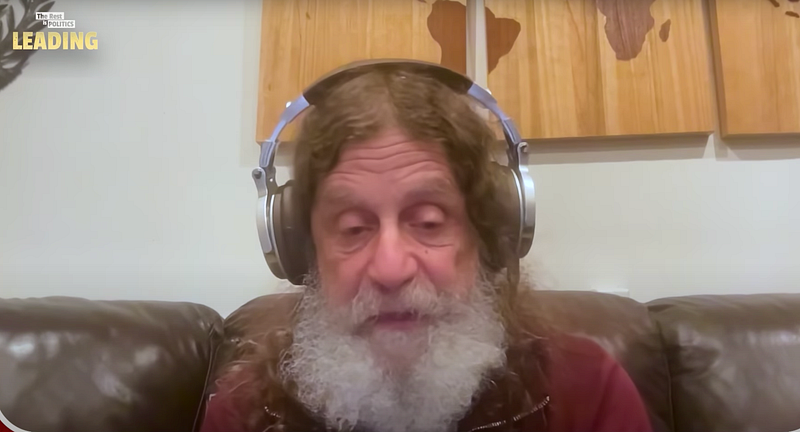
If you watch a lot of podcasts you may have encountered Stanford Professor Dr. Robert Sapolsky. He has done the rounds recently since releasing a book called “Determined”, in which he outlines his view that we “don’t have a shred” of free will. Sapolsky is a hard determinist, like many scientists he sees this through the prism of his field, suggesting all our behaviour is caused by prior biological states and causes, be they genetic, hormonal, environmental etc, and that we do not have an ounce of free will in between. On an interview with UK podcast The Rest is Politics, he said:
“Here’s an example, you’ve got two people, they go to a movie, it’s some inspiring movie about some everyday Joe who does something heroic from out of nowhere, one person comes out of the movie changed by the experience, the person’s behaviour changes, they come out and say “wow that was the most inspiring thing I’ve ever seen I’m going to go over, there’s a booth right over there for Amnesty international, and I’m going to give them my life savings.” The second person comes out of the movie changed by the experience, their behaviour changes, they come out and say “that was the most manipulative emotionally puerile movie I've ever seen I can’t believe they tried to manipulate us that way i hated the cinematography and I'm going to go over to the ticket taker and punch the person because how offensive it is that they even showed this movie”. Whoa, two people’s behaviours changed by this experience, two totally different ways and you know it’s not by chance. Two people went into that experience having been sculpted by a lifetime of stuff they had no control over that made them who they were in that moment, they did not choose to change in watching that movie, they were changed by it as a function of whose circumstances construct them into being. [I]
My problems with this view of the world are so many it's hard to cram it into an article. To begin with, if the difference between someone giving money to a charity and someone punching the ticket vender is arbitrary, then the difference between someone who is inclined to believe free will does not exist and someone who does is also arbitrary. Indeed the difference between preference for all truth claims is a difference of inclination and circumstance. Anyone who expresses the belief that free will does not exist ironically assumes something about the mind's ability to self-reflect and to be worked upon by values such as truth, and they must unspokenly exclude themselves from their own conclusions.
This view is one that also entirely views consciousness as behaviour. It assumes a third person view of those people, and excludes the possibility of self-reflection, of consciousness. Consciousness in this analysis is merely epiphenomenal upon biological causation, an arbitrarily chosen preference for a level of analysis of what constitutes personhood.
The question, though, is whether consciousness itself constitutes something different. Nobel prize winning physicist Roger Penrose has also observed something of the strangeness of consciousness itself. He said it was while studying at Oxford he first came to realise that consciousness could not be “computation”, because consciousness, unlike computation, contains understanding, a word he uses with great importance. He describes this realisation while attending lectures:
From Steen’s lectures it made it completely clear, he put it in a way which is not the way people often do it, people usually, at least in popular accounts say “oh well Girdles theorem shows there are things in mathematics you can’t prove”, you see, unprovable statements. And I didn’t like the idea of that. But Steen made it completely clear that… well provable by what means? Now do you trust the means of proof? If you trust the means of proof then you can transcend them. Now what’s going on there? You see, it means our understanding enables us to go beyond any rules of proof that you trust…what we do when we consciously understand something is not computational. [II]
For now, to say we can’t grasp consciousness very well scientifically is to understate the reality. We have absolutely no idea how to explain consciousness in the brain. None. We don’t even know how to put together the categories by which we would integrate subjectivity into a scientific concept of mind. It seems then that given that the ground of our intuition about free will is unexplained it would be at the very least premature to be that dogmatic about denying it.
This is not to say that free will simply lurks somewhere in the brain we haven’t yet discovered, and scientific progress will likely do little to change the basic dynamics of the free will debate. But all of our intuitions about free will itself are not based on biology, they are based on the fact that in this moment right now you are witnessing the actual experience of self-reflection, asking the question of who you are and what your mind is doing. Unlike the animal world that clearly follows behavioural patterns, when humans are most conscious we seem to possess what Penrose refers to as understanding, a deeply mysterious ability to rise out of unconscious cause. And whether or not Sapolsky acknowledges it, this rising above is assumed by his very stance on free will. It is assumed that he in those moments of thought has the ability to transcend those constraints that would make a pursuit of the abstraction of truth meaningless and arbitrary.
You can of course suggest that even this moment of self-reflection is determined, yet determined by what? You must simply refer to a chain of causation, each regress taking you to an infinitude of cause and we are beyond our scientific categories in the realm of incomprehensible theology.
The basic problem that is ignored in deterministic concepts of free will is the difficulties of joining the levels at which we can describe reality. In theory, history is reducible to social or behavioural science and psychology, these sciences to biology, biology to chemistry, and chemistry to the mystifying world of quantum physics.
In theory. The problem is that if this was true “higher” levels of analysis would be both epiphenomenal and unjustified ascriptions of meaning to illusory phenomena. If we speak about the causes of history, those causes aren’t really what causes history, what causes them are interactions of particles governed by the most fundamental of physical laws.
Yet you are then left with the problem of emergence, consciousness itself is a singular and whole experience apparently produced by that fundamental level of causation, yet presents us with the basic problem of not apparently being reducible to it. It seems that across these levels of analysis through which we can look at reality, some elements that exist on those levels can only be spoken about at those levels.
Sapolsky then is choosing to see all reality though his own field of biology. Humans, rather than being conscious beings are defined by genetics, hormones, and the shaping of experience and environment. Consciousness and values are of course excluded because they don’t exist on such a level of analysis.
Where exactly we factor in causation remains problematic. On a biological level for example the specific structures of cells are part of a system of cause that has as much meaning as the interactions of subatomic particles, since whatever those subatomic particles are doing contains in it the higher order structure that we can analyse. The difficulty we have is ultimately deciding where “cause” exists fundamentally.
This “cause” is also a temporal analysis, a causes b is linear in time, even if Einstein revealed time’s relativity in relation to space. What if time itself is an illusion of consciousness? What if we misunderstand time? Where does that leave our concepts of causation?
It has long since been clear to theologians that this concept of causation on which much science is based is ultimately problematic. “A causes b” justifies the existence of neither a nor b, because cause must not exist just in the past but in the present. Something must ground or give being to both a and b. In theology this is God as absolute being, or the “ground of being”. But since this takes us beyond science, which must assume this being in order to go to its work, many scientists making philosophical statements tend to ignore or exclude this basic problem, Sapolsky, evidently is included in this.
Hard determinism then is incongruent with many basic apparent features of reality. However we must avoid zero sum or absolute arguments. Many points Sapolsky raises about the way our justice system works, about the obvious contingencies that affect human behaviour, are valid and often need to be brought more seriously into consideration. As much as we are conscious with all all the mystery that entails, we also are clearly biological, contingent and the products of our environment. Moments of sincere consciousness and transcendence are far too few. But the answer to the deep questions we ask about will and circumstance must be resolved by bringing these things together, not dismissing one in favour of the other. Believing there is no free will might suit a certain worldview, but it can only be upheld with a generous accompaniment of irony, and an excluding of oneself from the constraints it seems to present. Ignoring the theological has done us little to help understand ourselves better. The same confusions abound, with little resolution in sight.


