
Spirituality | Religion | Self
Free-Thinking & Christianish? Choose One of These Cross-Alternatives for Your Neck
Great for keeping your faith private, or fine-tuning your own unique spiritual path

In a recent article, I talked about how some people emotionally retreat when they see a cross around a stranger’s neck. It’s not because they’re hostile to Christianity, but because someone wearing a cross has bullied, berated, or otherwise abused them.
Like, oh, say the person who thinks it’s okay to badger someone with questions designed to determine whether they’re the “right kind of Christian.” Ditto those who throw on the verbal thumbscrews until they determine to their satisfaction whether you’re “a real Christian” with the ferocity of an inquisitor.
The arrogance of some people…I swear!
If you approach your faith at an angle, as I do, you may also feel a simple cross pendant isn’t enough. Common enough to be symbolically meaningless, it’s also based on death, rather than a deep, fertile life. This makes it a difficult symbol for me to get behind.
Here’s my take — Jesus spent three years teaching in Palestine before the state executed him. His life was meaningful because of his teachings, which later formed the foundation of a major world religion. His death was tragic, but a mere biographical detail. The message is what he would want us to focus on.
Throughout the 20 centuries since its foundation, Christianity has blossomed into a garden of diverse paths. Today, we have a rich assortment of meaningful and life-affirming symbols free-thinking, Christianish folks can choose from.
Let’s look at a few of these now.
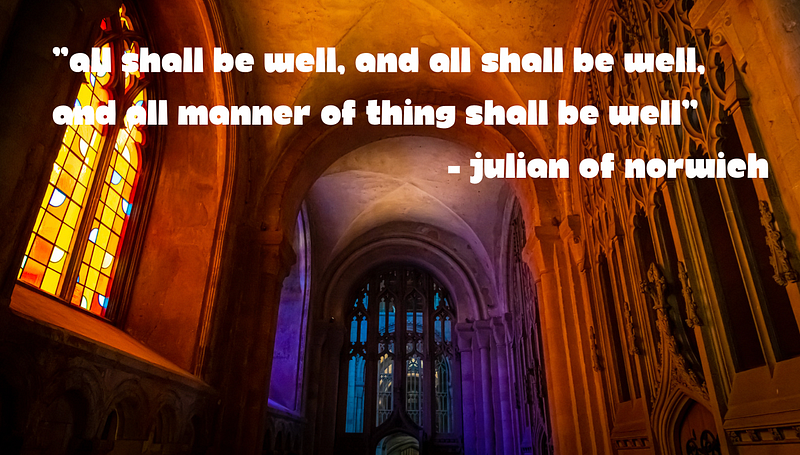
The Hazel Nut
Julian of Norwich, was a medieval English mystic. Her memoir, The Revelations of Divine Love, is the earliest book written in English by a woman that has survived to this day.
In 1373, she received a vision in which God demonstrated his love and care for our world and everything in it.
“And in this he showed me a little thing, the quantity of a hazel nut, lying in the palm of my hand… I looked upon it with the eye of my understanding, and thought, ‘What may this be?’ And it was answered generally thus, ‘It is all that is made.’ I marveled (sic) how it might last, for I thought it might suddenly have fallen to nothing for littleness. And I was answered in my understanding: It lasts and ever shall, for God loves it. And so have all things their beginning by the love of God. — Julian of Norwich, Revelations of Divine Love
I’ve found some perfectly divine hazel nut pendants in pewter and also sterling on Etsy. They’re probably available elsewhere, and in gold too. I’m not throwing links in here, because I don’t want to drive traffic to any particular shop, but I’m sure you’ll find the perfect hazel nut if you do a quick search.
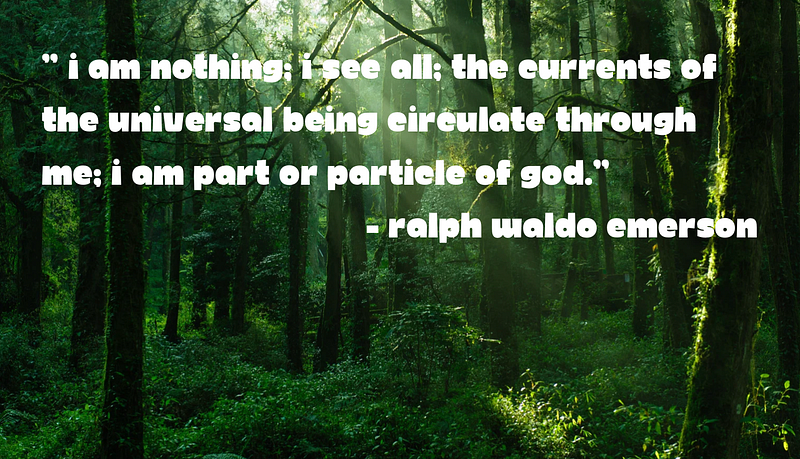
The Eye
Ralph Waldo Emerson, considered the Father of Transcendentalism, was a poet, philosopher, essayist, lecturer, and abolitionist in 19th century Concord, Massachusetts. Best friends with Thoreau, he found God in all things.
Long walks in the woods were his meditation — a lifestyle choice I can get behind.
Although I appreciate what he was trying to tell us with the following passage, I wish he’d used his poetic skills to make it more enticing. Here, he’s grasping to find a metaphor to describe his experience of transcendence as he walks through a forest.
All mean egotism vanishes. I become a transparent eye-ball; I am nothing; I see all; the currents of the Universal Being circulate through me; I am part or particle of God. — Ralph Waldo Emerson, Nature
The transparent eye-ball is hilarious, even just to say out loud. Typing “eye pendant” into Etsy or an equivalent, however, will bring up some enticing options.
Okay, a few are ridiculous, but most I find very fetching. Some are absolutely beautiful — to my taste, at least.
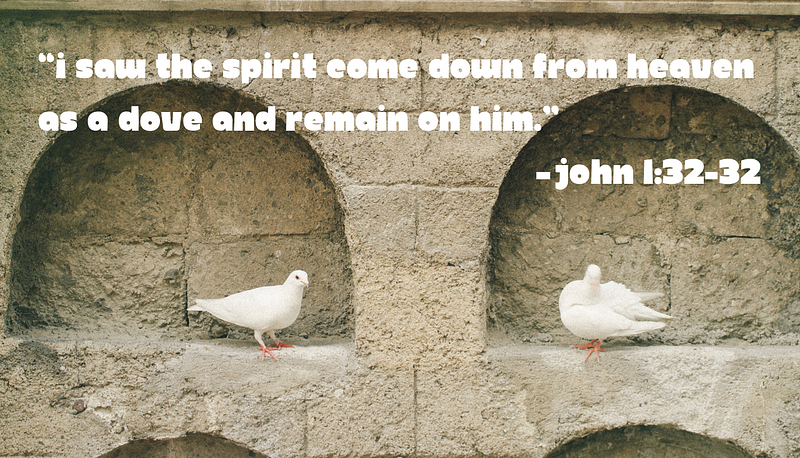
The Bird
Saints Kevin of Glendalough and Francis of Assisi are associated with birds. Doves are especially symbolic of the Holy Spirit.
Then John gave this testimony: “I saw the Spirit come down from heaven as a dove and remain on him.” — John 1:32–32
The dove is also an international symbol of peace. If you can visit the United Nations’ Conference Building in New York City, you’ll see an impressive mosaic of a dove bringing peace to the nations.
Birds hold special significance in other religions and cultures as well. Ancient Greeks and Romans watched the patterns of birds in flight as a popular form of divination. I’ll stop here; if we open the doors to what birds represent in religions from around the world, this article would turn into a book.
Instead, let me leave you with this story. Years ago, I was taking instruction on the Bhagavad Gita with a Hindu friend and her recently widowed father, whom everyone called Baba. During class one day, a bird flew in through the open window. It flew purposefully around the room for a few moments, then made its way out the way it came.
We all watched and remarked among ourselves on the beautiful visitation, but Baba sat stone still, gazing up. Tears welled in his eyes. “It was my wife,” he said. “She had a message for me.”
A couple of weeks later, Baba died in his sleep. I guess the message his wife had for him was, “Settle up your affairs, Dear One, because soon you’ll be coming home.”
Etsy provides a broad array of options if birds are your jam. Vintage shops are also a good place to start your search, as well as museum shops.
1970s peace doves carrying an olive branch are ready for a comeback, don’t you think?
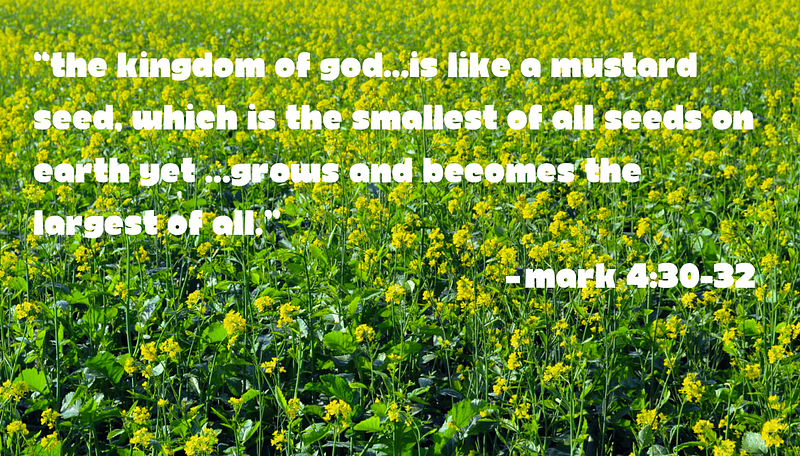
The Mustard Seed
A traditional choice. There are plenty of glass pendants with mustard seeds suspended inside, because they are a perennial favorite. You even may find one in your mother’s jewelry box, or your grandmother’s. If not, you can find both new and pre-loved versions at many jewelers.
Why so popular? The Mustard seed appears in three gospels — Matthew(13:31–32), Mark (4:30–32), and Luke (13:18–19).
30 Again he said, “What shall we say the kingdom of God is like, or what parable shall we use to describe it? 31 It is like a mustard seed, which is the smallest of all seeds on earth. 32 Yet when planted, it grows and becomes the largest of all garden plants, with such big branches that the birds can perch in its shade.” — Mark 4:30–32
Most Americans, at least, don’t use mustard seeds in cooking, nor do they cultivate mustard. Few know what a mustard seed even looks like.
For this reason, Bible translations in conversational English sometimes use other seeds — such as the poppy seed, because anyone who eats bagels knows how big those are — or the acorn because everyone knows at least one oak tree.
Speaking of trees….
The Tree
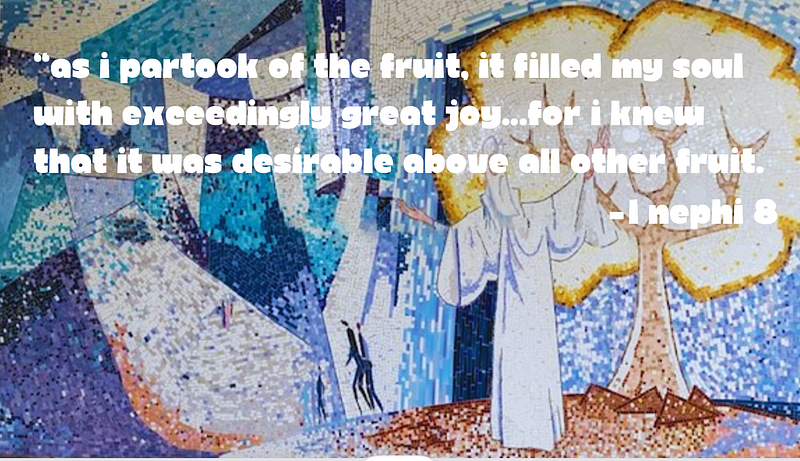
I’m in love with a vintage piece that I picked up at a Goodwill auction. It’s a rectangular gold pendant with a cutout silhouette of a mature tree — either an oak or a sycamore — suspended on a 14K chain. Both oaks and sycamores enjoy frequent reference in the Bible, along with olive trees and the magnificent cedars of Lebanon.
For devotees of the Goddess and Divine Feminine, we have the sacred tree of Asherah.
Israel’s association of Asherah with sacred trees is repeated over thirty times in the Bible…contemporary discoveries have further indicated that, at least in the opinion of some ancient Israelites, YHWH and Asherah were appropriately worshipped as a pair. Susan Ackerman, Asherah
Pretty cool, huh? More wow follows.
It turns out that the Tree of Life is a powerful symbol, far beyond the followers of Judaism, Christianity, and Islam. The tree of life concept appears to be older than the book of Genesis, coming as it does out of the ancient Mesopotamian worldview.
Common features of various myths include supernatural guardians protecting the tree and its fruits that grant those who eat them immortality. It is typically planted at the centre of the world, often within a sacred garden or forest. Stephen Eldridge, Encyclopaedia Britannica
The World Tree / Tree of Life appears in the religions of the Ancient Norse, Egyptians, Greeks, and Assyrians, Chinese Taoists and Altai Shamans. As part of the larger Sacred Tree tradition, it links to just about every religion on the planet.
Love and reverence for trees is something most of us humans can agree upon. I like that.
The tree brings us in a circle back to all the other symbols we have discussed — the seed, the nut, the bird, as well as Emerson’s transcendent walks through the deep woods of New England.
Other images — please share your own!
I’m considering the pearl made famous in the Gospel of Matthew, the owl representing Wisdom (Sophia - Σοφία) and the egg, which Marilyn Flower talks about in her article, What’s With Mary Magdalene and the Eggs? Beyond these, however, await an almost infinite number of options.
Readers, please share your own favorite symbols. I’d love to know what is meaningful to you!
This search for personalized symbols to represent our own spiritual path is both fun and richly illuminating. It’s an internal journey, yet promises an external reward. Rather than scaring people off, wearing these new symbols can invite people into relationship.
It’s a natural conversation starter when someone says, “Hey, I like your necklace!”
Further reading:
Lisa Isherwood’s article Asherah, the Tree of Life and the Menorah : Continuity of a Goddess symbol in Judaism? is the reference for so many other scholars and writers. It’s well worth a read-in-full.
Here are some of the books I used in putting together this article:
- Ralph Waldo Emerson, The Spiritual Emerson: Essential Works by Ralph Waldo Emerson
- Julian of Norwich, Revelations of Divine Love
- Frank Moore Cross, Jr., Canaanite Myth and Hebrew Epic: Essays in the History of the Religion of Israel
Let’s keep in touch!
Click for more Religion and Spirituality stories, or just hit “Follow.” Thanks!