
Free Speech Under Threat From Cancel Culture
That’s what privileged white writers would have you believe
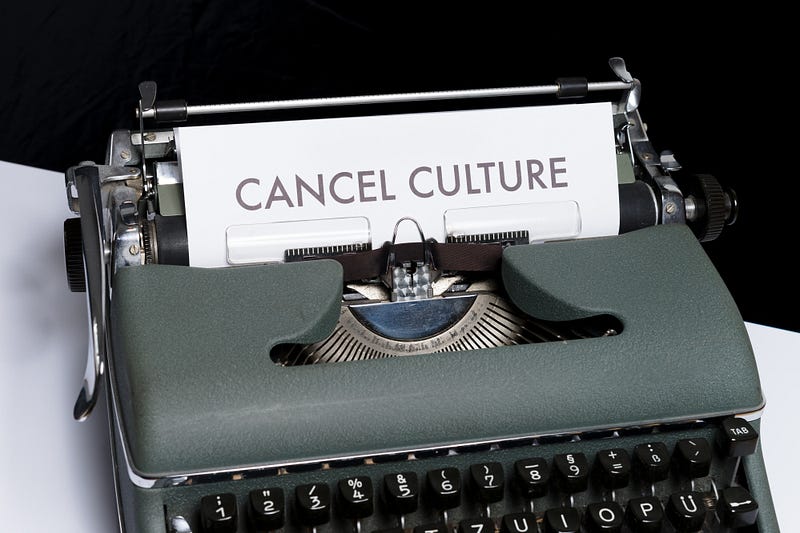
So began Jennifer Finney Boylan’s defense. A letter signed by some well known authors demanding an end to ‘cancel culture’. Poor Jen was horrified to discover it was nothing more than a vague message that completely missed the mark.
You would have thought that the world’s top writers were more than capable of writing a letter or two. Turns out, ‘cancel culture’ is hard to define.
What is ‘cancel culture’ ?
“The act of canceling, also referred to as cancel culture (a variant on the term “callout culture”) describes a form of boycott in which an individual (usually a celebrity) who has acted or spoken in a questionable or controversial manner is boycotted.” Source — Wikipedia
That seems pretty straight-forward. Online shaming to the point where the shamed can no longer be employed thanks to bullying. Of course, if that person had actually done something shameful, then possibly they deserved what they get. Judge, jury and executioner online. The masses have spoken. The condemned move offline to a corner somewhere to sob.
Bullying is bad. We can all agree on that. Being held countable to the sins of your past no matter how long ago, is a little more questionable. Mark Wahlberg was recently ‘outed’ again for his beating up random strangers. Mark served time. All parties moved on with their lives. Yet, the story never quite goes away. The headline screams atrocity and the audience is outraged. ‘Boycott’ the braying masses cry out. Cancel Mark.
The signatures
JK Rowling, Salman Rushdie and Margaret Atwood are among the signatories to the controversial open letter warning that the spread of “censoriousness” is leading to “an intolerance of opposing views” and “a vogue for public shaming and ostracism”.
JK is currently fighting publicly with the Trans community. Harry Potter has distanced himself from her views. The Grand Wizard doesn’t do battles against the perceived wisdom of a mob.
She said she was “proud to sign this letter in defence of a foundational principle of a liberal society: open debate and freedom of thought and speech”.
Open debate and tolerance are at stake. Noam Chomsky, Martin Amis and Malcolm Gladwell are among the signatures. None of them like being questioned. It all feels rather personal for the older generation. They’ve confused a lack of reverence from people who are able to air their views for the very first time, with an attack on their right to free speech.
It’s probably the first time they’ve been exposed to an audience that has finally found its voice. The letter is brimming with thin-skinned privilege, seeing it as a coded attack on marginalised minorities for having the gall to criticise people with power and platforms.
They have mistaken the new ways they can be told they are wrong or irrelevant as the baying of a mob.
Oh dear.
What does the letter say?
The letter states: “the tendency to dissolve complex policy issues in a blinding moral certainty”.
Yeah. No irony intended. ‘Cancel culture’ is a complex issue. It involves employers ending the career of racists. It raises interesting questions, but these are more about employment rights and the encroachment by bosses into areas of private opinion and conduct.
It’s complicated.
The letter criticises how “editors are fired for running controversial pieces; books are withdrawn for alleged inauthenticity; journalists are barred from writing on certain topics; professors are investigated for quoting works of literature in class; a researcher is fired for circulating a peer-reviewed academic study; and the heads of organisations are ousted for what are sometimes just clumsy mistakes”.
The letter, described by Anne Applebaum, who conceded on BBC Radio 4’s Today programme, that it consists of a series of statements that are, in themselves, quite “anodyne”.
“We need to preserve the possibility of good-faith disagreement without dire professional consequences,” the Harper’s letter concludes.
That’s a statement you can’t argue against. Disagreement shouldn’t lead to dire professional consequences. The problem with this statement is that it’s not always professional disagreement. Sometimes, it’s outright hostility. It’s a whack-a-mole of trolls spouting horrid views. Or it can be. It’s complicated. Have I already stated that? What counts as good faith and who decides? Is it this counsel of writers?
What if you’re David Starkey, the historian and broadcaster. A man widely respected in his field and you make a statement like this:
“Slavery was not genocide, otherwise there wouldn’t be so many damn blacks in Africa or in Britain would there? You know, an awful lot of them survived.”. Source — Guardian
Why shouldn’t we call for David to be sacked from any prominent position for such offensive racist views? By the same ridiculous, twisted logic, the Holocaust would not be counted as a genocide either. This man had already been dropped from a fundraising campaign in 2015 after complaints from staff and students that he was “aggressively racist”.
‘Cancel culture’ for the win. It’s complicated but sometimes very, very clear-cut.
The problem with abstract thought
What we do know is that there is no such thing as total tolerance: it cannot logically tolerate intolerance. And there is no such things as pure freedom of expression either: the expression of some views necessarily encroaches on the dignity and freedom of others.
Zoe Williams, Guardian writer had this to say about the open letter.
“We should think carefully before lining up behind an abstract, on either side — absolutes have a tendency to dissolve on contact with reality. And it’s in reality, of course, with its compromises and discomforts and competing demands, that we actually live.”
If ‘cancel culture’ is hard to define, a complex and tangled group-thought, then who are we to take a stand and make an absolute judgement? This heralded community of writers, fighting for freedom of speech and tolerance, have shown just how intolerant they actually are.
‘Cancel culture’ can risk abuse and overuse, but I find it impossible to totally disagree with a mob seeking to boycott harmful individuals. A mob to some is a protest group to others.
Long live freedom of speech. Including you JK.
Did I say it’s complicated?
Here’s a final word from the writers (again with no hint of irony):
“The way to defeat bad ideas is by exposure, argument, and persuasion, not by trying to silence or wish them away”.
Indeed.


