avatarC.S. Voll

Free AI web copilot to create summaries, insights and extended knowledge, download it at here

4176

Abstract

omain/zero/1.0/deed.en">CC0 1.0</a>).</figcaption></figure><p id="405d">This also signaled the start of a strenuous work day for those on the shore. Women and children would have to find bait, often muscles or, if they weren’t available, they would look for limpets on the coasts. This was essential work, so these gatherers were often on the exposed beaches during dire storms, too.</p><figure id="a0e4"><img src="https://cdn-images-1.readmedium.com/v2/resize:fit:800/1*PeCPHqhyB0lSckQ55bsQrw.jpeg"><figcaption>Limpet gatherers sit on a rock (1880s). By Francis Meadow Sutcliffe from <a href="https://commons.wikimedia.org/wiki/File:Limpet_gatherers.jpg">Wikimedia Commons</a> (Public Domain).</figcaption></figure><p id="f474">Certain beaches could supply enough bait. Some women thus walked over 15 miles to reach Robin Hood’s Bay, a region with a large population of limpets. They would spend the night in the village. The following day, they carried their heavy containers full of limpets all those miles to their homes.</p><figure id="936e"><img src="https://cdn-images-1.readmedium.com/v2/resize:fit:800/1*gDrvpnS5XfpKG_ZEQdBxBw.jpeg"><figcaption>Fisher folk of Robin Hood’s Bay (circa 1880). By Francis Meadow Sutcliffe from <a href="https://commons.wikimedia.org/wiki/File:Fisher_Folk_in_Robin_Hood%27s_Bay_,_1880.png">Wikimedia Commons</a> (Public Domain).</figcaption></figure><p id="6c57">At home, the women shucked the shellfish to get it ready to be used as bait. When the men returned, the women carried the nets into their houses in the coastal communities. The fishers went to sell the catch of the day while it was fresh. Meanwhile, the women cleaned the bait lines.</p><figure id="f1ed"><img src="https://cdn-images-1.readmedium.com/v2/resize:fit:800/1*BlD284OCBFS9U8TUHFGJbQ.jpeg"><figcaption>Beaching a boat, the Gratitude (circa 1890). By Frank Meadow Sutcliffe from <a href="https://commons.wikimedia.org/wiki/File:Frank_Meadow_Sutcliffe_-_Beaching_the_Gratitude_-_Google_Art_Project.jpg">Wikimedia Commons</a> (Public Domain).</figcaption></figure><p id="d1db">The men returned to eat dinner at their homes. During the evening, all the family members worked side by side while they cleaned and baited the fishing lines. Everyone gets a little shut eye before the cycle begins anew.</p><h1 id="280c">Thoughts that feed a fire</h1><p id="e23e">Frank Sutcliffe developed an interesting philosophy during his travels as a photographer. His first employer, Francis Frith, instructed him to remove all humans from the scenes. Frith’s business was to create images that resemble tourist mementoes, after all.</p><figure id="e5c1"><img src="https://cdn-images-1.readmedium.com/v2/resize:fit:800/1*aOinmtXJxw-UpAu8hLWovQ.jpeg"><figcaption>Fisherfolk (1889). By Francis Meadow Sutcliffe from <a href="https://commons.wikimedia.org/wiki/File:Sutcliff35.jpg">Wikimedia Commons</a> (Public Domain).</figcaption></figure><p id="840b">A different way of thinking would permeate Sutcliffe’s work, though. He wanted to include the residents of the places in his shots. In his photos, they were as much a part of the landscape as the castles and lanes.</p><figure id="8bf0"><img src="https://cdn-images-1.readmedium.com/v2/resize:fit:800/1*18njccZRRbwbytpClcPxAA.jpeg"><figcaption>Whitby fishermen (circa 1885). By Francis Meadow Sutcliffe from <a href="https://commons.wikimedia.org/wiki/File:Frank_Meadow_Sutcliffe,_Whitby_Fishermen,_c._1885,_NGA_108746.jpg">Wikimedia Commons</a> (<a href="https://creativecommons.org/publicdomain/zero/1.0/deed.en">CC0 1.0</a>).</figcaption></figure><p id="c3b4">Also, he wanted to capture the ways of life before they disappeared, because the world had already changed a lot during the Victorian era. He wasn’t only a documentarian, though. He <a href="https://archive.org/details/the-amateur-photographer-46">wrote about</a> the importance of imagination in The Amateur Photographer in 1907:</p><blockquote id="70ea"><p>But what has imagination to do with photography? More than appears on the surface…One might even go so far as to say that the best photographs are done by the men whose knowledge of the works of painters and eng

Options

ravers is the greatest. These men are, as it were, saturated with pictures, and when they make photographs some of this solution becomes crystallised.</p></blockquote><p id="346c">Some lessons of framing, lighting, and metaphorical meaning are features of photography and painting. Sutcliffe knew what to incorporate from his father’s profession to communicate with a viewer. His imagination also allowed him to create alternative approaches.</p><figure id="0fd1"><img src="https://cdn-images-1.readmedium.com/v2/resize:fit:800/1*B3hHIj-2ltge3CFqsaUUZg.jpeg"><figcaption>Houses along the coast in Robin Hood’s Bay (circa 1890). By Frank Meadow Sutcliffe from <a href="https://www.getty.edu/art/collection/object/1045YQ">J. Paul Getty Museum</a> (<a href="https://creativecommons.org/publicdomain/zero/1.0/">CC0 1.0</a>).</figcaption></figure><p id="9110">Frank Sutcliffe’s influence on the artistic growth of early photography was great. His stature led him to be a founding member of The Linked Ring, a British group that <a href="https://readframes.com/look-closer-the-genius-of-whitby-frank-meadow-sutcliffe-by-rob-wilson/">encouraged</a> the exchange of knowledge between photographers across the world. His involvement in the growth of the art form continued for many decades. He <a href="https://amateurphotographer.com/iconic-images/frank-meadow-sutcliffe-1853-1941-iconic-photographer/">died</a> in 1941, aged 87, after many sights had changed, as he had prophesied.</p><figure id="0a70"><img src="https://cdn-images-1.readmedium.com/v2/resize:fit:800/1*7ctsFhbxb-kowBZIi5LHsg.jpeg"><figcaption>A Whitby lifeboatman wears a cork lifejacket (circa 1890). By Francis Meadow Sutcliffe from <a href="https://commons.wikimedia.org/wiki/File:Sutcliffe12.jpg">Wikimedia Commons</a> (Public Domain).</figcaption></figure><p id="41db">The magic of Sutcliffe’s work is that he balanced the whimsy of a pastoral painter with the hard eyes of a documentarian. Unlike some contemporaries, he didn’t create idealized pictures, but rather sought to see the splendor in a harsh reality. His images whisper of the beauty in the tenacity of the human spirit in the face of challenges.</p><p id="a8ad"><b>Sources:</b></p><p id="244c">Amateur Photographer. “Frank Meadow Sutcliffe (1853–1941) — Iconic Photographer” in <a href="https://amateurphotographer.com/iconic-images/frank-meadow-sutcliffe-1853-1941-iconic-photographer/">Amateur Photographer</a>.</p><p id="7424">Barton, P.E. 2008. Sutcliffe, Frank Meadow. In Hannavy, J. (ed.). <i>Encyclopedia of Nineteenth-Century Photography</i>. 1363–1364. New York: Routledge.</p><p id="6681">Butchart, A. “The History of Jet Jewellery in England” in <a href="https://www.english-heritage.org.uk/visit/inspire-me/history-of-jet-jewellery/">English Heritage</a>.</p><p id="618b">Frank, P. 1976. Women’s Work in the Yorkshire Inshore Fishing Industry. <i>Oral History</i> Vol. 4, №1. 57–72</p><p id="4b64">Frank, P. 1976. History and Photographs: Frank Meadow Sutcliffe (1853–1941). <i>History Workshop</i> №2. 93–95.</p><p id="940d">J. Paul Getty Museum. 2024. “Frank Meadow Sutcliffe” in <a href="https://www.getty.edu/art/collection/person/103KH8">J. Paul Getty Museum</a>.</p><p id="20a1">Lindquist-Cock, E. 1978. Sentiment, Compassion, Straight Record: The Mid-Victorians. <i>The Massachusetts Review </i>Vol. 19, №4.717–728</p><p id="1401">Ryan, J.R. 2017. Placing Early Photography: The Work of Robert Hunt in Mid-Nineteenth-Century Britain. <i>History of Photography</i> Vol. 41, Issue 4.</p><p id="24d3">Sutcliffe, F.M. 1907. “The Whole Art of Photography” in The Amateur Photographer 9 April 1907.</p><p id="f9ee">Sutcliffe, F.M. 1907. “On Imagination” in The Amateur Photographer 20 August 1907.</p><p id="4ddf">Sutcliffe, F.M. 1907. “Holiday Work” in The Amateur Photographer 27 August 1907.</p><p id="dd83">Sutcliffe, F.M. 1907. “A Dealer in Postcards” in The Amateur Photographer 1 October 1907.</p><p id="c619">Wilson, R. 2022. “Look Closer: The Genius of Whitby — Frank Meadow Sutcliffe” in <a href="https://readframes.com/look-closer-the-genius-of-whitby-frank-meadow-sutcliffe-by-rob-wilson/">FRAMES</a>.</p></article></body>

Frank Meadow Sutcliffe Immortalized the Fisherfolk of North Yorkshire

He sought to reframe scenes with his artistic eye
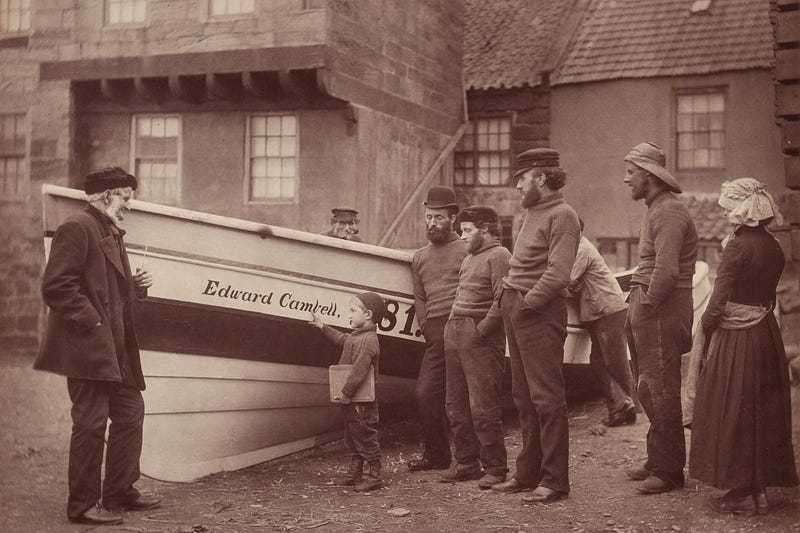
A scene in Whitby, England (1890s). By Francis Meadow Sutcliffe from Wikimedia Commons (Public Domain).

Photography still found its feet in the first decades after its invention in the first half of the 19th century. Because it created images, many pioneers looked to an established art form, painting, for ways to approach the art. As a result, they tended to photograph subjects in studios or controlled environments to recreate fashionable pastoral or mythical scenes. One young photographer rebelled against the popular conventions by taking his camera into the costal environment surrounding Whitby, England.

The divergence from a path

Thomas Sutcliffe, a noted English watercolor artist, pushed his son to become an artist. He did not believe that the new-fangled photography was a legitimate art form. In 1871, he died while he was only 43 years old.

A year later, young Frank pursued photography as a profession, despite the disdain some people held for it. He had experimented with it during his teenage years, but now he threw himself into the world. His first commission was to photograph nearby tourist sites for Francis Frith.

To grow his enterprise, he established a studio in Tunbridge Wells, nearer to the homes of the well-heeled clientele. This enterprise was a failure. Frank moved back to Whitby, where his father had established the family in 1870.
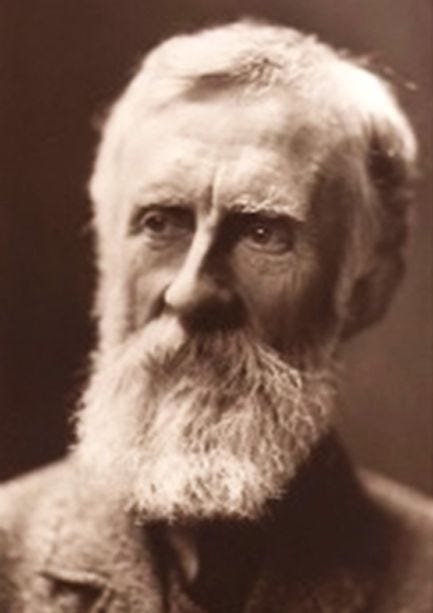
A photo of Francis Meadow Sutcliffe. From Wikimedia Commons (Public Domain).

The small studio in the seaside town did steady business. Still, Frank did not enjoy shooting the studio portraits that were his meat and potatoes. The places that sparked his creativity lay outside the boundaries of the four walls. To balance his work responsibilities, he wandered outside, where he photographed the routines of various people.

Push the boat out to sea

The town of Whitby had a history as a shipbuilding centre. During the 19th century, new transport links fostered tourism and the growth of a jet jewelery industry, which created jet for mourning wear. Perhaps its most famous appearance in fiction is in Bram Stoker’s Dracula. One common activity during the settlement’s existence was fishing.
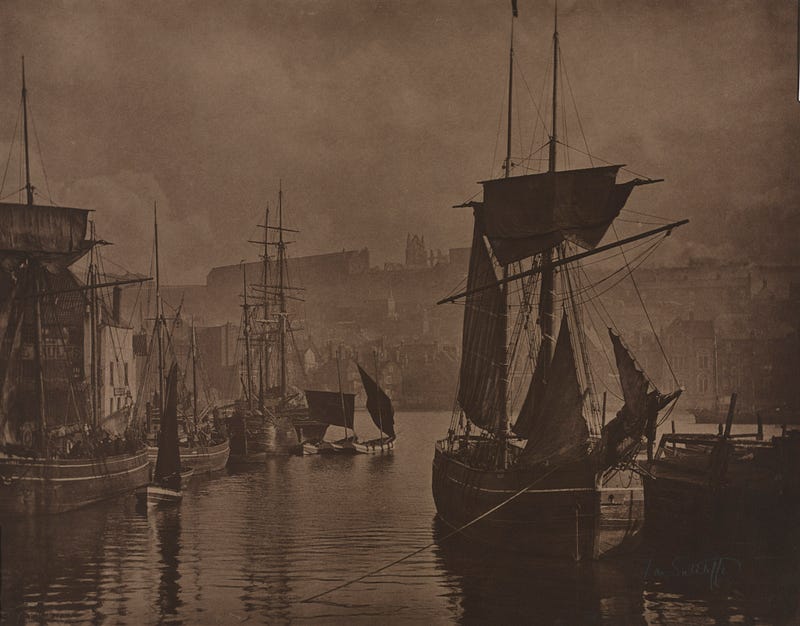
Whitby harbor (circa 1885). By Frank Meadow Sutcliffe from Wikimedia Commons (CC0 1.0).

Most fisherfolk woke up before dawn, then checked the weather outside. They would embark for the open ocean if the conditions weren’t too unfavorable. Of course, everything could turn on a dime — their lives were always at risk after they said their farewells to their families.
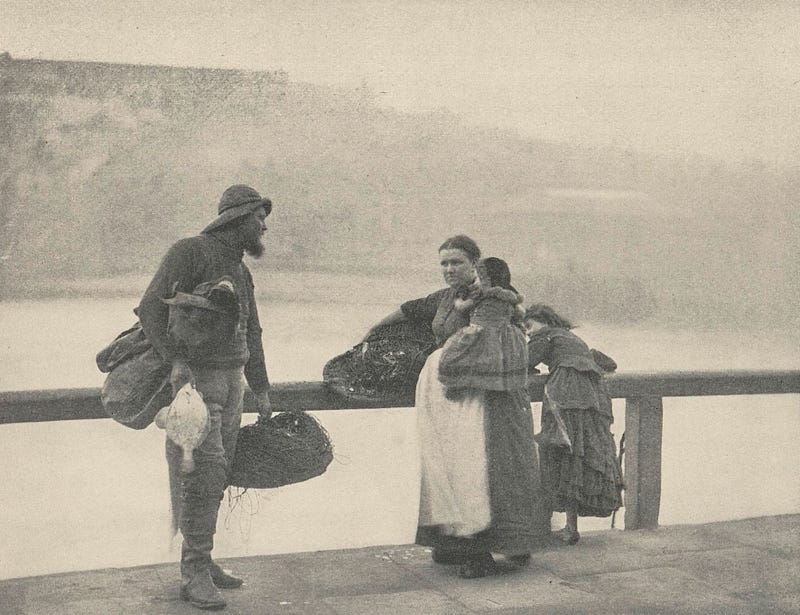
A fisherman, a woman, and two children (circa 1896). Edited by the author. By Frank Meadow Sutcliffe from Wikimedia Commons (CC0 1.0).

This also signaled the start of a strenuous work day for those on the shore. Women and children would have to find bait, often muscles or, if they weren’t available, they would look for limpets on the coasts. This was essential work, so these gatherers were often on the exposed beaches during dire storms, too.
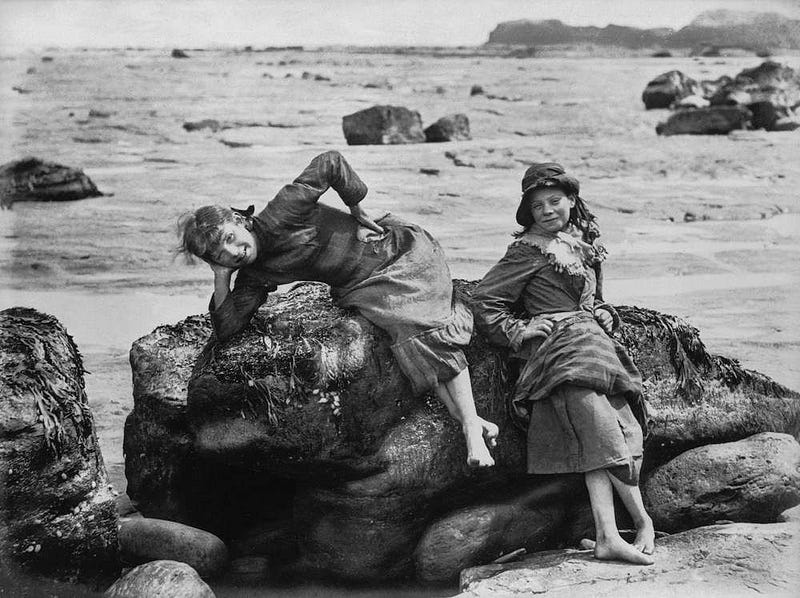
Limpet gatherers sit on a rock (1880s). By Francis Meadow Sutcliffe from Wikimedia Commons (Public Domain).

Certain beaches could supply enough bait. Some women thus walked over 15 miles to reach Robin Hood’s Bay, a region with a large population of limpets. They would spend the night in the village. The following day, they carried their heavy containers full of limpets all those miles to their homes.
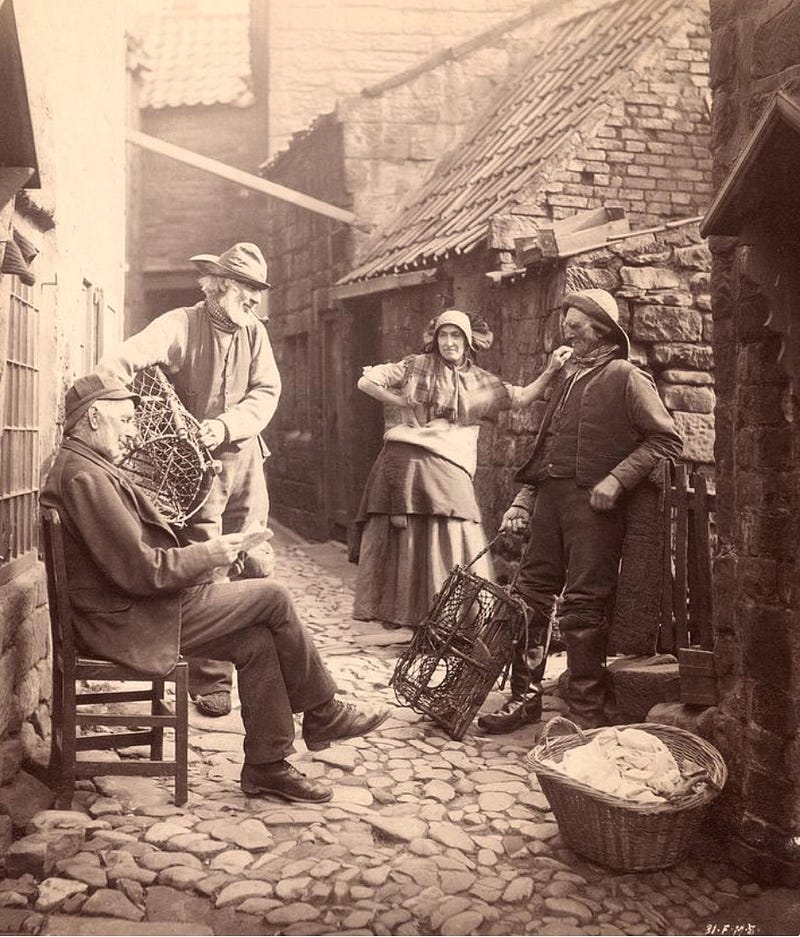
Fisher folk of Robin Hood’s Bay (circa 1880). By Francis Meadow Sutcliffe from Wikimedia Commons (Public Domain).

At home, the women shucked the shellfish to get it ready to be used as bait. When the men returned, the women carried the nets into their houses in the coastal communities. The fishers went to sell the catch of the day while it was fresh. Meanwhile, the women cleaned the bait lines.
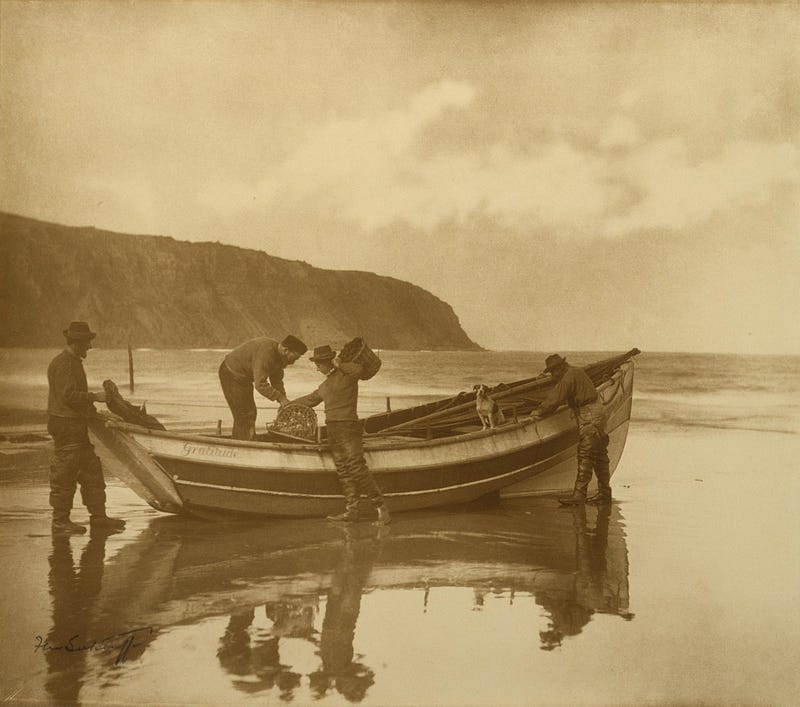
Beaching a boat, the Gratitude (circa 1890). By Frank Meadow Sutcliffe from Wikimedia Commons (Public Domain).

The men returned to eat dinner at their homes. During the evening, all the family members worked side by side while they cleaned and baited the fishing lines. Everyone gets a little shut eye before the cycle begins anew.

Thoughts that feed a fire

Frank Sutcliffe developed an interesting philosophy during his travels as a photographer. His first employer, Francis Frith, instructed him to remove all humans from the scenes. Frith’s business was to create images that resemble tourist mementoes, after all.
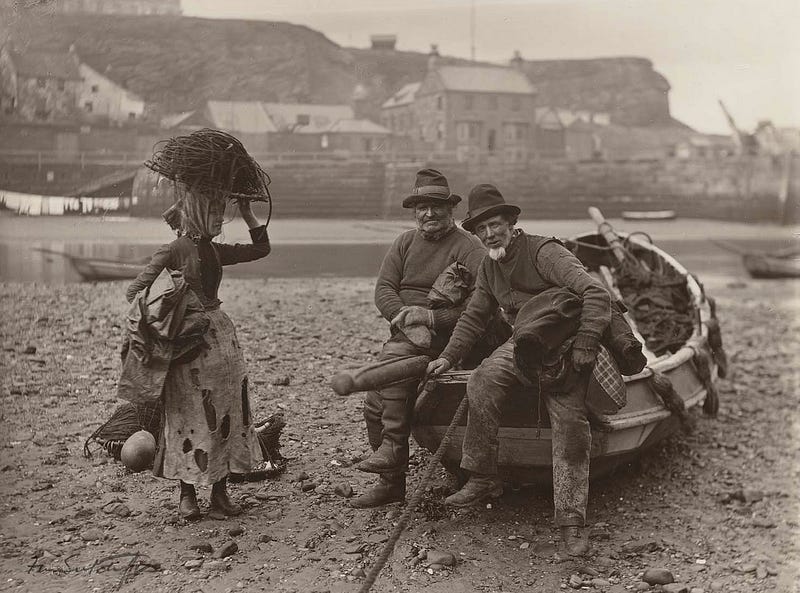
Fisherfolk (1889). By Francis Meadow Sutcliffe from Wikimedia Commons (Public Domain).

A different way of thinking would permeate Sutcliffe’s work, though. He wanted to include the residents of the places in his shots. In his photos, they were as much a part of the landscape as the castles and lanes.
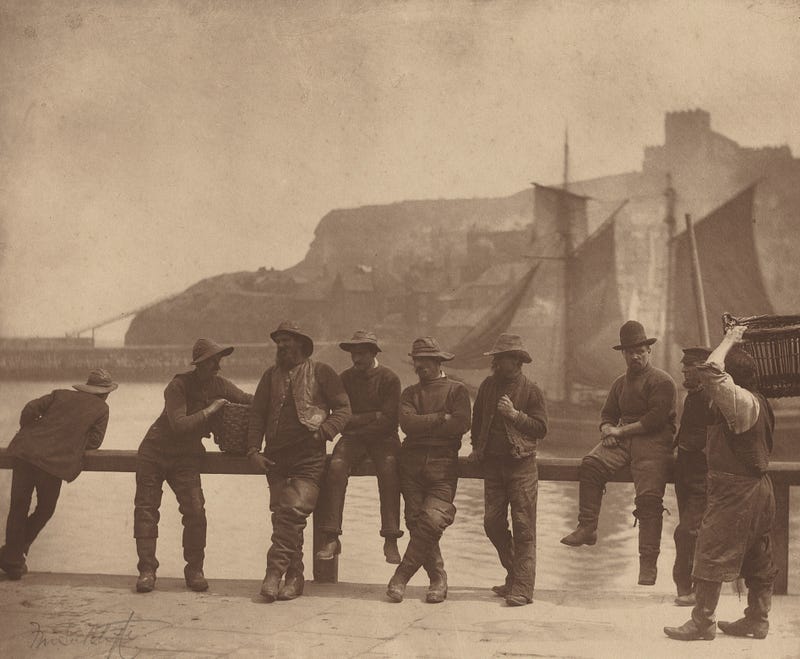
Whitby fishermen (circa 1885). By Francis Meadow Sutcliffe from Wikimedia Commons (CC0 1.0).

Also, he wanted to capture the ways of life before they disappeared, because the world had already changed a lot during the Victorian era. He wasn’t only a documentarian, though. He wrote about the importance of imagination in The Amateur Photographer in 1907:

But what has imagination to do with photography? More than appears on the surface…One might even go so far as to say that the best photographs are done by the men whose knowledge of the works of painters and engravers is the greatest. These men are, as it were, saturated with pictures, and when they make photographs some of this solution becomes crystallised.

Some lessons of framing, lighting, and metaphorical meaning are features of photography and painting. Sutcliffe knew what to incorporate from his father’s profession to communicate with a viewer. His imagination also allowed him to create alternative approaches.
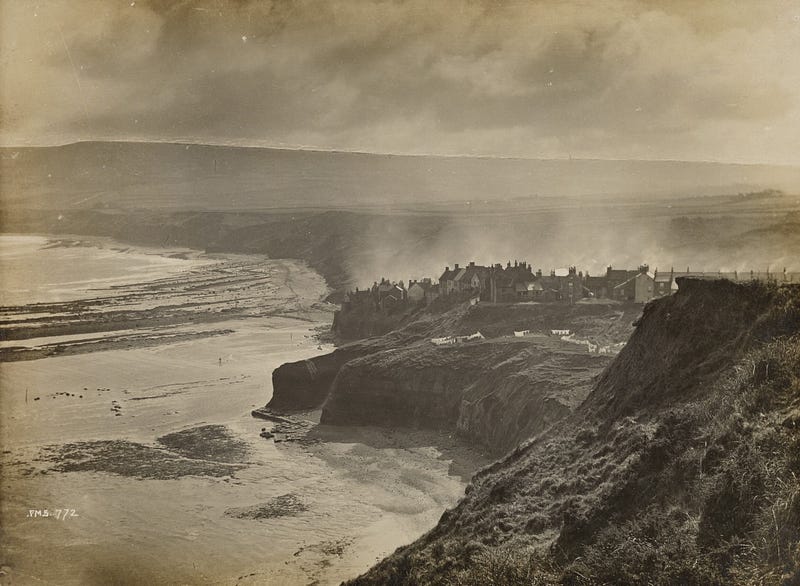
Houses along the coast in Robin Hood’s Bay (circa 1890). By Frank Meadow Sutcliffe from J. Paul Getty Museum (CC0 1.0).

Frank Sutcliffe’s influence on the artistic growth of early photography was great. His stature led him to be a founding member of The Linked Ring, a British group that encouraged the exchange of knowledge between photographers across the world. His involvement in the growth of the art form continued for many decades. He died in 1941, aged 87, after many sights had changed, as he had prophesied.
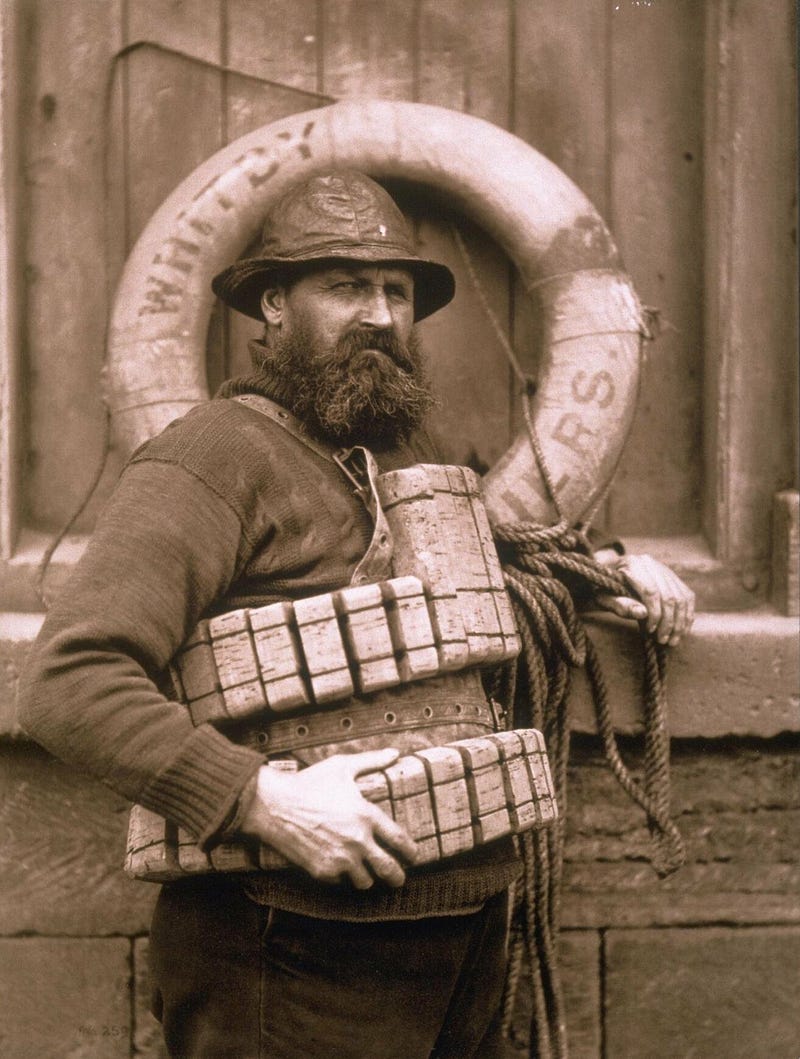
A Whitby lifeboatman wears a cork lifejacket (circa 1890). By Francis Meadow Sutcliffe from Wikimedia Commons (Public Domain).

The magic of Sutcliffe’s work is that he balanced the whimsy of a pastoral painter with the hard eyes of a documentarian. Unlike some contemporaries, he didn’t create idealized pictures, but rather sought to see the splendor in a harsh reality. His images whisper of the beauty in the tenacity of the human spirit in the face of challenges.

Sources:

Amateur Photographer. “Frank Meadow Sutcliffe (1853–1941) — Iconic Photographer” in Amateur Photographer.

Barton, P.E. 2008. Sutcliffe, Frank Meadow. In Hannavy, J. (ed.). Encyclopedia of Nineteenth-Century Photography. 1363–1364. New York: Routledge.

Butchart, A. “The History of Jet Jewellery in England” in English Heritage.

Frank, P. 1976. Women’s Work in the Yorkshire Inshore Fishing Industry. Oral History Vol. 4, №1. 57–72

Frank, P. 1976. History and Photographs: Frank Meadow Sutcliffe (1853–1941). History Workshop №2. 93–95.

J. Paul Getty Museum. 2024. “Frank Meadow Sutcliffe” in J. Paul Getty Museum.

Lindquist-Cock, E. 1978. Sentiment, Compassion, Straight Record: The Mid-Victorians. The Massachusetts Review Vol. 19, №4.717–728

Ryan, J.R. 2017. Placing Early Photography: The Work of Robert Hunt in Mid-Nineteenth-Century Britain. History of Photography Vol. 41, Issue 4.

Sutcliffe, F.M. 1907. “The Whole Art of Photography” in The Amateur Photographer 9 April 1907.

Sutcliffe, F.M. 1907. “On Imagination” in The Amateur Photographer 20 August 1907.

Sutcliffe, F.M. 1907. “Holiday Work” in The Amateur Photographer 27 August 1907.

Sutcliffe, F.M. 1907. “A Dealer in Postcards” in The Amateur Photographer 1 October 1907.

Wilson, R. 2022. “Look Closer: The Genius of Whitby — Frank Meadow Sutcliffe” in FRAMES.

Photography
History
England
Fishing
Full Frame
Recommended from ReadMedium