

France’s Lucrative Pensions Are Finally Being Cut
You’ll be shocked to hear that the French aren’t happy.
Last week, over a million people took to the streets of France. To be fair, it doesn’t take much to get the French public agitated, and this situation is a good example of that.
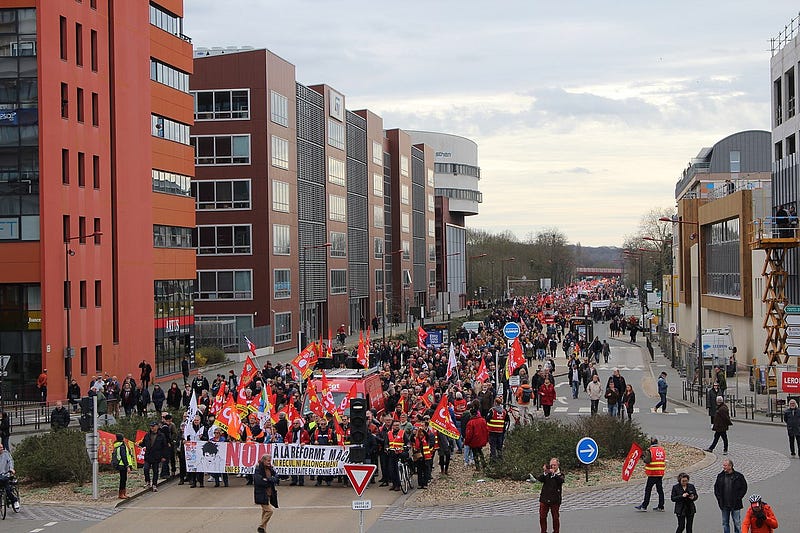
President Emmanuel Macron has decided to raise the qualifying age for state pensions to 64. The current age, 62, is the lowest of all major European economies, and even Macron’s planned new age is still younger than the retirement age nearly anywhere else in Europe.
The decision, to put it mildly, is an unpopular one, to the extent that Macron didn’t even bother holding a vote on the reforms in parliament. Instead, he used special executive powers granted by the constitution to ram the bill through.

That’s a political risk, since the same article that grants those executive privileges also gives parliament the right to hold votes of no-confidence if Macron uses them — and it wasn’t long before a centre-left coalition and the far-right Front National announced that they would indeed hold such votes.
It’s not clear if Macron will survive them.
The last round of legislative elections wiped away his parliamentary majority, and the most recent opinion polling suggests that 66% of the public disapproves of him. It would be fair to say that Macron won re-election not because he was popular, but because voters united behind him only to keep far-right nationalist Marine Le Pen from winning the top job.
But this is not a fight Macron is going to back down from in his second and final term in office.
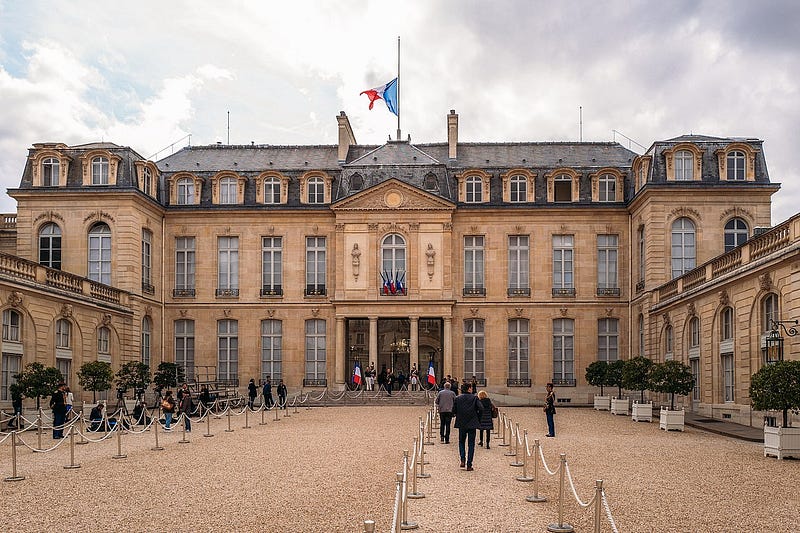
Although he began his political career as a member of the Socialist Party, Macron is perhaps best described as a pro-business technocrat. His first professional background was as a financial auditor for the French government; he later became an investment banker at Rothschild and Co.
Macron has been mocked as “the president of the mega-rich” and has devoted much of his political capital to carrying out major economic liberalisation reforms. Pensions have been on his chopping block for years; he’s had to back down in the past, but remains insistent that the pensions have to be trimmed back.
The facts suggest that he’s on to something. France’s pensions make up almost 14% of its GDP, which is the 3rd highest in the OECD after Italy and Greece (by comparison, the figure is 7% in Sweden and 4% in Australia). France’s pension system also scores very low on rankings of sustainability; it’s basically a ticking bomb.
One counterargument is that France has a relatively healthy population pyramid, thanks to Europe’s highest birth rate and one of its highest shares of migration.

Yet fertility is declining in France, while increases in life expectancy are also leading to an older population. There are now only 1.7 workers for every pensioner in France, compared to 2.1 at the turn of the millennium.
Another bone of contention is that in the French system, people who want to retire at 62 need to have an almost continuous work history to make the required number of payments (otherwise, full pensions become available at age 67).
In Germany, you only need to have paid in for 30 years, which means workers have more space for a career break, travel, further training and so on. The French system’s lack of similar flexibility especially punishes mothers that take career breaks to raise children.

In the end, however, Macron isn’t going to quit this battle over such details. He’s decided to stake his career on raising the pension age. Previous presidents have had to grapple with similar pension reforms, and raising the age has always been unpopular — but the age has been raised before.
In 2010, Nicolas Sarkozy weathered a storm of disapproval to raise the age from 60 to 62. It’ll probably be raised several times more in my lifetime.
If the votes of no-confidence fail, he’ll still have to overcome the unions. So far, the protests have been a little muted, although hundreds have been arrested and the odd petrol bomb has been thrown. The most noticeable feature of the current resistance is the trash which is piling up on city streets as sanitation workers strike — 10,000 tonnes have been left on the streets of Paris.

But the unrest could definitely increase in the coming weeks. We’ll just have to wait and see.