avatarNour Alhakk

Summary

The article discusses France's historical and recent actions that have been perceived as antagonistic towards Islam, questioning the sincerity of its commitment to "freedom of expression."

Abstract

The article presents a historical perspective on France's relationship with Islam, highlighting specific incidents where French figures and policies have targeted Islamic sites and figures, such as the Prophet Muhammad. It details the French Crusader prince Raynald of Châtillon's attacks on Mecca and Medina, the conversion of mosques into churches during the French occupation of Algeria, and the massacre of Algerian civilians. The article contrasts these historical events with the French government's support for the publication of controversial cartoons depicting the Prophet Muhammad by Charlie Hebdo, which were justified under the banner of "freedom of expression." However, the article points out a recent incident where France reacted with anger to a satirical cartoon published by the Russian embassy, leading to the withdrawal of the cartoon and a statement from President Emmanuel Macron condemning it. This contradiction is used to argue that France's commitment to freedom of expression is selective and hypocritical.

Opinions

  • The article suggests that France has a history of hostility towards Islam and the Prophet Muhammad, citing actions by historical figures like Raynald of Châtillon and policies during the French occupation of Algeria.
  • It criticizes the French government for its selective application of "freedom of expression," particularly in the context of the Charlie Hebdo cartoons depicting the Prophet Muhammad.
  • The article implies that the French government's outrage over the Russian embassy's cartoon, which led to its withdrawal, contradicts its previous endorsement of cartoons that offended Muslims.
  • The author questions the authenticity of France's belief in freedom of expression, suggesting that it is used as a pretext for actions that are perceived as disrespectful to Islam.
  • The article draws a parallel between the number of civilian casualties in historical conflicts involving the Prophet Muhammad and the actions of the French in Algeria, suggesting that France's historical actions resulted in a higher proportion of non-combatant deaths.

France Is Angry at “Freedom Of Speech!”

More French hypocrisy on cartoons

Photo by Ashkan Forouzani on Unsplash

Throughout its history, France has always been vocal about its enmity with Islam and the Prophet Muhammad (PBUH) in particular.

The French Raynald of Châtillon was the first Crusader prince to attack Mecca, where the Prophet Muhammed was born, and Medina, where his mosque and tomb are. He vowed to exhume his grave.

The policy of turning mosques into churches set the French occupation apart from other colonial countries. Algerian historical accounts show that the French ruler of Algeria in 1832, Duke de Rovigo, decided to storm the 300-year old Ketchaoua mosque and turn it into a church.
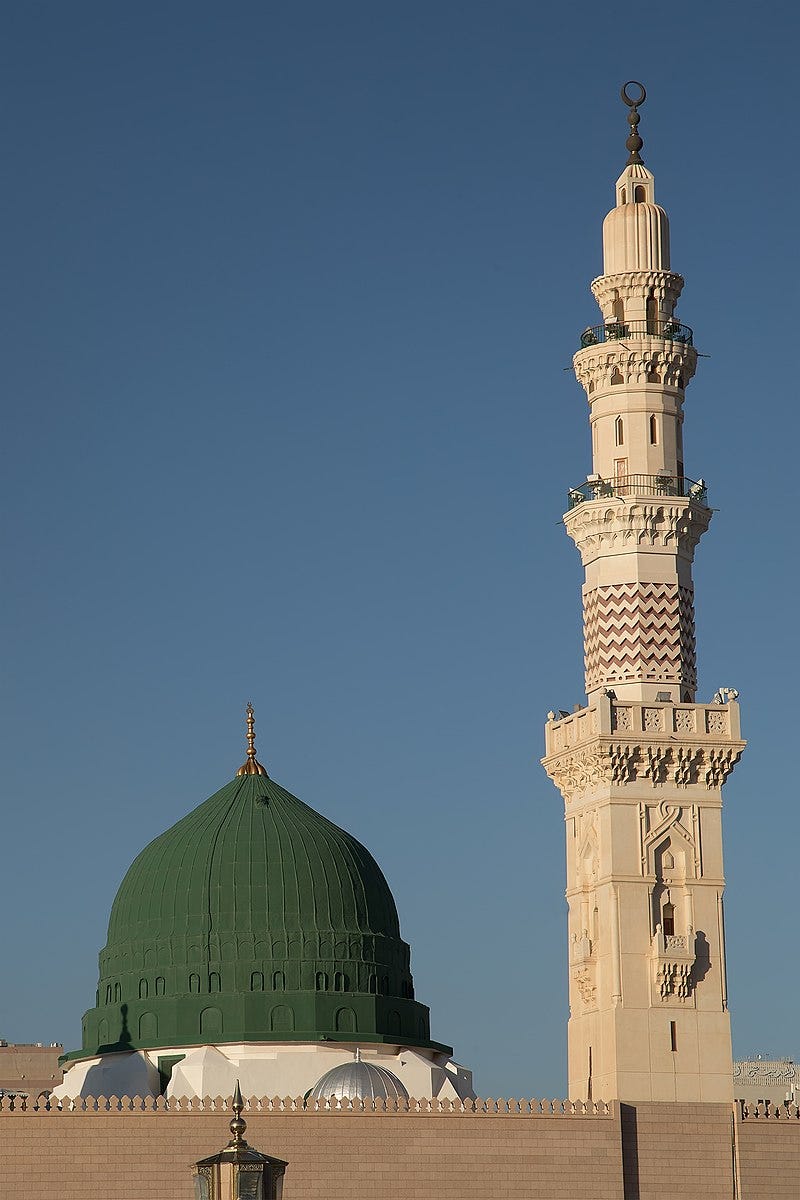
The French Raynald of Châtillon vowed to destroy Medina and Prophet’s Muhammad grave, which is the site under the green dome (Source: Wikipedia)

Four thousand Algerians staged a sit-in inside the mosque in an effort to stop it from being converted into a church. The French forces demolished the mosque, massacred all those inside, and burned copies of the Quran.

Four thousand civilians were killed in one day. Compare that to 1,284 lives that died in ten years during the Prophet Muhammad’s wars. The percentage of dead non-combatants in his wars relative to the number of combatants who participated in them was only 1.5 percent.

This simple mathematical comparison is difficult for Charlie Hebdo’s yellow journalists to comprehend. In 2015, they drew the Prophet Muhammad as a terrorist, a naked man, and a gay!

France endorsed these cartoons that mocked the Prophet and displayed them on its governmental buildings, citing “freedom of expression.”

This time, after the Russian embassy published a satirical cartoon, France became infuriated and summoned the Russian ambassador, and the cartoon has since been withdrawn.

Speaking to reporters in Brussels, President Emmanuel Macron dismissed the cartoons as false propaganda.

It’s unacceptable. We believe in a respectful dialogue and will continue it and that means respect on all sides. It’s a mistake. It’s been corrected and I hope it won’t happen again. We demanded it.

Is there anyone on earth who still believes that those people really believe in “freedom of expression”?

Ukraine War
Cartoon
Free Speech
Prophet Muhammad
Politics
Recommended from ReadMedium