
‘Fragments of Horror’ — Junji Ito
Counter Arts Book Club — July (better late than never!)
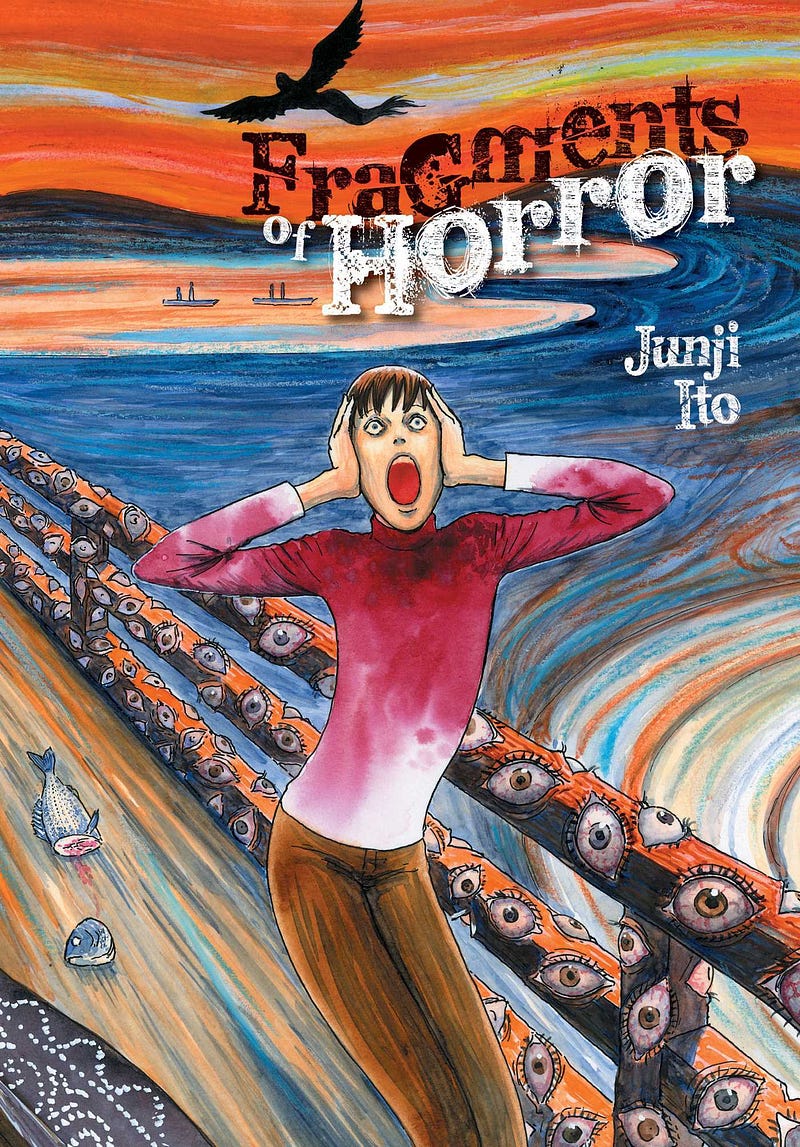
For the month of July, the Counter Arts Book Club (in the guise of Jess the Avocado) set us a collection of graphic short stories as our monthly read for review.
“A new collection of delightfully macabre tales from a master of horror manga. An old wooden mansion that turns on its inhabitants. A dissection class with a most unusual subject. A funeral where the dead are definitely not laid to rest. Ranging from the terrifying to the comedic, from the erotic to the loathsome, these stories showcase Junji Ito’s long-awaited return to the world of horror.” — https://www.goodreads.com/book/show/23705532-fragments-of-horror
This is a real departure for me, as I’ve never read comic book/manga/graphic novel formats — except for Neil Gaiman’s ‘Sandman’ series, which I love, but the story behind that exception is the subject of another essay (which may well be coming to this publication soon).
I also don’t normally have any real tolerance for ‘Horror’, in any medium. It’s a genre which simply doesn’t appeal to me — each to their own, I guess, but I’ve honestly never understood the appeal of watching/reading/looking at/listening to something which leaves me terrified. I have more of a stomach for gore (though I find it unnecessary), but psychological horror absolutely defeats me.
One occasional exception to this rule of mine is an older (Victorian) gothic story. Classics the like of ‘Dracula’ (Bram Stoker),’Frankenstein’ (Mary Shelley) or the novels of Ann Radcliffe:
The Gothic | The British Library (bl.uk)
So when I saw the Junji Ito work on our list as this month’s book, I was intrigued — especially given the extremely visual form concerned — and decided to give it a go.
Ultimately I was pleased that I had, as this style of work provides a very particular and intriguing feast for the eyes and imagination.
Junji Ito was born in 1963 in a semi-rural part of central Honshu, the main island of the Japanese archipelago. He began to read his sisters horror comics when young — works by veteran mangaka Shinichi Koga and Kazuo Umezu (author of ‘The Drifting Classroom’ 1970–74).
He later became a revered mangaka in his own right, producing graphic novels and collections of short stories; plus being mentioned as inspirational by creators of a game in which the images of horror are drawn in his black and white style:
“If recent games such as Polish developer Paweł Koźmiński’s Ito-inspired one-bit RPG, World Of Horror (2019), are anything to go by, Ito-esque horror has a compellingly grim future in interactive entertainment. Let’s be sure to keep a haunted channel open in anticipation.” — The Quietus | Features | Strange World Of… | The Strange World Of… Junji Ito
There were also rumours, though they have since been brought into doubt, that Junji Ito was going to be involved with the creative team on Hideo Kojima’s now cancelled ‘Silent Hills/(P.T.)’ project, alongside award winning film maker Guillermo del Toro.
He did take a part in Kojima’s post-apocalyptic, star-studded game ‘Death Stranding’ (2019).
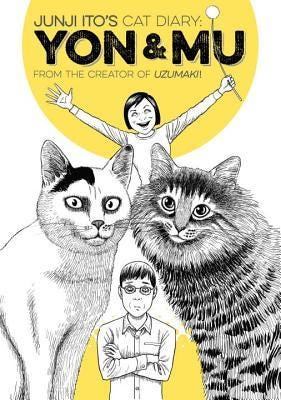
Along with producing masterworks of simple but visceral visual horror, everything I’ve read in researching his work for this piece also mentions Junji Ito’s love of cats.
The perfect example of this side of his personality would seem to be his ‘close to’ autobiographical work: ‘Junji Ito’s Cat Diary : Yon & Mu’ (2009) (pictured above).
In 2014, Ito returned tentatively to his horror story work, producing ‘Fragments of Horror’, after an absence from the genre of eight years.
“Fragments of Horror (魔まの断片かけら, Ma no Kakera) is a Japanese horror anthology manga series written and illustrated by Junji Ito. It was serialized in Nemuki between April 2013 and February 2014 as seven separate short stories, with an eighth being added for the tankōbon release. Viz Media published it in North America under its Viz Signature imprint. The Junji Ito Collection anime anthology, which premiered in January 2018, adapts several stories from Fragments of Horror.”
Fragments of Horror — Wikipedia
Contained in this collection are the following titles:
1.’Futon’ 2.’Wooden Spirit’ 3. ‘Tomio’ 4.’Gentle Goodbye’ 5. ‘Dissection Girl’ 6. ‘Blackbird’ 7.’Magami Nanakuse’ 8.’Whispering Woman’
As a whole, this work draws heavily upon the mundane, using the ordinary and every day as the sources of the horror portrayed. Junji Ito’s work seems to rooted in a folkloric and traditional Japanese culture, whilst also referring to contemporary society and simultaneously evoking the horrific potential of our imaginations. It’s really rather impressive. The fact that the drawings are all black and white and fairly simple only adds to the cleverness of this authors work.
“Inspired by the ghost stories of Edogawa Ranpo and the non-mythos tales of H.P. Lovecraft, Ito has wrangled ectoplasmic entities, maundering wraiths, and hostile revenants into countless shorts, one-shots, and novels that feel cursed by a maniacal energy. His clean yet obsessive line work uneasily echoes the demented nature of his many protagonists, while re-animating bodily materials such as hair, saliva, sweat, blood, and pus, as the semi-sentient avatars of heightened emotions.”
— The Quietus | Features | Strange World Of… | The Strange World Of… Junji Ito
Ito tends to stick to a tried and true selection of themes and images. Those he uses in the ‘Fragments of Horror’ collection are no exceptions. As mentioned in the quote above, some of these images do seem positively Lovecraftian.
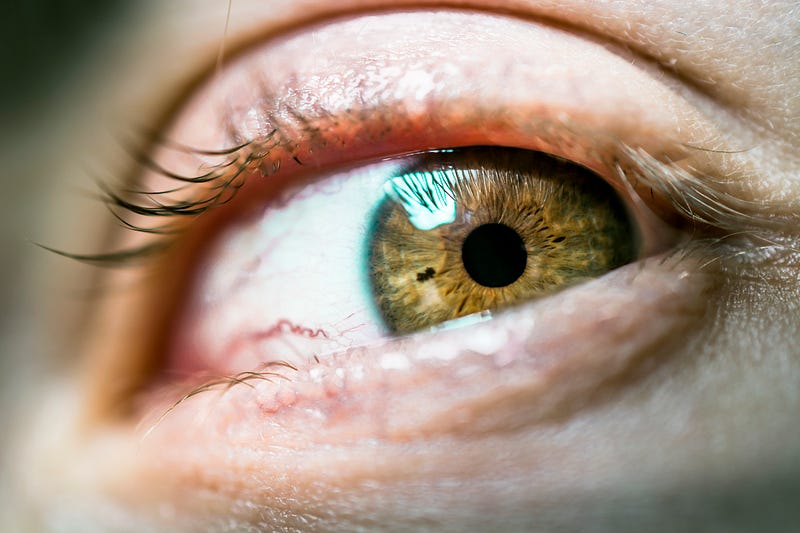
For example, much to my chagrin as they are probably the only part of anatomy over which I get at all squeamish (and for these, believe me, I get very squeamish), one very simple image which is used to great effect is Eyes.
At the very beginning of this essay you will have seen the front cover of ‘Fragments of Horror’.
For many people, myself included, the first thing that strikes us on viewing this image (which is actually a section of a larger one), is that it is somewhat reminiscent of ‘The Scream’:
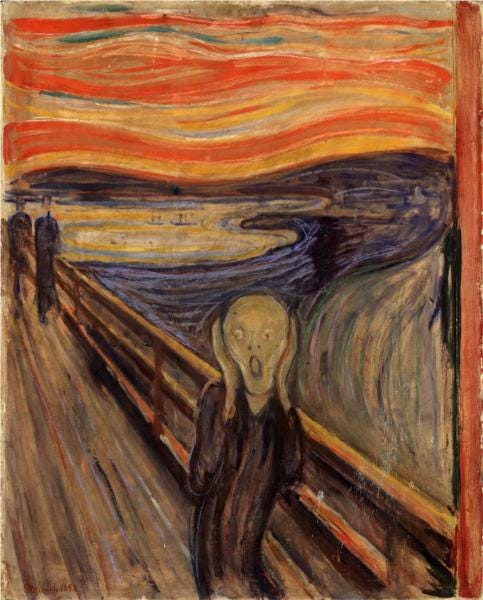
“The Scream is the popular name given to a composition created by Norwegian artist Edvard Munch in 1893. The agonized face in the painting has become one of the most iconic images of art, seen as symbolizing the anxiety of the human condition. Munch’s work, including The Scream, would go on to have a formative influence on the Expressionist movement.[1]
Munch recalled that he had been out for a walk at sunset when suddenly the setting sun’s light turned the clouds “a blood red”. He sensed an “infinite scream passing through nature” — The Scream — Wikipedia
All of the description above could also be applied to ‘Fragments of Horror’.
The second thing I noticed about the cover image was of course the eyes. There are eyes all along the wooden railings.
This use of eye imagery is most obviously continued in/a reference to the second story of this collection ‘Wooden Spirit’. In this story, a young woman who claims to be a student of architecture arrives at a house built in 1854 and recently designated of historical significance. She looks around, declares the house to be “sexy”, then asks the owner if she can live there as a lodger for a while so as to further study it. Cooking, washing and cleaning she soon ingratiates herself with the owner (a widower) — though his daughter is less sure.
In no time at all, the man is besotted and marries the young woman, but fairly quickly becomes unhappy and talks about the house feeling “weird”. His daughter sees her step-mother naked and rubbing her body all over the wooden floors and walls. She is barely taking any notice of her new husband now.
One night, the house begins to shake. The daughter hears what sounds like breathing and smells what seems to her to be something like halitosis. She finds her father downstairs, scrubbing at the floor and raving about graffiti. As she approaches him the girl sees eyes all over the floor. Then one blinks — and she realises that they also cover the beams and ceiling (wherever there is wood).
If you want to know how that tale ends, you’ll have to look for yourself, but this is a strikingly effective method of conveying that the wood this house is made of contains some form of consciousness. More than that though, if we look at the symbolic meanings of eyes in Japanese culture particularly, we come across the concept of ‘sanpaku’:
“…there’s a lot of superstition surrounding sanpaku eyes among the Japanese.
And having such eyes can have a negative impact on a person’s destiny. This is also thought to indicate a physical and mental imbalance in traditional Japanese medicine.”
- Sanpaku, a Different Face Reading Method | T Singapore Blog
In this way, the author is clearly utilising imagery to convey a sense not only of sentience, but also of malevolence and foreboding.
The house (place) itself therefore becomes a character in it’s own right, a second reoccurring image/theme often used in the work of Junji Ito.
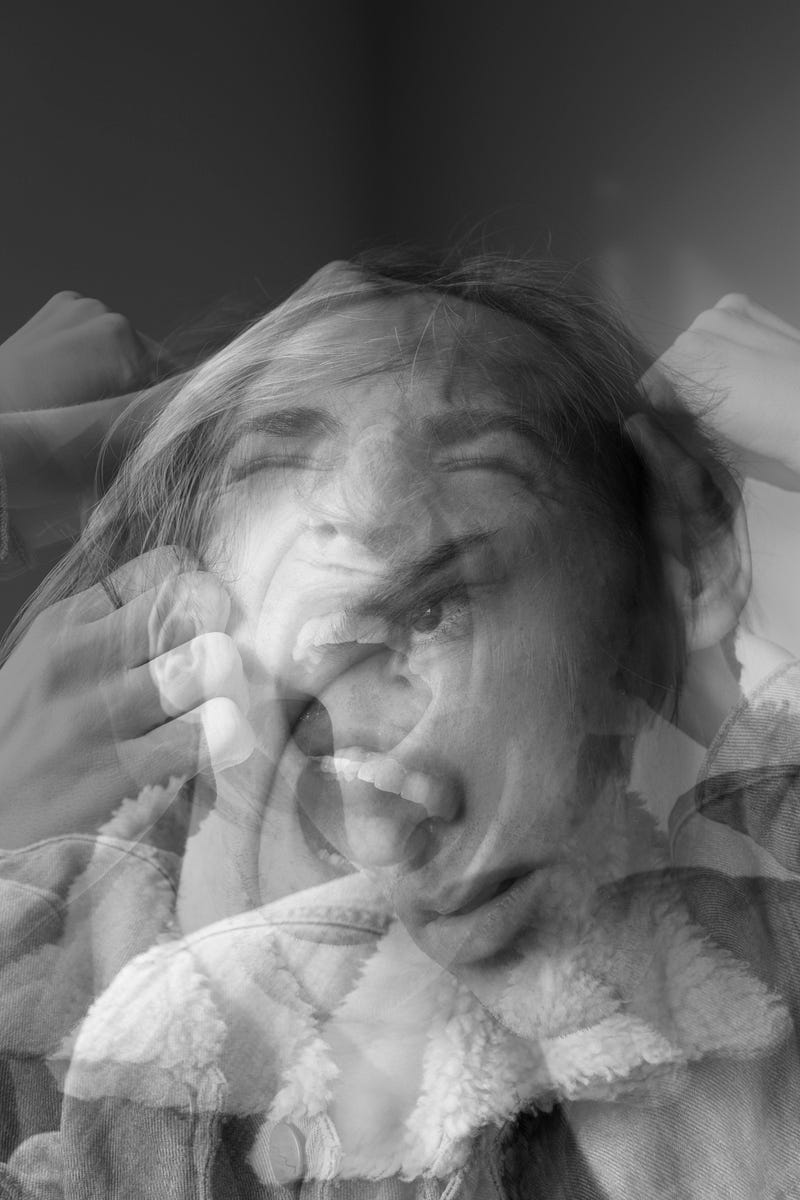
Recurring imagery we see throughout Ito’s work, which also appears in ‘Fragments of Horror’ includes:
- Characters who are driven mad and/or pushed to great (excessive) lengths by powerful emotions.
- Creatures or conscious objects with unexplained origins. (Here we see the Lovecraftian inspiration coming to the fore).
- Many plots involving trapped and/or immobilised people. (See for example the first story, ‘Futon’.)
- The danger to people and society of ‘mob mentality’.
- Characters who will do anything (anything) to avoid death.
- Unexplained transformations.
- Parents as the ‘bad guys’.
- Plots which tackle addiction.
- Locations which become characters themselves.
- The use of horror as an allegory — often with the purpose of criticising society or cultural norms.
(the list above is in part paraphrased from a section of this article: 10 Recurring Tropes in Junji Ito’s Works (cbr.com))
In the interests of brevity (oh alright, maybe not brevity, I’m not sure I’m actually even capable of that…), I won’t go through all of the stories in ‘Fragments of Horror’. I did enjoy them all and I’ve developed a new appreciation of both the author and the form.
All eight stories were by turns and degrees interesting, creepy, and poignant. With regards to the latter, I think that my favourite of the lot was probably the fourth, ‘Gentle Goodbye’.
In ‘Gentle Goodbye’, Riko has had recurring nightmares after losing her mother when she was young, fearing that her father will die too. She marries Makoto and moves into his intergenerational family home, only to discover that quite a few members of the family are actually ghost-like versions of themselves called ‘after-images’. These are magically created after death by the collective prayers of all the remaining (living) family members.
Again, I won’t spoil the rest of the story for you, but this one elicited a more emotional reaction than the others. Strange as it was, the idea was rather an attractive one, rather than being scary and/or paranormal horror.
Further reading/reference:
10 Facts About Junji Ito (One Of The Greatest Horror Mangaka’s Ever) (cbr.com)
10 Recurring Tropes in Junji Ito’s Works (cbr.com)
The Horrifying Appeal of Junji Ito | The Artifice (the-artifice.com)
The Quietus | Features | Strange World Of… | The Strange World Of… Junji Ito
Junji Ito’s Horror Manga Tomie Turns Femme Fatales Terrifying (msn.com)
Junji Ito: 10 Best Stories from Japan’s Master of Horror (japanobjects.com)
VIZ | The Official Website for Junji Ito
Best of Junji Ito (23 books) (goodreads.com)
Dreamland Japan: Writings on Modern Manga by Frederik L. Schodt | Goodreads
Thank you for reading. If you would like to know more about book club, or to read some of the essays written for previous months, see the link below:
If you enjoy my writing, please do consider making a small contribution to supporting my writing life. You could do that by hitting the newly installed ‘tip’ button below, or alternatively, use this referral link to subscribe to Medium:


