
Fractal Dimensions: Seeing the World in a New Way
Mountains to Music: How Fractal Geometry Shapes Our World
I was fascinated when I first read about fractal dimensions when I was in college. The fractal dimension of a coastline changes with the scale that was used!
Fractal dimensions is a novel concept that has intrigued mathematicians, scientists, and artists alike for several decades. It provides a unique way of understanding and characterizing complex, irregular shapes and patterns that are often found in nature and human-made objects.
Fractals are a class of geometric objects that exhibit self-similarity at different scales. This means that as you zoom in or out of a fractal, the pattern or shape remains the same or similar. For example, the coastline of a country looks very similar when viewed from space or when viewed up close. Similarly, the branches of a tree look similar to the entire tree, and the leaves of a fern look similar to the entire fern. Fractals are often used to model natural phenomena such as clouds, mountains, lightning, and the human circulatory system, among others.
The concept of fractal dimensions was introduced by the mathematician Benoit Mandelbrot in the 1960s. The fractal dimension is a measure of the degree of self-similarity of a fractal object. Unlike Euclidean dimensions, which are integers (1, 2, 3), fractal dimensions can be non-integer values. The fractal dimension provides a way of characterizing the complexity of a shape or pattern that cannot be fully described by its Euclidean dimensions.
To understand the concept of fractal dimensions, let’s consider a simple example of the Koch snowflake. The Koch snowflake is a fractal that is created by starting with an equilateral triangle and recursively replacing each straight line segment with a smaller equilateral triangle. After several iterations, the shape of the Koch snowflake becomes more and more complex, with the perimeter increasing infinitely.
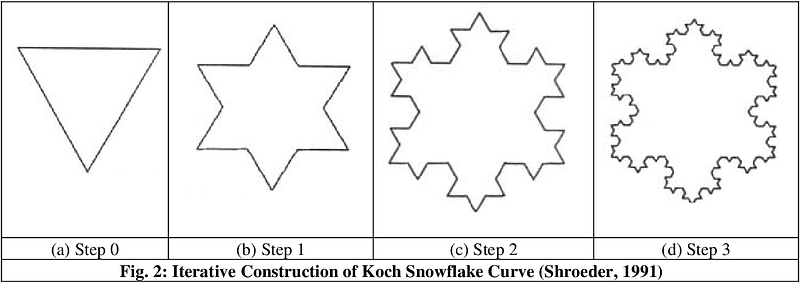
To calculate the fractal dimension of the Koch snowflake, we need to use a mathematical formula that takes into account the self-similarity of the object. The formula used to calculate the fractal dimension is based on the idea that the number of self-similarities that can fit within a given space changes with scale. For example, if we take a line segment of length 1 and divide it into two equal parts, we can fit two line segments of length 1/2 within the same space. If we repeat this process several times, we can see that the number of line segments that can fit within the same space increases exponentially with each iteration.
In the case of the Koch snowflake, the fractal dimension can be calculated using the following formula:
D = log(N) / log(S)
where D is the fractal dimension, N is the number of self-similarities at a given scale, and S is the scaling factor that relates the size of the object at different scales. For the Koch snowflake, the scaling factor is 1/3, and the number of self-similarities at a given scale is 4. By applying the formula, we can calculate that the fractal dimension of the Koch snowflake is approximately 1.26, which is greater than the Euclidean dimension of the object, which is 1.
Fractal dimensions have many applications in science, engineering, and art. In science, fractal dimensions are used to study and model complex natural phenomena such as fluid turbulence, geological structures, and biological systems. In engineering, fractal dimensions are used to design efficient and robust structures, such as antennas and fractal antennas, which have a higher bandwidth and lower energy loss compared to traditional antennas. In art, fractal dimensions are used to create aesthetically pleasing images and animations, such as fractal landscapes and the famous Mandelbrot set.
Mathematical examples of fractal dimensions
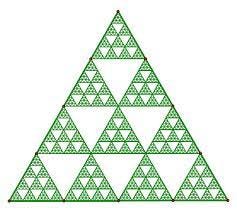
- Sierpinski Triangle: The Sierpinski Triangle is a fractal that is created by starting with an equilateral triangle and recursively removing the central triangle of each remaining triangle. The fractal dimension of the Sierpinski Triangle is approximately 1.58.
- Cantor Set: The Cantor Set is a fractal that is created by starting with a line segment and recursively removing the middle third of each remaining line segment. The fractal dimension of the Cantor Set is exactly equal to log(2)/log(3), which is approximately 0.63.
- Koch Snowflake: As mentioned in the previous section, the Koch Snowflake has a fractal dimension of approximately 1.26.
- Mandelbrot Set: The Mandelbrot Set is a famous fractal that is created by plotting the set of complex numbers that do not diverge under a certain iterative function. The fractal dimension of the Mandelbrot Set is estimated to be between 1.3 and 2.0, depending on the method used to calculate it.
- Fractal Brownian Motion: Fractal Brownian Motion is a type of stochastic process that is used to model a wide range of phenomena, such as terrain elevation and noise in electronic circuits. The fractal dimension of Fractal Brownian Motion depends on the “Hurst exponent”, which is a parameter that describes the degree of persistence of the process. For example, a Hurst exponent of 0.5 corresponds to a fractal dimension of 1.5, while a Hurst exponent of 0.9 corresponds to a fractal dimension of 1.1.
Fractal dimensions are not limited to two-dimensional objects or fractals. They can be calculated for three-dimensional objects and even time series data. For example, the fractal dimension of a coastline or a mountain range can be calculated in three dimensions, while the fractal dimension of a time series of stock prices or heart rate variability can be used to characterize the degree of randomness or predictability of the data.
Fractal dimensions can be a powerful tool for characterizing complex patterns and shapes, and their applications are numerous in various fields.
Fractal dimensions of coastlines
The fractal dimension of a coastline is dependent on the scale at which it is measured. This is due to the fact that the coastline is a self-similar structure that exhibits a similar pattern at different scales. As such, the fractal dimension of a coastline can vary depending on the length of the ruler or measuring device used to measure it.
In 1967, Benoit Mandelbrot famously claimed that the fractal dimension of coastlines is greater than 1, indicating that they are infinitely long and infinitely intricate. He argued that the fractal dimension of coastlines is somewhere between 1.2 and 1.3, which would mean that they are very complex, with many twists and turns.
Later studies have produced different estimates of the fractal dimension of coastlines, with some researchers suggesting that the fractal dimension can range from 1.0 to 1.7, depending on the specific coastline being measured and the method used to calculate the fractal dimension. However, most estimates fall within the range of 1.2 to 1.6.
It’s important to note that the fractal dimension of coastlines is not a fixed value, but rather a range that is dependent on the scale of measurement. The smaller the scale, the more detailed and complex the coastline appears, and the higher the estimated fractal dimension. Conversely, the larger the scale, the smoother and simpler the coastline appears, and the lower the estimated fractal dimension.
Here are some estimates of the fractal dimension of coastlines based on different studies:
- The fractal dimension of the English coast, measured at a scale of 2–3 km, was found to be 1.25. (Mandelbrot, 1967)
- The fractal dimension of the coast of Norway, measured at a scale of 2 km, was found to be 1.52. (Falconer, 1990)
- The fractal dimension of the coast of California, measured at a scale of 5 km, was found to be 1.25. (Falconer, 1990)
- The fractal dimension of the coast of Ireland, measured at a scale of 1 km, was found to be 1.26. (Grossman and Meir, 1989)
- The fractal dimension of the coast of the Baltic Sea, measured at a scale of 100 meters, was found to be 1.45. (Kolwankar and Gangal, 1992)
The true fractal dimension of coastlines may not be a fixed value, but rather a range of values that depend on the scale and level of detail of the measurement.
Examples of fractal dimensions from real world
Fractal dimensions have been observed in many real-world phenomena, ranging from physical structures to biological systems. Here are some examples of fractal dimensions in the real world:
- Earthquakes: Earthquakes can exhibit fractal behavior in the distribution of their magnitudes. The magnitude-frequency distribution of earthquakes follows a power law relationship, which implies that earthquakes occur on a fractal network of faults. The fractal dimension of the earthquake distribution is approximately 1.3.
- Blood Vessels: The branching patterns of blood vessels exhibit fractal dimensions. The fractal properties of blood vessels may help to optimize the flow of blood through the body, and can be used to characterize changes in blood vessel structure and function in disease. The fractal dimension of blood vessel networks is estimated to be between 2.0 and 2.5.
- Neural Networks: The branching patterns of neurons in the brain can exhibit fractal dimensions. The fractal properties of neural networks may play a role in information processing and communication within the brain. The fractal dimension of neural networks is estimated to be between 1.5 and 2.0.
- Urban Landscapes: The layout of cities and urban landscapes can exhibit fractal dimensions. The fractal properties of urban landscapes may help to optimize transportation and communication networks, and can be used to characterize the growth and development of cities over time. The fractal dimension of urban landscapes is estimated to be between 1.8 and 2.5.
- Lung Cancer Tumors: The growth patterns of lung cancer tumors can exhibit fractal dimensions. The fractal properties of tumors may provide insights into their growth and progression, and can be used to develop more effective treatments. The fractal dimension of lung cancer tumors is estimated to be between 1.5 and 2.0.
- Music: Musical compositions can exhibit fractal properties in the patterns of pitch and rhythm. The fractal properties of music may play a role in the perception and enjoyment of music, and can be used to analyze and classify different types of music. The fractal dimension of musical compositions is estimated to be between 1.3 and 1.6.
- Clouds: As mentioned previously, clouds can exhibit fractal properties at different scales. The fractal dimension of clouds is estimated to be between 1.3 and 2.0, depending on the specific type of cloud and the method used to calculate its fractal dimension.
- Trees: Trees are another example of a natural structure that exhibits fractal dimensions. The branching patterns of trees, from the large branches down to the smallest twigs, can be modeled using fractal geometry.
- Lungs: The structure of the human lung, with its branching network of airways and blood vessels, also exhibits fractal dimensions. The fractal properties of the lung may help to optimize its function, allowing for efficient gas exchange.
- Mountain Ranges: The rugged peaks and valleys of mountain ranges can be thought of as fractal structures. From the smallest crags to the largest peaks, the terrain exhibits self-similarity and complexity that can be captured using fractal dimensions.
- Electrocardiogram (ECG) signals: The electrical signals generated by the human heart, as measured by an electrocardiogram (ECG), can exhibit fractal dimensions. The fractal properties of ECG signals may provide insights into heart health and disease.
- Financial Markets: Financial markets can exhibit fractal dimensions in the patterns of price movements over time. Fractal geometry can be used to model these complex patterns and potentially predict future market behavior.
The concept of fractal geometry has broad applications in many fields, from physics and biology to finance and engineering.
- “The Beauty of Complexity: Exploring Fractal Dimensions in the Real World”
- “Unveiling the Hidden Order of Nature: Fractal Dimensions in Physical and Biological Systems”
- “From Mountains to Music: How Fractal Geometry Shapes Our World”
- “Fractal Dimensions: The Fascinating Mathematics Behind Nature’s Complexity”
- “Fractal Dimensions in Real Life: Understanding the Self-Similarity of Our World”
- “Exploring the Fractal Universe: From Clouds to Financial Markets”
- “The Power of Fractal Geometry: How It Helps Us Understand Earthquakes, Blood Vessels, and Beyond”
- “Unraveling the Mysteries of Fractal Dimensions: What They Reveal About Our World”
- “The Beauty and Science of Fractals: Finding Patterns in Complexity”
- “Fractal Dimensions: Seeing the World in a New Way”
Consider becoming a member, writing your own stories and earning from Medium yourself. Start here: https://ermanakdogan.medium.com/membership