
Self | Money
Four Wastes Of Money That People Still Fall For
I’ve been trying to tell you.

I’ve seen more than a few lost souls.
A dude smoking a cigarette while using an oxygen machine. People taking out loans to gamble. I saw one guy pull out $3,000 at an ATM. He looked like he didn’t have $1 to his name.
The casino is a highlight reel of bad money decisions — and I’m one of them. It’s my guilty pleasure but I have rules and no regrets.
Every day, I hear about people drowning in debt, having low income, and fighting with their spouses about their spending too much on food, or partying.
I have a few opinions on spending. Not all of them will be popular.
Trying to look younger with junk products
The anti-aging industry generates more than $60 billion a year. There’s always some gimmick, about how you can look more youthful without spending thousands on plastic surgery.
“This cream comes with 6 bonus extra packs! But if you order now, you’ll get another 10 for the low, low price of 3 easy payments of $299!”
A dermatologist will be the first to tell you that most anti-aging products don’t work.
Rejuvaderm XR (I made that up) is designed to get you hooked on it for life. You’ll be shoveling incremental payments to cover for some Ceo's extra 18 holes of golf.
And look — I have no qualms with people wanting to look younger. Eating healthier and losing weight can obviously help. My hot take: if you are dead set on looking younger, and want an actual age-defying solution — you should probably just call a surgeon.
You’ll have a better shot at that result and won’t bleed money for years and years. But I’d try natural solutions first.
Also, I noticed this very peculiar thing.
Nobody seems to admit to getting plastic surgery. Yet, there sure are a ton of plastic surgery clinics within a few miles of every house I’ve owned.
The bigger takeaway: beware of throwing money at things that you want to be the solution. Companies make fortunes because we are afraid of doctors, and commitment in general.
Anti-virus software
Spoiler alert: most security experts don’t pay for anti-virus software.
No, it’s not because they know how to manually fix viruses. They just know those programs are overkill.
Modern operating systems come preinstalled with solid security systems. A secure computer is in the manufacturer’s best interest too.
If they send you a PC that can be easily hacked and ruined, it is catastrophic for their brand. A sure sign that anti-virus software is a waste: most of the people calling you to sell it are calling from spam phone numbers and are from overseas.
The irony is that programs like McAffee are actually rather intrusive and slow your PC down.
The coffee problem
“Starbucks, how may I help you?”
“Hi, yes, I’d like an Eastern Malachian Tumba T’isk Grande latte with a splash of sugar”
“I’m sorry ma’am, we don’t take orders in Klingon.”
All kidding aside, the line at Starbucks completely blows my mind. Every, single, time, there is a zig-zagging line that extends through the grocery store parking lot, jamming up shoppers.
Micro-spending is one of the biggest sources of waste because we don’t see how the math compounds over time.
There was a coworker at my old job who came from a developing nation. She used to stare in horror as I came into the lunch room with my $22 salad delivery from Panera each day.
And she was completely right. There’s a balance between “treat yo’self”, and being a complete fool.
Buying just to say you own it
Conspicuous consumption will explain a lot of the most ridiculous social media flexing.
Dudes leaning on lambos with their $350 non-polarized Gucci sunglasses. People posting pictures of their $100 bacon and eggs brunch they could have made at home for $9.
Conspicuous consumption was first coined in 1899 by economist Thorstein Veblen. It means, “Buying something that is far more expensive than would be practical.”
For example, look at those $400 Jordan shoes. They aren’t any better than the $10 sneakers Jordan played with in high school.
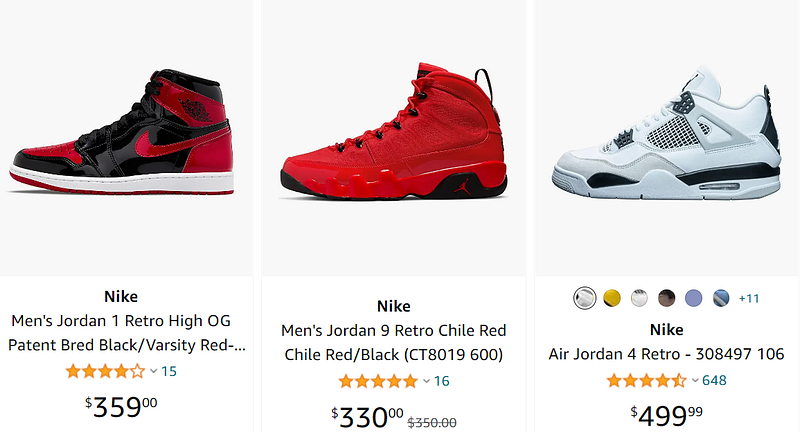
Even further, we all suffer from a price-value bias. We often assume because something is expensive, it means it has high quality.
The $2500 Prada purse is no better at storing your money than a $100 version.
Conspicuous consumption describes that humans love to project status. It makes them feel accomplished and important. Playing the status game is a highly expensive hobby, and your toys all lose value fast.
One of my favorite things to do is look up expensive watches on Amazon and then read the reviews.

“Mine didn’t fit so I decided to use it to prop up my wobbly table.”
“My wife needed chemo treatment but I decided to own a $40,000 watch was more important.”
I tried to join in and wrote a joke review last year about how my watch made a great chew toy for my dog but it got deleted.
There is virtue in investing in quality, dressing nice, and wearing clothes that actually fit (this applies to men especially).
The underlying problem: buying for status doesn’t provide contentment. The value decays quickly. If you are looking for happiness, look elsewhere.
The takeaway
Look — the ultimate say in what is or isn’t a waste of money is you.
I can’t fault someone for spending money they earned, in a way that they choose. I try to strike a balance between being smart with my money, but also not acting like a scrooge and developing a reputation for being cheap.
Studies have consistently shown that investing in experiences, vacations, and trips with friends, provides longer-term satisfaction than buying things.
It’s as I’ve always said, “Memories over money.”
Enjoy this? Subscribe to Relax and Read for more.