
Four Thousand Weeks: What I Learned From Oliver Burkeman’s Treatise on Toxic Productivity Culture
“Everyone dies with a to do list”…and other morbid thoughts that add a little more meaning to life
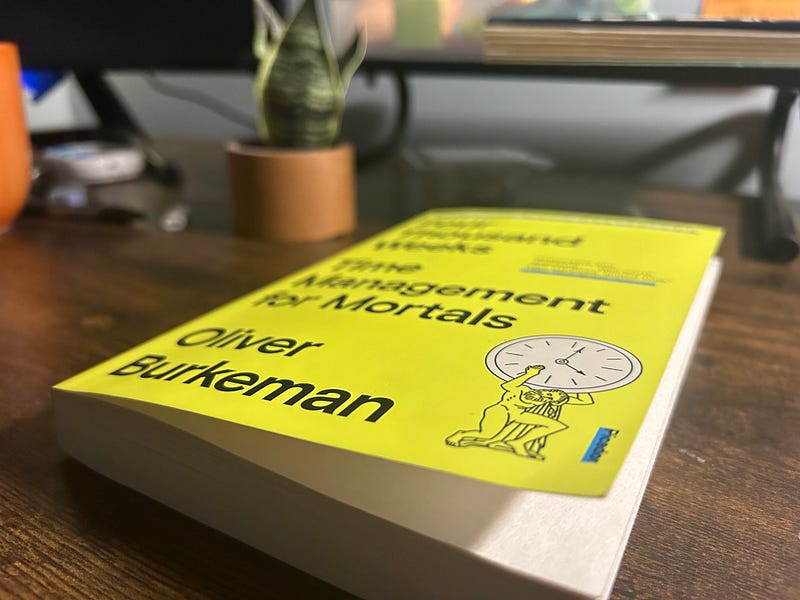
At around 2am on New Years Day, I finished Oliver Burkeman’s Four Thousand Weeks: Time Management for Mortals. For three or so days, I couldn’t part with it.
Every chapter, every section, and every point was an original, thought out and evidence based ounce of wisdom that I readily ate up.
Burkeman is not only an incredible writer, but makes fascinating and new points in a book that I assumed would just be a compilation of things I’d heard before.
I added it to my list only after my therapist recommended it, and could quickly assume why.
I, like many, want to do a lot with my life.
I often place unrealistic expectations on myself and my time to “get it all done” as the productivity gurus of the world would say (myself included).
His point is to ditch time management as we know it altogether.
An ambitious undertaking, I know.
Through stories, facts, evidence, and well-articulated arguments, Burkeman explains how you should spend your precious 4,000 weeks of your life.
Here are the four main lessons that I walked away from the book with:
#1: Standardized time is a social construct
From the get-go in this book, Burkeman argues that the way we understand time is all wrong, and that it’s negatively affecting the way we live our lives.
During the Industrial Revolution, everything started to go downhill as far as our perception of time. We had a clock and standardized time and a schedule which the world was supposed to operate around.
He describes also how people began to be paid by the hour, and how time quickly became something that wasn’t happening in the present — but chunks of seconds and minutes that went on into the future.
“Before, time was just a medium in which life unfolded, the stuff that life was made of. Afterward, once “time” and “life” had been separated in most people’s minds, time became a thing that you used…” — Oliver Burkeman
This is the cornerstone of how we think about life and ourselves today. We’re often looking at a Google Calendar schedule that extends into infinity or we have a paid-by-the-hour mentality towards ourselves even when there isn’t a boss involved.
Time doesn’t really work that way.
It’s not meant to be a commodity, or something that we trade, save, make, or organize. It’s just the thing with which we live life.
#2: We have to dig deep and pause
About halfway through the book, Burkeman talk about “cosmic insignificance therapy”, and The Great Pause that he and others have used to refer to the way time “stopped” during the COVID-19 pandemic.
I had never heard a time like used to refer to the time of quarantine, and I appreciated his insights about how everyone being home changed our perception of time. The Great Pause made many people much more present and helped them to live much more slowly.
“…it became normal to hear people express a sort of bittersweet gratitude for what they were experiencing: that even though they were furloughed and losing sleep about the rent, it was a genuine joy to see more of their children, or to rediscover the pleasures of planting flowers or breaking bread.” — Oliver Burkeman
He points out how we proved in this life how much humanity cares about one another, and he quotes Julio Vincent Gambuto, who wrote this at the end of the lockdown:
“This is our chance to define a new version of normal, a rare and truly sacred (yes, sacred) opportunity to get rid of the bullshit…”
In order to best harness our 4,000 weeks, we have to only choose to include what matters, and get out of the rat race that is the way most people live their lives today.
#3: Convenience is killing us
In a chapter of the book titled “The Efficiency Trap”, Burkeman describes how many features of our modern life were designed to promote convenience and get rid of inconvenience.
He argues, however, that in the process of convenience-boosting everything that we’ve actually lost a lot of value and meaning.
“It’s true that everything runs more smoothly this way. But smoothness, it turns out, is a dubious virtue, since it’s often the unsmoothed textures of life that make it livable, helping nurture the relationships that are crucial for mental and physical health, and for the resilience of our communities.” — Oliver Burkeman
It’s like how having devices means we don’t gather around the family radio or television to share things together, or how we order online and never get the pleasure of interacting with another human being at a restaurant.
Living in a world fixated on “making more time” and promoting efficiency is ruining our ability to actually enjoy time, savor moments, and really connect with the people around us — which is arguably the point of life in the first place.
#4: We might not even get 4,000 weeks
This was the most sobering but necessary reminder for me.
I’m only twenty-one years old. Heaven forbid, I might never live past twenty-one years old. I might not even make it through the night.
The point is, nothing is ever promised. The 4,000 weeks metric is just the average human lifespan, not a guarantee or a promise that comes with our birth certificate into this life.
“…a vital bit of perspective: I happen to be alive, and there’s no cosmic law entitling me to that status. Being alive is just happenstance, and not one more day of it is guaranteed.” — David Cain
The best time management strategy is remembering that it could all end today.
It’s just like the Selena Gomez song I used to listen to growing up says, “live like there’s no tomorrow”. She goes on:
If time came to an end today And we left too many things to say If we could turn it back What would we want to change And now’s the time to take a chance Come on, we gotta make a stand What have we got to lose The choice is in our hands
In the final chapter of the book, Burkeman talks about the concept of hopelessness — and how we should embrace it when ti comes to thinking about the way that we will spend our life.
We are only one person. With one lifetime. With only 24 hours a day.
No matter how organized, efficient, or clever we are, we will never be able to do everything in this life that we’d like to do. So many goals, tasks, projects and pursuits will be left unchecked, untouched, and unattained at the end of our life.
“It’s a cause for relief. You get to give up on something that was always impossible — the quest to become optimized, infinitely capable, emotionally invincible, fully independent person you’re officially supposed to be. Then you get to roll up your sleeves and start work on what’s gloriously possible instead.” — Oliver Burkeman
His point is that that’s okay — there’s nothing we can do about it — and that we should celebrate that fact in favor of the life we really can live.
We only have so much time. We didn’t need a book to tell us that. What we do need in my opinion, though, is an awakening to how we could be spending our time — and what’s getting in the way.
The never-ending to-do list and the pursuit of goals put onto us by no one but ourselves needs to end.
We have to step away from those things in order to do the most good and be the most good with the time that we have.
I hope these lessons have been impactful for you, and that maybe you’ll take this book recommendation and run with it too. I don’t think you’ll be disappointed.
Best of luck, and (maybe) happy reading!