
Four Myths about the Electoral College and Three Ways to Get Rid of It
Only one way is likely.
The merits of the case
In every democratic country, the person who wins the most votes gets the power — this a fundamental principle of democracy. Let’s not pretend Democrats are acting only in self-interest by wanting to get rid of the Electoral College without noting that popular vote wins are in line with every other advanced democracy.
Democracy isn’t just majority rules. It’s deliberation. It is the protection of minority rights. It is all these things, but once we’ve done our due diligence, argued, deliberated, debated, and voted, it should just come down to whoever persuades the most people gets to win.
And in future elections, if the other side persuades more people, they should win.
Both Hillary Clinton and Al Gore won the popular vote and not the Presidency. Clinton won by a whopping 2,868,518. Gore won it by a much smaller number, 537,179, but still, he won more votes.
One more vote is more votes.
What is the Electoral College?
The way it works: Each state is given a number of electors.
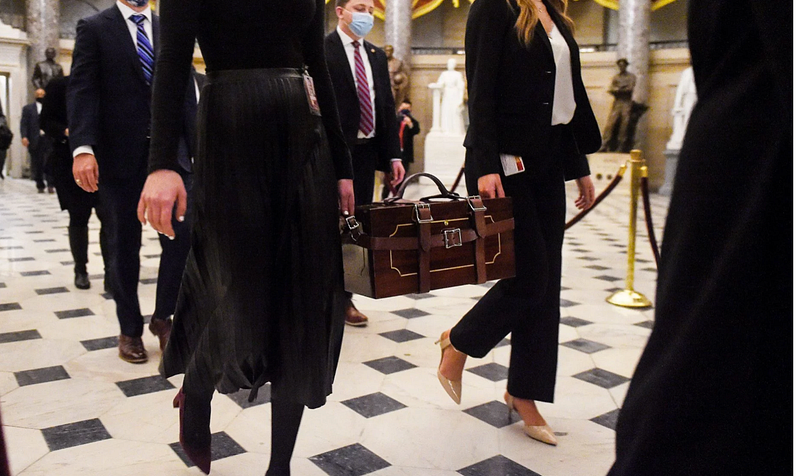
That number is based on the number of Senators each state has, plus the number of representatives in the House of Representatives. Every state has two Senators. Each state gets a number of electors based on population size as well. To become President, you have to win a majority of electors. There are a total of 538 electoral votes. The candidate that gets more than half (270) wins the election.
The candidate has to win the most votes in some number of states to get their Electoral College vote. If any particulate state is over 51%, all of those votes could be wasted. It’s not one election; it is like 50 separate elections. In theory, you can win an election with around 30% of the vote and still win a majority of Electoral College votes just based on the distribution of votes and population.
In any other country, Biden would have won the day we voted because he had already who the popular vote by at least 4M votes. It was more than apparent that he had won the national popular vote on that Tuesday.
Four Electoral College myths
Myth #1 — The Electoral College was deliberate.
No. It was not. Far too many people mythologize the Founding Fathers, a group of about seven men. I’m a little obsessed with Alexander Hamilton, not just because he’s capable of producing a great rap battle, but because I loved economics in high school, and it was my major in college. Hamilton is responsible for our financial systems — out of thin air. But he was human. He cheated on his wife and was both arrogant and stubborn.
The Electoral College was not exquisitely designed or deliberate.
In reality, the Founding Fathers didn’t know how to run an election without today’s modern technology. People were scattered, had no phones, letters took days or weeks to get from place to place. The Founding Fathers knew the first president was going to be George Washington anyway for the foreseeable future.
The Electoral College was cobbled together by 30-something-year-olds assembled during the summer of the Constitutional Convention of 1787, which took place in Philadelphia from May to September. I grew up near Philadelphia, the summer isn’t pleasant. They were hot, tired, missing their wives, and just wanted to go home to deal with more pressing matters of the time. And they were drunk for most of the day on hard cider and whiskey. And probably weren’t drinking adequate amounts of water.
The group of men behind the creation of the Electoral College was a bunch of very tired and kind of drunk politicians who couldn’t figure out a solution to one particular problem. Instead of working on it, they bailed and ended on something like, let’s just go back to the bad idea someone else had when we first got here. That’s often what happens in long negotiations when not everyone can agree on one idea or one way of doing things.
So they tabled it, intending to figure it out in the future. They knew the Electoral College wasn’t great. 200 years later, we have the same terrible system.
One of the myths people believe is that the Constitutional Convention of 1787 was a high-minded group of philosophers. Get past the mythology of the Founding Fathers. While a fascinating group of men, these were actual living human beings who made mistakes, they were interesting because they were charting a new course for America. It’s a fascinating time to read and study. But know, they were drinking alcohol all day while working, owned slaves and had many more flaws.
Just because something is written down in a formal document doesn’t make it a good idea. Ask any person who has been divorced. Or married, for that matter.
Myth # 2— The Electoral College was designed to enhance the power of slave states.
The Electoral College wasn’t designed at all. It was haphazardly thrown together (see myth #1). It was a kludge.
Although it was not designed to enhance the power of slave states, it unintentionally enhanced the power of slave states.
Because the Electoral College is based on House representation, it gave this bonus to candidates who had the support of the slave South. This had a huge impact later on because it determines and gives us the first 12 American presidents, who were all slave owners from the South (except for John Adams and John Quincy Adams. Although not completely innocent, they profited off the slave industry as well).
So, the Electoral College incidentally gives the South a lot of power. An unfortunate unintended consequence.
The three-fifths compromise reflects ideas about what representation actually meant then.
The three-fifths compromise: “a compromise agreement between delegates from the Northern and the Southern states at the United States Constitutional Convention(1787) that three-fifths of the slave population would be counted for determining direct taxation and representation in the House of Representatives.”
In 2020 we think of representation as people. One person, one vote. And why we find the Electoral College so offensive because it is basing something on representation that is not simply tied to one person, one vote.
Back then, in the late 1700s, representation included things like wealth (or how many slaves you owned). It was considered a normal idea that if you’re designing representation to represent relative wealth in different parts of the country, it counted slaves for the South. The Electoral College wasn’t created to protect slavery but became an instrument for protecting slavery because slavery grew and didn’t go away for a while as the Founding Fathers were convinced it would.
“The popular ‘it’s because of slavery’ explanation attributes a level of intentionality and villainy — which is emotionally satisfying — but isn’t accurate. The slaveholders weren’t necessarily thinking to themselves, ‘I must entrench slavery.’” — James Bouie
“On the other hand, Southern delegates threatened to abandon the Convention if enslaved individuals were not counted. Eventually, the framers agreed on a compromise that called for representation in the House of Representatives to be apportioned on the basis of a state’s free population plus three-fifths of its enslaved population. This agreement came to be known as the three-fifths compromise.” — Britannica.com
Granting slaveholding states the right to count three-fifths of their population of enslaved individuals when it came to apportioning representatives to Congress meant that those states would thus be perpetually overrepresented in national politics.
If the Founding fathers had known that the three-fifths compromise would end up giving the South this hammerlock on the Presidency for 50 plus years, they would have found another way. I don’t see the Founding Fathers anticipating the future when they came up with the Electoral College, especially because they knew it wasn’t a good idea to begin with.
They needed a new government, they had disagreements, so they left it like, let’s just figure out something that is minimally acceptable to everyone here.
Myth #3 — People didn’t really complain about the Electoral College.
People have been complaining about the Electoral College since enacted. The Electoral College doesn’t make any sense. The truth is 19th-century lawmakers introduced amendment after amendment to get rid of it without success.
The beneficiaries of slavery end up becoming the fiercest opponents of Electoral College reform. They won over and over again because of it, just like Republicans do today.
But by the 20th century, the South has emerged as a voting block.
Jim Crow laws more or less wipe out Black voting in the entire South, giving Southern Democrats the best of both worlds. In that their Black populations are legally allowed to vote — they are constitutionally enfranchised but can’t actually vote, so they get the bonus of representation — full representation — for Black people in their states.
Because of this decisive block, Southern lawmakers are in Congress for 30, 40, 50 years. The Black population is counted in their redistricting, as in how many districts they get, they get all these extra seats, but because Black people can’t actually vote de facto, they fill those seats with whatever white people they want at the time. That is the mechanism of mass disenfranchisement. Those Solid South lawmakers block attempts to repeal the Electoral College throughout the early 20th century.
The world begins to turn in the 1960s.
Until the 1960s, there wasn’t much divergence between who won the popular vote tally and who won the Electoral College vote. People who want change begin to care in the 1960s when there is a big push for more democracy in the South and elsewhere.
Myth #4 — The Electoral College benefits rural/small states.
It doesn’t do that.
Florida isn’t a small state. Pennsylvania isn’t a small state. These are gigantic states with lots of people in them. The small states in the country RI, VT, WY, ID — no one gives two hoots about these states in the presidential election. Candidate don’t visits these states, no one thinks about them, no one spends money in them.
The Electoral College doesn’t enhance the voices of small states. Rural areas are given even less attention.
Half of California is made up of farmland, but no one cares about those voters. 94% of campaign visits and spending is in 12 states. There is no reason for Democrats and Republicans to campaign in states that are always red or always blue.
For instance, in two debates, we talked about fracking in Pennsylvania. Two debates. Two debates that didn’t include the wildfires that burnt down large areas of California. While fracking is an important issue, what about other issues, like the wildfires in California.
It didn’t get talked about because everyone knows there is no way California is going for a Republican.
Why bother talking about wildfires, a climate crisis issue that actually merits talking about because it affects the entire world. In most debates, all the candidates talk about are issues that are important in swing states.
No one is going to go visit Kansas for a presidential election. This is odd because millions of children are going to school virtually right now, but during the debates, neither candidate talked about how Broadband has barely penetrated most of rural America. I was told the Electoral College made sure these issues get discussed.
The opposite is true.
What a presidential race would look like without the electoral College.
Four out of five Americans live in cities.
If we got rid of the Electoral College, and candidates actually had to win the popular vote, we’d witness a completely different Republican Party. Right now, Republicans have no policies that are relevant to people who live in cities. Why would they? They are losing the cities by large numbers.
We would get candidates that make their presidential campaigns with all Americans in mind.
There are very few places in the country that are truly politically uniform. Most states are at most 70% one party. The majority of states are either somewhere around 60/40%, bare majorities, or modest majorities. In Mississippi, 40% of the people routinely vote for Democrats. In Massachusetts, 40% of the people who live in that state routinely vote for Republicans.
All states are politically evenly mixed throughout the country.
Candidates would cease trying to win states and try to win votes instead. And votes are everywhere.
An auditorium of 10,000 people in the middle of Arkansas is worth the exact same as one elsewhere. For example: in 2016, more people in raw numbers voted for Donald Trump in Los Angeles than in West Virginia. Because they’re a lot more people in Los Angeles than there are in West Virginia.
It would eliminate the incentive — by Republicans it is essential to note here, Republicans, not Democrats — to try to reduce the number of voters on the rolls. Republicans’ incentive structure would move from trying to keep people off the rolls to finding every way possible to get their people registered to vote.
It would increase participation because everyone would know that their vote counts.
Democracy — A work on the process.
People want to participate, but the system puts everything possible in their way to make them less likely to vote.
We always ask the question, “why don’t people want to vote?” The question we should be addressing is, “why is it that states and our political system make it so difficult for people to vote?”
People choosing not to vote is a smaller number than people who just can’t vote.
Just look at the endless lines posted via social media from this past election. People were standing in hours-long lines just to cast a ballot. If you can’t spend an entire workday in a line, forget about it, even people who want to participate won’t.
Just make the lines short. Or better, have everyone mail in their ballot. These two common-sense ideas will do more to boost turnout than any single thing or anyone pushing a particular ideology down our throats.
What does the prospect for reform look like right now? Three ways to get rid of Electoral College Vote:
- A constitutional amendment is the cleanest and simplest way, but the Constitution has proven difficult to amend.
- Find some way to either get every state to distribute their electoral college votes by proportional vote or some mechanism to assign them all to the popular vote winner. The National Popular Vote Interstate Compact (NPVIC) is an agreement among a group of US states and the District of Columbia to award all their electoral votes to whichever presidential candidate wins the overall popular vote in the 50 states and the District of Columbia. The case that the NPVIC is constitutional is that legislatures can assign their electoral votes however they want. That case for it not being constitutional is that the courts have frowned on Interstate Compacts claiming they are a go around to Congress. What would have to happen to make this agreement constitutional enough? Congress would have to pass a law affirming Interstate Compacts. This is a high bar and unlikely to happen because of the Senate filibuster — another undemocratic tool.
- The third and most likely. What will do get rid of the Electoral College once and for all? When the big states start flipping. I thought Texas would turn blue in the last election — it will happen eventually.
If Texas flips under the Electoral College system, it basically becomes impossible for a Republican to win the Presidency. If Texas flips, Georgia will likely become blue as well. Like states move alike.
In that world, it is not likely a Republican will win the Presidency.
This is the recipe for reform.
If no one thinks they’re going to benefit in the future from the Electoral College, it will change. When Texas turns blue, Republicans will eliminate the Electorate College and reform the system because they’ll be on the losing side, like Democrats are now.
Right now, the problem is that one party believes very strongly that it will continue to benefit under the current system. As long as that’s true, then constitutional reform is effectively off the table.
Funny — The idea of flipping Texas would not exist if whoever won the popular vote wins the Presidency. Because there wouldn’t be states to “flip,” you either get the country, or you don’t.
Archaic rules be gone.
If we decide who is President by popular vote, The Republican Party can win a national election by popular vote. They just have to work at it and start talking about policy and running campaigns to win the popular vote.
George W. Bush did this in his 2004 campaign. He ran a popular vote campaign. Bush and his team campaigned in a way to try to build a majority. They appealed to POC and Hispanic voters on the basis of religion.
Liberal take heed.
A popular vote election isn’t necessarily one that Democrats will like to see in terms of the kinds of messages Republicans will use — ahem, Trump — because, as we’ve borne witness to for the last five years, deplorable messages attract large numbers of people. Fear and anger move a large segment of the American population. It has been used successfully since time immemorial.
What is Democracy?
Majority rules. One vote for one person
People point to the horrible outcomes of democracy in American history. They point to Jim Crow laws, they point to Japanese internment camps, in each situation, the country wasn’t fully democratic. Jim Crow laws weren’t imposed by a democratic majority; they were imposed by an empowered minority.
The worse aspects of American history have always come at the hands of a minority empowered by institutions that block full democratic expression. You can’t make the case that democracy has been a problem in this country; the country’s problem from its beginning is lack of democracy.
Jessica is a writer, an online entrepreneur, and a recovering perfectionist. She lives in Los Angeles with her extrovert daughter, two dogs, and two cats.


