
Fossil of the heaviest penguin in history found; weighed over 150 kg
Paleontologists have found fossils of two previously unknown penguin species in New Zealand. One of them weighed more than 150 kilograms, making it the heaviest penguin to have walked on the planet.
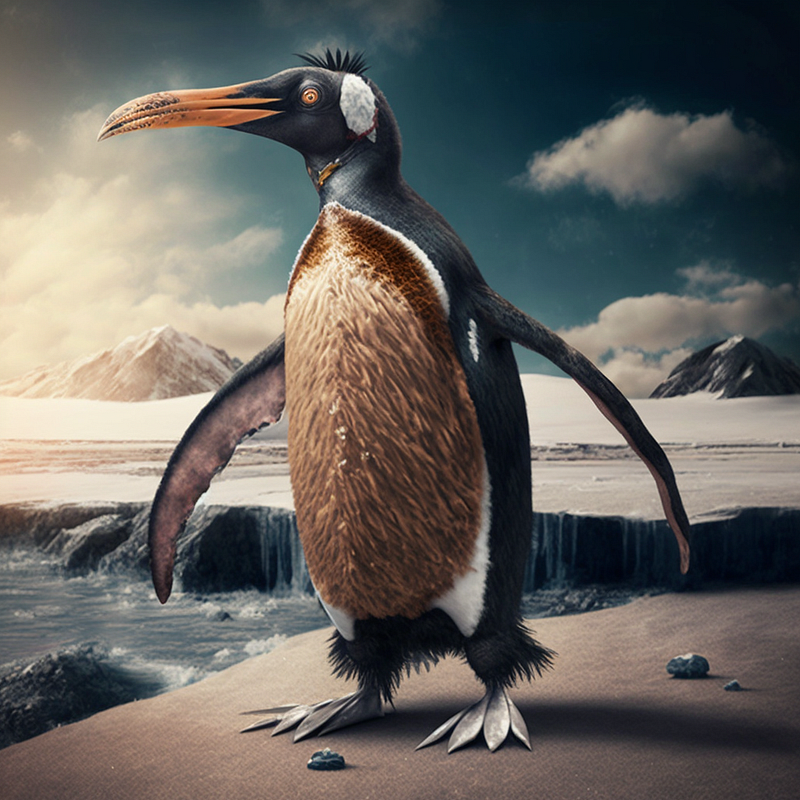
Penguins are unusual animals that inhabit regions of Antarctica, the coast of South America and around New Zealand, among others. These birds have evolved to survive in the harsh polar conditions.
The first species even appeared ca. 60 million years ago, but not all have survived to the present day. Today the largest representatives of this family do not exceed 130 cm in height and weigh up to 45 kg, although in the past much larger individuals roamed the Earth.
The world’s largest penguin
Until now, it was thought that the largest known penguin was the one whose fossils were discovered in Antarctica. Palaeeudyptes may have been as tall as 2 meters and weighed about 115 kg. This giant lived during the Paleogene period about 36–40 million years ago. However, it turns out that our planet may have been inhabited by even larger specimens in prehistory.
In a groundbreaking discovery, paleontologists hailing from New Zealand have unearthed a treasure trove of penguin fossils, comprising several distinct species. Among these were two previously unknown species that have not yet been classified. The findings of the study suggest that one of these newly discovered species could be the largest penguin species ever known to have existed in history. The massive bird has been estimated to weigh up to a staggering 154 kg, based on meticulous analysis conducted by the scientists. That’s about as much as an adult male gorilla weighs. Kumimanu fordycei, as the new species was named, lived about 50 million years ago.
The research team, which included experts from the University of Otago, the University of Canterbury, and the Auckland Museum, made the discovery in the Otago region of New Zealand’s South Island. The area has long been recognized as a site of great importance for paleontologists, who have been excavating the region for more than two decades, in search of new insights into the region’s natural history.
Five other fossils belonged to the same species, which had also never been discovered before. Scientists have given it the name Petradyptes stonehousei. The researchers say the individuals lived about 59.5–55.5 million years ago.
Paleontologists have also found the remains of Kumiman, an extinct bird of the penguin family, which is also classified as a giant penguin. In the past, based on other fossils, it was estimated that representatives of this species weighed about 100 kg and reached about 1.77 m in length.
The discovery sheds new light on the evolution of these birds
The fossil of the largest penguin is in large boulders that were identified in 2017. Paleontologists from the National Museum of New Zealand Te Papa Tongarewa have since tried to access the fossilized bones in such a way as not to disturb any structure. They published the results of their research in February in the scientific journal Journal of Paleontology.
The scientists claim that the newly discovered penguin species were among the first to live on Earth. Paleontologists believe that their remains can help understand the evolutionary history of these animals over millions of years.
“Both Kumimanu fordycei and Petradyptes stonehousei had rather primitive fin bones. They somewhat resembled the flippers of modern flying birds, which are also good swimmers. However, prehistoric penguins, like their modern relatives, did not fly,” Daniel Ksepka, a paleontologist at the Museum of Greenwich, says in an interview with Live Science.
The world’s largest birds
While the mass of K. fordycei may be impressive, it is worth remembering that there are equally large birds on Earth today. Currently, it is the ostrich (Struthio camelus) that is the largest representative of this vertebrate family. This flightless land bird inhabits the semi-deserts and savannas of Africa, areas south of the Sahara, as well as Syria and the Arabian Peninsula. The largest individuals weigh about 160 kg and reach 275 cm in height.
Other species of giant birds are:
- Southern Kazuar (45–85 kg, 155 cm)
- Northern Kazuar (43–75 kg, 150 cm)
- Emu (32–70 kg, 153 cm)
- Emperor Penguin (30–45 kg, 152 cm)
- Nandu (15–40 kg, 140 cm)
Cool that you made it to the end of this article. I will be very pleased if you appreciate the effort of creating it and leave some claps here, or maybe even start following me. It would be nice if you also left a tip! Thank you!