
Fortune, Empress of the World
Who were we, and who have we become?
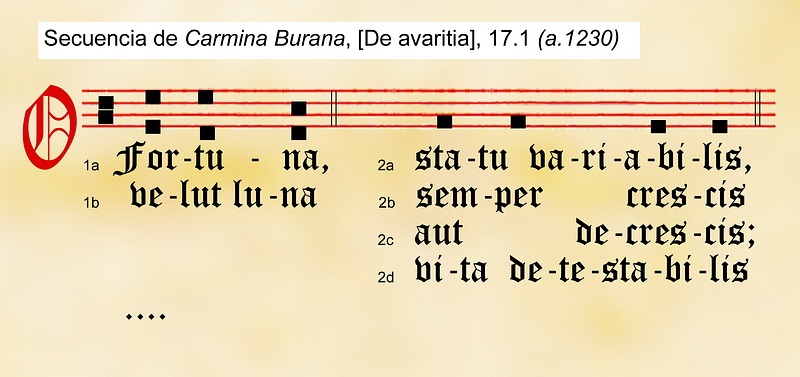
What accounts for the enduring attraction Carmina Burana, a contemporary orchestral setting of the songs of a band of 13th-century goliards? Perhaps modern rebellious spirits identify with those wandering scholars and divinity students as they partied their way across late medieval Europe, satirizing late medieval society along with the then all-powerful Church of Rome.
Carl Orff’s masterpiece holds the distinction of most frequently performed choral work of the 20th century despite having been a favorite of the Nazi regime. Perhaps they were drawn to its celebrated, if occasional, stamping rhythms, which seemed reminiscent of the goose-stepping columns of the Third Reich. Thankfully, their favor failed to pollute this magnificent work.
Oh Fortuna, a crashing and stamping chorus made famous by its appearance in movies and advertising, both opens and closes Carmina Burana.
It begins
O Fortune, like the moon you are changeable, ever waxing and waning; hateful life first oppresses and then soothes as fancy takes it;
and ends with
So at this hour without delay pluck the vibrating strings; since Fate strikes down the strong man, everyone weep with me!
The matching Oh Fortuna choruses bookend songs of spring, love, laughter, drunken carousal, gambling, and the blows of that most merciless of goddesses, Fortune.
As the goliards drank and gambled their way through the nights of their world of ceaseless war, grinding poverty and great wealth, and widespread disease and death, they begged Fortune for mercy, asking a mute universe, “Why the injustice? Why should we endure the tongue lashings of scolds guilty of the same transgressions¹? Why should we not at least try to carve out a space of joy in a world ruled by inscrutable, random chance? Why should we not at least try to turn the inscrutable to our advantage with dice, cards, and drafts?”
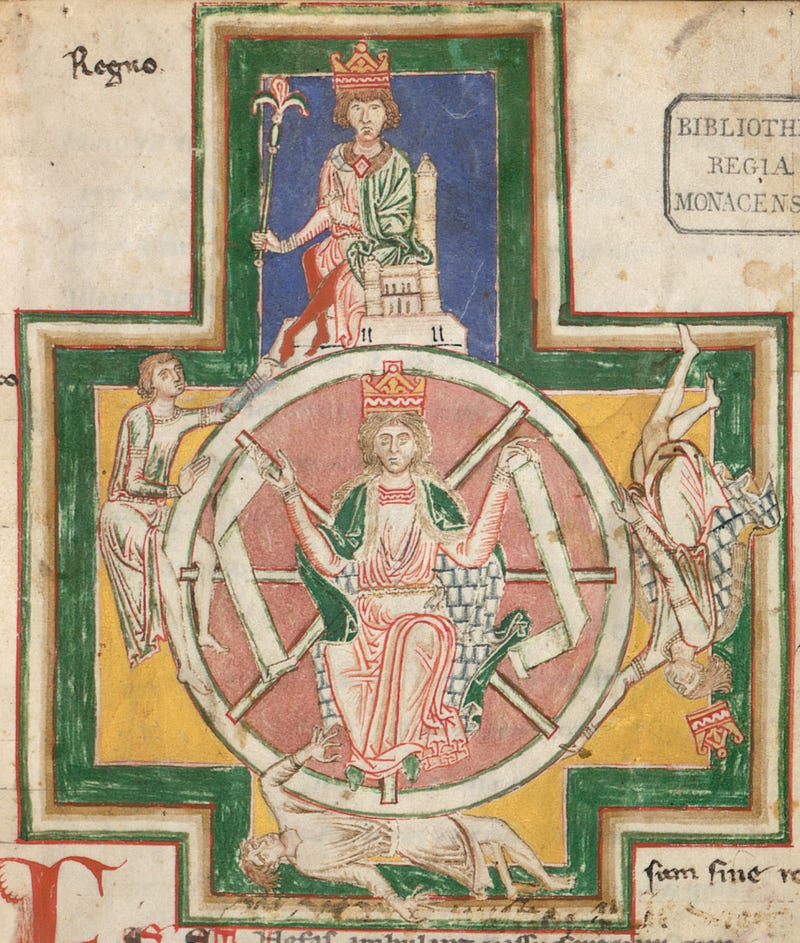
Fortune, that mighty wheel of life, could turn in one’s favor, if only for an interval. She threw the mighty from their exalted seats. “Surely she could favor me, lowly me, if only for this one brief night! May her moon-like phase change to favor me. Bring me joy, bring me money, bring me love, oh Fortune, I beseech you!”
What sustains us, their successors, through our contemporary world of endless war, grinding poverty and obscene wealth, and now, to our modern befuddlement, worldwide disease and death? We strain to control that inscrutable wheel by the power of science, technology, data mining, forecasting models, and world-spanning commerce.
The wheel crashes on as ever. A life form so tiny we cannot decide if it is truly alive made the leap from animal to human. Infections mounted. No worries, we told ourselves, as our world-spanning commerce system collapsed, our high-tech hospitals overflowed, and corpses waited in refrigerator trucks for burial .
No worries. We are advanced people. No need to watch helplessly as Fortune rolls on and crushes us. That was for the world before the germ theory of disease, before vaccines. We got this.
We produced, in what by comparison with previous efforts seemed no time at all, vaccines the like of which the world had never seen. 95% efficacy! We beat polio with 65%²! Our predictive models told us what to do. Roll out those vaccines, jab those arms. Vax girl summer awaits!
What happened?
Contrary to Dr. Einstein’s protestations, God really does play dice. Our much-vaunted science confirms this. On the most basic level, randomness rules.
Nature does not ask our leave. Nothing stands still, least of all viruses. The random wheel we call mutation ceaselessly churns out new things. We give them names, bicker over the names, then settle on letters from an ancient alphabet.
Even in places where almost everybody is vaccinated, cases skyrocket. We knew our wonderful shots were not proof against mere infection, but this? Omicron is less serious, we say, but with case numbers this staggering our hospitals overflow once more.
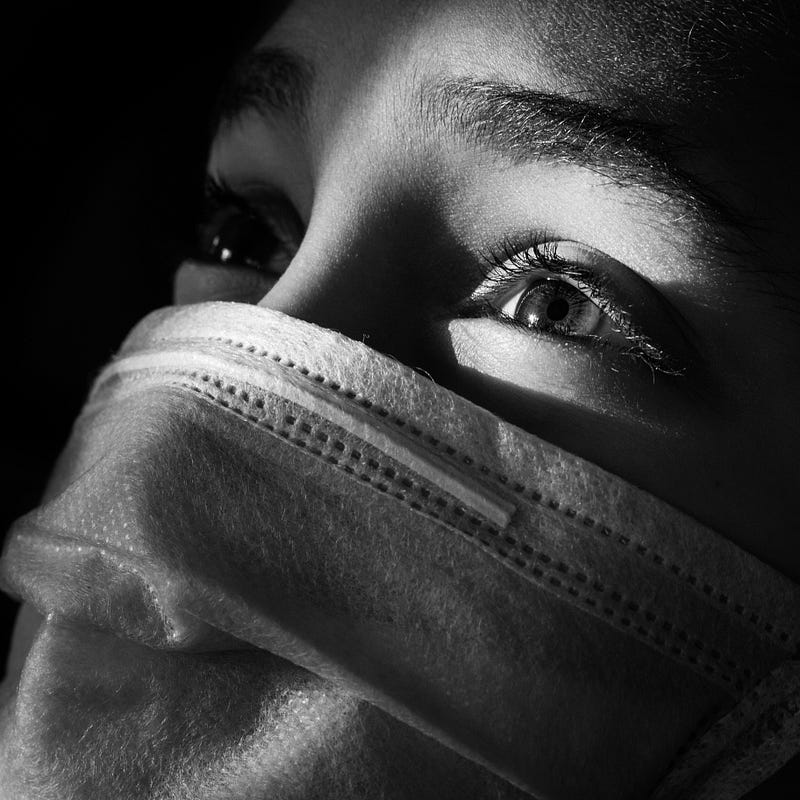
The germ theory of disease denies us the comforts of our 13th-century forebearers. Drinking and carousing are out. Masking and distancing are in. They had the tavern. We have the internet. We have come so far to find ourselves — where, exactly? Alone in our centrally heated dwellings, should Fortune so favor us.
The 13th century would give way to the 14th century and with it the year 1346, the official start of what would be remembered as The Black Death. The world of Carmina Burana knew nothing of what was to come. If they had, they would have been powerless to stop it.
Are we equally blind and helpless? Our predictive models continue to warn of what looms on our modern time horizon. A disaster of our own making, one that will make our current plague seem like child’s play. We cannot with justice blame Fortune, so we blame each other. A world that cannot band together to fight a simple thing like a pandemic seems ill-equipped for what lies ahead.
As I write this, and as I prepare to sing this masterwork with the Rhode Island Civic Chorale, the omicron variant ravages our little state. We have become accustomed to rehearsing and performing in masks, but now even that is not enough. We rehearse via Zoom, a difficult task even with the best technology. In March we will join the Island Moving Company, a local ballet company, to produce a magnificent musical and visual event.
If Fortuna allows it.
Special thanks to Richard Leslie.
Sources other than my disordered brain:
¹ Quamvis bibant mente leta, sic nos rodunt omnes gentes et sic erimus egentes. However much they cheerfully drink we are the ones whom everyone scolds, and thus we are destitute. From Chorus 14 “ In taberna quando sumus (When we are in the tavern)”
² Or something like that. Originally I got this figure by listening to the TWIV podcast, where they mention it frequently as a contrast to the mRNA COVID-19 vaccines. If you want to get technical, it depended on the type of polio. It was 60–70% against PV1, Over 90% effective against PV2 and PV3, and over 94% effective against the development of bulbar polio. It is worth noting the efficacy and effectiveness are two different, though related, things when it comes to vaccines.


.jpg)
