
Formatting Poetry: New Guidelines on Whether to Hit “Enter” or Not?
And explanation to my switch in edits made

New poets and experienced poets on Medium have such a dilemma to face — to space out your verses or keep them tight-knit? In this piece I will:
- illustrate with some examples what the two options are,
- how social media and Medium highlights might factor into your decision and
- one Medium flaw that makes sparse highlights difficult.
Examples: tight-knit or sparse?
(There’s probably a more formal name for this but I’m running with this style guide to address some questions I get on The Brain is a Noodle submissions. Please do share if you have other more official terms to describe this phenomenon!)
Version 1: Tight-knit formatting
Example:
Here is a line to my poem here is the second line to my poem what a terrible poem.
How to achieve this: After each line, hit “SHIFT” and “ENTER” at the same time to create the closest separation between lines.
Version 2: Sparse formatting
Example:
Here is a line to my poem
here is the second line to my poem
what a terrible poem.
How to achieve this: After each line, hit only “ENTER” at the same time to create the sparse separation between lines.
Social Media and Medium Highlights
In general, I respect when writers choose to use sparser or tight-knit formatting between lines of their poem. I find that each formatting choice illustrates a different essence.
Two pieces from Jen, one using each type of formatting, might help illustrate the difference.
Tight-knit formatting Social media note: Notice in this example that you can highlight across lines of the poem as long as they’re within the same verse. This also means that readers are able to tweet multiple lines of your poem to share their favourite snippets on social media.
Sparse formatting Social media note: Notice in this example that with sparce formatting, you can only highlight one line at a time. This also means that readers can only promote up to one line of your poem on social media, unless they manually edit the tweet.
If you have a clear vision of how your poem needs to be formatted, how readers interact with your piece may not be as important to you. However, if’ you’re on the fence on what kind of spacing to consider, considering readers’ experience in interacting with, responding to and promoting your piece might be helpful in tipping your decision towards one direction!
The One Key Issue with Sparse Formatting
Sparse formatting can be easier if you only have one verse of your poem. After all, it must be easier pressing that one button rather than two. However, when you start having multiple verses, Medium’s autoformatting will erase the segmentation between verses, which can be annoying to work with.
Here’s an example of what a draft might look like as you work on it (or as pasted from a Word document).
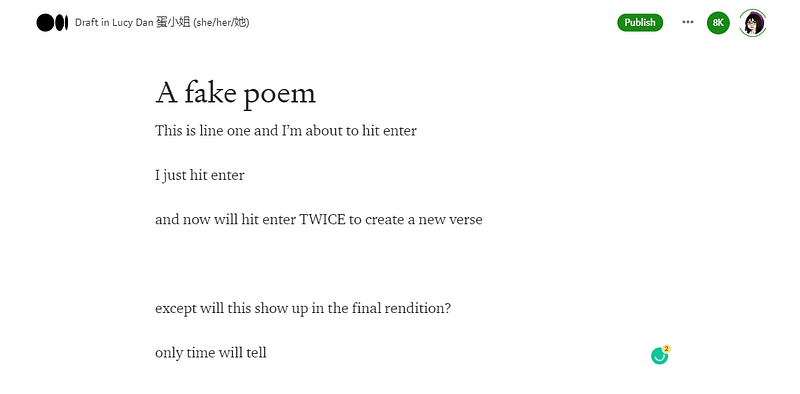
This same draft, once published on the Medium platform, will actually look like this:
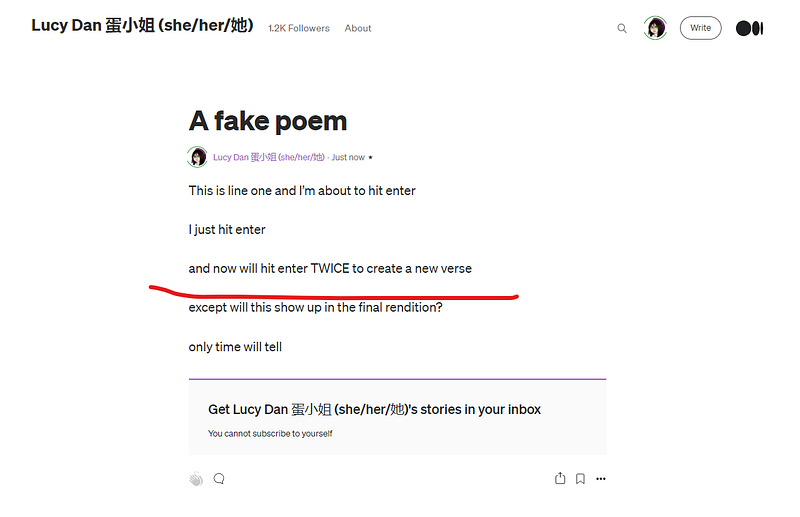
The spacing that was manually added after the 3rd line (end of 1st verse) will be erased.
I’m guessing the intention of this formatting default for Medium is to help longform writers remove any “double enters” they may have pressed in between paragraphs, making for a streamlined appearance. It makes poetry writing and publishing really annoying.
What I used to do: Because there’s no way to work around the Medium default and verses submitted to TBIN are consistently lost if sparse formatting is used, I did what I knew best in the past. I converted it into tight-knit formatting — which can be a consuming conversion for longer poems. I’ve gotten some pushback on this edit to preserve verses, asking me to revert it back to sparse formatting because of how the sparse formatting illustrates the essence of the poem, which is an equally time-consuming reversal and requires abandoning verses altogether.
What I will now be doing: Inspired by Jen’s use of page breaks (e.g., the three dots — which you can create by hitting “CTRL” + “ENTER” on PC and “CMD” + “ENTER” on Mac), this is what I’ll be doing going forward to help preserve everyone’s verses. It’s much easier to reverse should either of us want to do so and much easier to illustrate why it was necessary.
Take home
Whether you like to write tight-knit poems, sparse poems or a mixture of either, be aware of the Medium default that erases “double-enters”!
My only way thus far has been to add page breaks per Jen’s style, which is less time-consuming and disruptive than converting it to tight-knit formatting. This will be the default edit going forward in efforts to preserve writers’ verses.
Of course, the most amazing thing would be if writers are cognizant of these two different formats and settle on addressing Medium issue before they arise! ❤ But I’m always here to support writers navigating the quirks of this system.
Edit June 3, 2021: As Dana Sanford’s response to this piece points out, the formatting is sometimes called single-spaced/ double-spaced! I strayed away from the terminology because most word processing software (e.g., Microsoft Word, Google Docs) have a button that can alternate between the two and you have much more control over post- or pre- paragraph spacing. In Medium, much like a typewriter, you have to take on that formatting yourself :’)
A special formatting shoutout
I couldn’t talk about formatting on Medium without acknowledging and celebrating Kasun Ranasinghe’s (half) heart-shaped poem to his girlfriend:
I can’t imagine how much love and patience it took to format and keep the words in place, especially on this platform.
Hi I’m Lucy Dan 蛋小姐 (she/her/她) and I’m a serial tight-knit poem writer. I’ve actually always written this way even back in high school when I wrote blog posts in poetry format too.
Hop down the rabbit hole? 🐰🕳


