
Forgive The Shortcomings Of People Of Virtue And Honor Because — When They Fall Into Error, Allah Raises Them Up:
Allah(swt) urges us in His Book to Forgive people and be patient with their annoyance — as He says: “Who spend [in the cause of Allah ] during ease and hardship and who restrain anger and who pardon the people - and Allah loves the doers of good”. (Al ‘Imran 3:134)
“If [instead] you show [some] good or conceal it or pardon an offense - indeed, Allah is ever Pardoning and Competent”. (An-Nisa 4:149)
“And if you punish [an enemy, O believers], punish with an equivalent of that with which you were harmed. But if you are patient - it is better for those who are patient”. (An-Nahl 16:126)
Virtue Of Forgiving Others In Islam:
The Muslim is the brother of his Fellow Muslim; he loves For him of good what he loves For himself, and he hates For him of evil what he hates For himself.
Undoubtedly there is no one among us who does not make mistakes and Fall short, and does not wrong other people or transgress their rights to some extent; each of us would like people to Forgive him For all the wrongs he has done to them, so that they will not ask For restitution thereof on the Day of Resurrection, which is the time when he will be most in need of his good deeds.
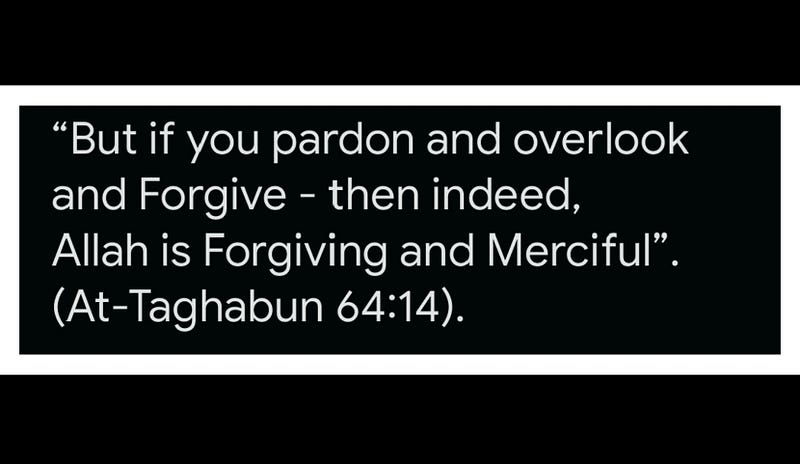
“But if you pardon and overlook and Forgive - then indeed, Allah is Forgiving and Merciful” (At-Taghabun 64:14)
The Messenger of Allah (saw) said: “Charity does not decrease wealth. No one Forgives, but Allah increases him in honour, and no one humbles himself before Allah but Allah raises him in status.”(Muslim:4689)
Ubadah ibn as-Samit said: I heard the Messenger of Allah (saw) say: “There is no man who suffers an injury to his body, then he Forgives [the one who caused it] as an act of charity, but Allah will absolve his sins commensurate with the extent of his charity.”(Ahmad :21643) (Classed as sahih by al-Albani in as-Sahihah, 2273)
When Mistah ibn Uthathah indulged in gossip during the slander incident (al-ifk), and Allah sent down revelation confirming the innocence of ‘Aishah (May Allah be pleased with her).
Abu Bakr, who had been spending on Mistah because he was his relative and was poor, said: By Allah, I shall never spend anything on Mistah again after what he said about ‘Aishah.
Then Allah revealed the words:“And let not those of virtue among you and wealth swear not to give [aid] to their relatives and the needy and the emigrants for the cause of Allah , and let them pardon and overlook. Would you not like that Allah should Forgive you? And Allah is Forgiving and Merciful”. (An-Nur 24:22)
Abu Bakr said: Yes indeed, by Allah, I would like Allah to Forgive me. So he resumed spending on Mistah as he used to do, and he said: By Allah, I shall never deprive him of it.
This Hadith was narrated by al-Bukhari (4381) and Muslim (4974).
Undoubtedly Allah does not bestow such a great characteristic upon anyone except the elite and best of His creation. The Muslim should take the righteous as his example. What could be more difficult than having a poor relative on whom you spend and whom you treat kindly, then he casts aspersions on your honour by speaking ill of it?
Yet despite that, Abu Bakr resumed spending on Mistah (May Allah be pleased with them both) and swore that he would never stop doing so. This can only be due to his purity of heart and his love of doing good, pardoning and Forgiving, otherwise he would not have sworn to never stop spending on him.
Allah(swt) says:“But whoever pardons and makes reconciliation - his reward is [due] From Allah”. (Ash-Shura 42:40)
Shaykh as-Sa‘di ( May Allah have mercy on him) said: “Stating that the reward of the one who Forgives is due From Allah motivates him to Forgive and to treat others as he wants Allah to treat him — Just as he wants Allah to Forgive him, he should Forgive others, and just as he wants Allah to pardon him, he should pardon others, For the reward is of the same nature as the deed.” (Tafsir as-Sa‘di, p. 760)
So,the point is that — we should Forgive each other's mistakes For the sake of Allah. The person who has hurt us, if we Forgive him For the sake of Allah, then his reward is the responsibility of Allah, and Allah is the best rewarder.
We ask Allah(swt) to improve our attitude and to make us among those who possess this noble characteristic.
May Allah(swt) make us Forgive each other's mistakes.(Ameen).
JazakAllah (May Allah Reward You [with] Goodness)For Reading.
https://sanahawan.medium.com/subscribe
Kindly Follow & subscribe to receive the latest insightful stories by email.