
Forget Vision Board, Here is The Chart that Aligns Your Goals and Dreams with Your Lifestyle
You Create Your Epic Life from Here, Now!
I’m not slaying vision boards as a popular visualization and manifestation technique. I have made a few myself, here’s my latest one:
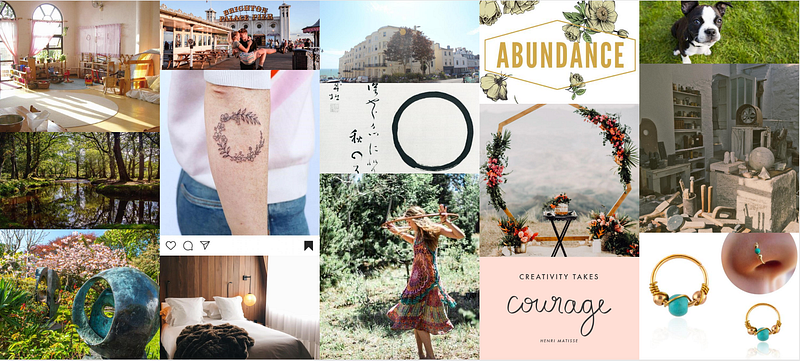
Instead of going through magazines and get distracted by Emma Stone’s torso on her Louis Vuitton campaign (true story), I searched images online, combined with some of my own, and created this inspiring board.
I want abundance in life and the courage to change. I want to move to a seaside town, have a dog, get a tattoo and a nose ring. Live a hippie and hygge life, and spend a lot of time in nature to make art.
Do you see what’s missing in this vision board? Well, everything. The why, the how, the what, the when. It’s not a plan, it's just a vision.
If we don’t bridge the gap between now and the vision and know precisely what to do to get us there, a lot of time will be wasted. We’ll also forget why do we want this in the first place and more easily to give up.
Why did I want a nose ring? I don’t remember.
Follow Up from Your Vision Board
To create an epic life isn’t just a manifestation meditation exercise, we need to make it happen. Step by step.
There are many goal-related action plans and project management tools out there like the Gantt Chart, Trello, Gyakusan Planner, etc. They’re all great, but I think there’s still a gap. These tools are more like a mechanism for organizing your projects, rather than to organize your vision. My chart adds an extra step before project management.
Personal goal and common good
After researching on the climate crisis, including binge-reading Greta Thunberg and Bill Gates’ blogs on the climate crisis, I was frustrated by how little time we have left in achieving zero carbon emission and why big evil corporates are so selfish and slow to respond.
The mission statement of a company is similar to a person’s vision board. It contains our personal goals, what we want to achieve as a person or a company.
Unless your whole goal is to be zero waste, the best we do individually is to add a picture of veganism or no plastic in our vision board. Same with companies, they add a corporate social responsibility page in addition to their mission statement. Our primary goal is always to maximize our own profit, whatever that is.
That’s all jolly and good, but in this highly specialized and modernized society, we are very detached from our planet, even though we are on it. There are big issues out there that we must take personal responsibility for and incorporate that when we think about what is your ideal life.
Not only big issues like the climate crisis should be our common goal, it’s possible that we have overlooked other specific areas that contribute to our happiness.
This includes your other roles in life, such as being a parent, a spouse, and a friend. For example, I’ve included ‘healing loneliness’ in my common good goals, because I know there are many lonely souls out there that need our care, including friends and family who live on their own. I want to make a specific point to bring kindness to them too.
A combination of personal and common good goals, with a vivid vision board of what your ideal life should look like, this forms your vision. By thinking about your ideal life from multiple angles; big and small, broken down and holistically, the visualization becomes more concrete and also more manageable.
Accumulation
My personal goal is to achieve peace and enlightenment, and my common good goal is to combat climate crisis and loneliness in cities, to support the equality and the mental health crisis of mankind.
“How?” is exactly the next question. To achieve a big goal is a process, even if your goal is straight-forward like becoming a successful writer, there’s a process of writing, getting published, marketing, and networking. We need to know what the process is. In other words, what you need to accumulate.
For me, based on my personal and common good goals, I need to accumulate two things: wisdom and knowledge. I don’t want to join a protest not knowing the basics, I want to be able to speak to others about my passion wisely.
It’s also the time to differentiate what’s the means and what’s the goal. For example, I want to write on Medium about my passion, get a following and financial support to make my vision happen. However, these are only means to an end. Whilst accumulating followers and wealth is very important, they are not directly related to my goal. Imagine if I have a lot of followers but no time to accumulate wisdom and knowledge, I still won’t be able to achieve my goal.
Think carefully what are the one or two “ultimate” things you need to accumulate, can’t be too greedy.
Bridge the Gap
Now, the above two big items are likely to be abstract, ideological things. We need to bridge the abstract with the reality now. We have to design the lifestyle that actually allows you to accumulate the things that help you to achieve the goals.
Let’s get physical!
1. Direct Actions
First, identify the most important things you need to do to accumulate the things you want to accumulate, I call it the direct actions. Think also in terms of time and space. For example, if I need to accumulate wisdom and knowledge, I will need time to read, space to think, and space to not think. The trick is that you always need the space to not do.
Not doing is an old concept in Taoism which I won’t go into today. But by not doing you can then rest and gain clarity. So no matter what, the model will always include not doing.
2. Design the Lifestyle (Finally!)
We finally get to designing the lifestyle part, which is the thing most people think about first and do a lot of research on. There are many ideas, minimalism, slow living, 4-hour work week, etc. But now, we have a clear idea in mind how to shape our life to meet the goals, the accumulation and the direct actions.
Read everything again and decide what exactly is the lifestyle that will cover all of these aspirations. You might still come to the conclusion of practising extreme minimalism, but in this model, that’s only a methodology, not a philosophy.
Based on my chart I’ll practise minimalism too, but I won’t get too caught up in making my home like Joshua Field Milburn’s (love his aesthetics though). I’ll
Tough huh? Yes, it is a little.
My blog is principally about the three things that I think everyone should include in their lifestyle design. Maybe these can give you some inspiration. My three things are sex, laughter, and alignment. You will find that these three encompass almost everything that will bring us true fulfilment.
- Sex: A positive relationship with sex, both on a solo (masturbation) and couple (intercourse) basis will bring you so much healing, relaxation, and joy.
- Laughter: Humour can come from films and books, but also from hanging out with the like-minded people for a good time. Laughter is always undervalued but it’s the best antidote to any wounds and sadness.
- Alignment: Long story short, to achieve anything you truly want involve working with the energy (or God, or Universe, you name it). By this, I mean to love your environment, to work with your body rather than against it, to have the patience for things to happen, to feel one with the universe.
Overtime I hope I will convince you why these three things are the essence of a good life. But feel free to create your own lifestyle design and mould it to fit the goals and accumulations.
In the ‘Lifestyle Design’ box, I include buzzwords that link directly into the goals and accumulations, such as the effects, the specific outcome and side goals.
You will end up having something like my chart below:
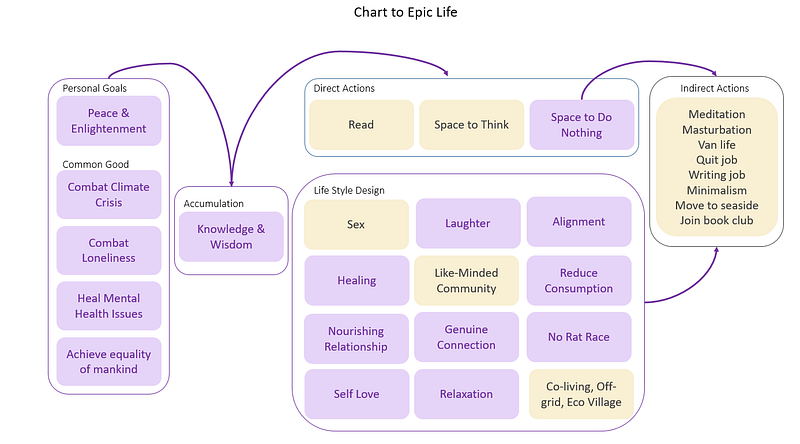
Finally, I have coloured all actions in beige and also added the Indirect Actions box on the last column to consolidate what exactly do I need to do.
Tadah! This is my holistic chart from vision to action. There are things that are unlikely to be achievable immediately such as making a career change and creating a co-living, off-grid, eco-village, but I can start with having a side-hustle of writing for Medium and van life, with the intention that every step will take me closer to my goals.
The chart is clear to always reference and reconsider if your actions match with your goals. Helpful check-ins would be does your current lifestyle match the actions in beige? And, are the actions in the beige boxes match with your goals in purple? We can constantly review that to ensure we’re on the right trajectory to our goals.
Compare to my vision board, my chart concludes a much more concrete action plan. Images like the nose ring and tattoo show the feeling of freedom and a more hippie-like lifestyle, but getting my nose pierced has nothing to do with my goals. It’s still good to have, but if you are making big life changes, you’ll need to be more systematic about it.
Ok now, it’s your turn! Are you ready to turn your vision to realistic actions? I’ve prepared a template for the chart for you to fill in. If you want one of these please enter your email below to get the life-changing chart!
My name is Midori and the above is real. I’m making these changes to create my dream life. I want to have a like-minded community, to connect with people who are passionate about the common good goals. Are you one of them? If you do please follow me on Medium Midori P. Yeung, on Instagram or buy me a cup of coffee!


