
Forget Productivity; Get Better Results by Practicing the Forbidden Art of Pleasure

There once was a little girl who believed that all things would come to her if she was good, worked hard, and always helped other people.
She got straight A’s in school. She was there for her friends. She climbed the corporate ladder, even went to graduate school. She was reliable, steadfast, and trustworthy. You could count on her to always be there for you.
She was working hard to increase her productivity. But while she was grinding away at her job, her well was running dry.
Work began to hold less allure for her.
She wasn’t getting the recognition or satisfaction she wanted from her work.
Her creativity was at an all-time low.
Her downtime was fun, but emotionally draining. She’d party, binge drink, and dance. She had lots of great friends, with whom she traveled and had adventures. Her love life was a soap-opera worthy rollercoaster. Her personal life made her feel simultaneously alive — and on the brink of disaster.
She began to feel many of the people close to her were starting to take her for granted.
She was single and stressed out, and her career was going nowhere. She was in debt and constantly feeling guilty. She became frustrated and bitter. Her life just didn’t look the way she’d always hoped it would.
She often resisted taking the breaks she needed, thinking she had to keep up the grind to be successful.
But eventually, she learned that practicing the forbidden art of pleasure could change her life. She started seeking pleasure everywhere, but in more manageable ways. Here’s how.
1. Make Space for Pleasure
Yes, that little girl was me, and that’s my hustle story. It’s no secret that we live in a world obsessed with productivity in the name of creating our best lives. But what about actually living them?
The physical act of working — either creatively, or for affection — becomes hollow, meaningless, and robotic when that’s all we do.
A work ethic serves us well and is important to develop. But to have a happy life, you need a balance.
When you’re working too hard, you always put aside pleasure and focus on being productive. You think only slackers take breaks and have fun.
But working more doesn’t mean you care more, or get more done. Working in an unsustainable fashion means you will inevitably crash.
Even worse, workaholism takes you away from really living your life and being present. I am all for leaning in. I do believe our future as a society depends on it. But not at the expense of our personal lives, health, or family life.
I believe workaholics do all this extra stuff because they enjoy feeling like heroes. Their high value on number of hours spent working means they will actually foster crises and fire-drills … because this creates more work for them, which proves their ongoing value. They can make people feel badly for working normal hours or taking a break, which leads to guilt, poor morale, and squashes any creative flow that may have been happening.
Problems are inescapable, and pleasure really is unnecessary for a good, moral, productive life. Right?
But with this mindset, in your downtime, you might find yourself still hustling — for your partner, for your family, for affection. You’re doing the emotional work you think is necessary to make yourself worthy of love.
I’m not that little girl anymore. I’m now married with two school-aged kids, a dog, a husband and three businesses to run.
I’m currently in the midst of several home improvement projects. I manage a small team, teach yoga classes each week, write regularly, and am constantly in the creative process.
If I don’t watch myself, I can slip right back into the all-hustle no-pleasure mindset. It hurts me every time.
When I find myself in more hustle than flow, I have to clear my plate of non-essentials, to make space for pleasure.
It is only in this space that I feel peace. I am able to rest. I begin to value my solitude. I can tap back into my lost creativity.
When we aren’t working, we get out of our linear, logical mind. We start to see more than black and white, right and wrong. We move away from critical thinking, productivity, morality, order, hierarchy, and competition. It is in this gray area that we can solve life’s most pressing problems.
Here are ten practices that work:
- Cut back on busy. For me, this includes anything related to the holiday season that does not feel like magic, outsourcing kids’ birthday parties, and lots of Amazon Prime.
- Realize that saying “no” to something good can mean saying “yes” to something better.
- A Social Media “Off-Season” (thanks, John Gorman).
- Gratitude journaling (in a paper journal, not online).
- Ruthlessly limit work hours. Phone is in a drawer, laptop is closed when kids get off the bus from school.
- When I work, devote myself to deep work.
- Follow Jessica A’s advice: “write like a hippie, edit like a Nazi.” (So good!)
- Focus on achieving just three meaningful things per day.
- Simplify, simplify, simplify. Drive less, spend less, consume less. Have few, but high-quality, social engagements. Anything that feels like a drag or an obligation is a “no.”
- At the end of the day, review my “wins”. Give myself a big fat pat on the back for doing something great.
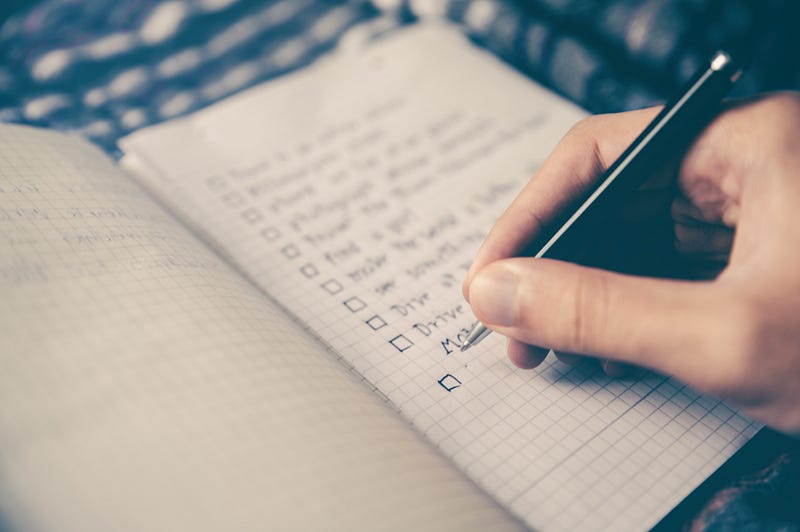
When pleasure is the goal, instead of using checklists and plans like workhorses, I’m now using them as a reminder to slow down. For example:
- Schedule picking up a bouquet of fresh flowers at the store once a month.
- Block off ninety minutes for taking a walk on a snowy path outside, or just sitting in the sunshine, once a week.
- Book sex, or just simple “naked time” with my husband.
- Block off entire days for solitude, friendship or self-care.
When I practice the forbidden art of pleasure, I have to remind myself to let go of thoughts about the future or the past. Thoughts like “I’m not doing enough,” or “I’m falling behind,” get in the way of pleasure. I remember, I am a human being, not a human doing. This takes me away from anxiety, worry, and fear. I can rest in the knowledge that I am enough, just as I am.
2. Respect the Detours
When you’re working toward a goal, you’re teaching yourself to put off pleasure until the next milestone is met.
A linear mindset, where we’re focused on getting from point A to point B at all costs (otherwise known as “goals”) forces us to plan out where we will be and when we will make it there.
We predict when we can make progress, even though we have no idea what circumstances or situations will arise along the way.
When we push ourselves to lose weight, succeed in business, hit that money target, become an Instagram sensation or write the best-selling novel in a specific timeframe, we are focusing on outcomes. When we do this, we often miss little detours along the way.
To reduce stress, I have found that focusing on, even falling in love with the daily process — the things you need to do to accomplish your goals, not the goals themselves — is better. In yoga, this is called “the practice.”
For many years, I felt very disconnected from my body. I had trained myself to dislike it, judge it, and put off feeling good, to suffer. I thought that through suffering I would be able to improve my body. So, I’d sit longer, outworking my competition at the office. I’d eat less, ignoring the hunger pangs, thinking this would help me get from “A” (unhappiness) to “B” (a supposedly happy, ideal weight or shape).
But the body sends these signals for a reason. If you fail to listen, the body will speak louder — usually in the form of injury or illness. I ended up with both.
Making time to do yoga almost daily at a studio became an essential key. It gave me space, community, joy, a healthy connection with people, and a way to unplug. It was the pressure valve I needed to find release, be myself, and explore my creativity.
Yoga has allowed me to tap more deeply into my instincts, feelings, and bodily sensations. Yoga is a pleasure for me, because the yoga pose is not the goal. Becoming flexible is not the goal. Standing on my hands is not the goal.
The goal is to not have a goal. In the practice, I can create space where I was once stuck. Deconstruct the fortress I’ve built around my heart. Appreciate my body for what it is, right now, in this moment — and understand that its form is ever-changing. Become aware of my mind, and its ceaseless chatter. Make peace with who I am, right now. Find the source fire, the love within my heart.
Unlike previous workout regimes that created an endless cycle of goals, self-judgment, and pain, with yoga I’ve begun to experience the awe, connection, intuition, and simple joy that comes with practice — for the sake of the practice. Instead of focusing on getting from “A” to “B”, I’m present to experience what happens along the way.
In respecting the detours, I have allowed myself to notice beautiful little accidents. Can’t stand on my hands today in yoga class? But wow, I nailed that forward fold!
This can be true for anything you do just for the sake of doing it. When we fall in love with the daily practice, we notice all the beauty in the journey.
3. Let Go of Guilt
Let’s say your Grandma believed that you can only be two things, selfless or selfish. She saw life as having two options: get what you want, the consequences be damned — then feel incredibly guilty afterward.
Or, do unto others without a thought for yourself. Sacrifice your wants, needs, and desires. Put aside personal pleasure, and play the martyr. When you slip up and take pleasure for yourself, feel guilty.
Those are your options.

The problem with this guilt-ridden way of thinking is, it’s been shown to make us do more, not less, of the behaviors we feel guilty about. Psychologists have shown that people will actually indulge less when they don’t feel guilty about indulging.
My upbringing in the church involved a lot of guilt about how to live. As a result, for much of my life, I wondered: why does it feel so good to be so bad?
It was only when I threw away my scale and stopped weighing myself obsessively that I stopped feeling so badly every time I ate something. This freed up time to focus on the pleasures of eating healthfully.
I believe the forbidden art of pleasure is why some Mediterranean cultures, especially the French, seem to be able to eat whatever they want.
Instead of super-sized portions, they eat the best quality food. Instead of driving everywhere, they take pleasure in fresh air, lower-stress public transit and walking.
Our guilt-ridden American culture has us in this cycle where we’re punishing ourselves for eating, but never really taking pleasure in food.
We think we need to do everything bigger, better, faster. We drive our cars right past and fail to stop and smell the roses along the way.
Guilt is a worthless emotion, with maybe one exception: when we’re demonstrating remorse over actions that harmed someone else. Most guilt is self-directed, after perceiving that we’ve failed to live up to someone else’s expectations. If we take a really good look at why we feel guilty, we will probably find that the thought process is not our own. It was something passed down to us from someone else. Like Grandma.
Practicing pleasure doesn’t have to be selfish or hedonistic. It might be necessary to access creativity, higher purpose, our very “why” for being on this planet in the first place.
4. Make it Worthwhile
Nothing great was ever achieved without enthusiasm. — Ralph Waldo Emerson
In work, pleasure is about opting out of the rat race, so that you’re free to create something worthwhile.
Many of us workaholics are susceptible to addiction issues because we mistakenly think we can get the energy we need to keep us going from a source outside ourselves, like food or alcohol.
But overeating, overworking, over-anything only throws our bodies and minds further out of balance, which leaves us craving the next high.
The forbidden art of pleasure isn’t about full-blown hedonism. It involves focusing on quality rather than quantity. Letting go of guilt, bringing elegance to everything we do. It’s about sampling the finest wine and cheese and chocolates, not having them as your main course. After all, feeling “stuffed” or hungover is the anthesis of pleasure!
When you’re less deprived, you’ll find you’re less susceptible to those blackout-worthy binges.
Before I realized the consequences of my workaholism, I was caught up in being “so busy” and wearing that like my lame-ass badge of honor. But I was just spinning my wheels. Stuffing down that small voice inside.
Our modern consumer culture is good at making us want more, presenting us with options, distractions, and defining for us what it means to “live well.” The usual result is dissatisfaction with our lives as they are, and a feeling we are unfit to be loved as we are unless we have more.
But who says we have to live by their rules? We can feel pleasure here and now when the life we are living lines up with our most deeply-held values. “Stop and smell the roses,” isn’t just something nice to do along the way. It’s the whole point of my life.
When we’re needy, guilty, pushing too hard, or overly judgmental of ourselves or other people, we block what we most want from becoming a reality in our lives.
When we believe that what we are doing right now is worthwhile, and go after it with enthusiasm, our entire lives become worthwhile. Even the littlest things.
5. Allow Pleasure to Permeate Everything
This is not a slam to the hustle or the grind. We all need to hustle, because our hustle does the heavy lifting to get our work into the world.
It’s just that most of us falsely chase hustle as our god, our one true goal.
It’s idolatry.
After a good swim in my pool of pleasure, I can come back to my work with a heightened focus. A new insight. I can create something I care deeply about. The final product often carries an otherworldly power that touches others, conveys meaning, heals hearts, creates connection. There’s a life force in it.
But when I forget about my forbidden pleasure place, I log the hours and grind my way through — and the result is not very inspiring.
When I don’t practice pleasure, my work suffers. My life feels empty and hollow. I start wondering, what’s the point?
Then I remember that pleasure, that why. It’s the source of my creativity and motivation. It’s where I rediscover my wild devotion to my work, and what called me to it in the first place.
I come back revived, refreshed, inspired. With a new perspective. I feel safe and good. I feel convicted, courageous and connected — because I am.
6. Tap Into Your Higher Calling
Whatever spirituality means to you, most people believe they were put on this planet for a reason.
Whatever your faith tradition, most of us believe in a higher calling, a higher purpose, a bigger plan. We may doubt the plan or our ability to live it out, but the bigger picture or universal energy still exists. Even if we don’t believe in some grander scheme, that it’s just ashes to ashes, we still typically want our lives to have some sort of meaning or trajectory. We have a calling, or some mission to achieve.
When I was hustling, it was often because I believed I wasn’t worthy, I wasn’t unique, I wasn’t an expert — so why should people listen to what I had to say? My focus was on what I was lacking, and what I had to prove.
Practicing pleasure means switching my focus to all-out gratitude for what is already mine. True abundance is happening now, in this moment. I don’t have to do anything more than give thanks and luxuriate in the pleasure of that knowledge.
I also know for certain that I have a message to deliver, and I must follow through on getting it out there to my people. I am the hands and feet of a life force, an energy, a wisdom that is expressing its truth through me. If I can tap into that higher calling, the entire world can be transformed.
At work, we typically care about the tangible, the numbers, the bottom line, the final product. But when that final product has been touched by the divine, it becomes radically more worthwhile.
Our life’s work is so much bigger than we are. God, the Universe, whoever you believe in — chose you to birth something specific into this world, because the world needs what we each have to offer. Not because of you, by yourself. But because the world would be missing a piece of itself without your contribution.
The little girl is now a woman, able to step away from her keyboard, slip off her earthly entrapments, and dive headfirst into the medicinal waters of pleasure whenever she likes. She’ll loll around for a while, letting it really soak in. When it dawns on her that she is in charge of her life and her pleasure, she is finally able to start practicing it herself, instead of waiting for someone else to give it to her.
But this is a daily practice. By adding the forbidden art of pleasure back into her life, she daily rediscovers her voice, and her true purpose. She can come back to her work with more meaning, clarity, and conviction. She firmly believes that you can, too.
About the Author
Hi there! I’m Amanda Jenkins, Creative Director at MarketIQ, a Multi-Business Owner, Digital Nomad, Yoga Instructor, and Mom. If this article resonated with you, please subscribe to my personal blog. You can also get to know me better on these social platforms: LinkedIn, Twitter, Facebook, and Instagram.