
Forever Autumn
The famous painting of an autumn scene by John Everett Millais poetically captures a moment of transient beauty
“The first instance of a perfectly painted twilight.” That’s how the influential art critic John Ruskin described Autumn Leaves, painted in 1856 by John Everett Millais. Millais explained it as, “something full of beauty, without subject,” and so it was hailed as an early influence on the Aesthetic movement and a paradigm of art for art’s sake. Of course, the image clearly does have a subject, as well as a poetic narrative, and employs the kind of symbolism the artist was already known for.
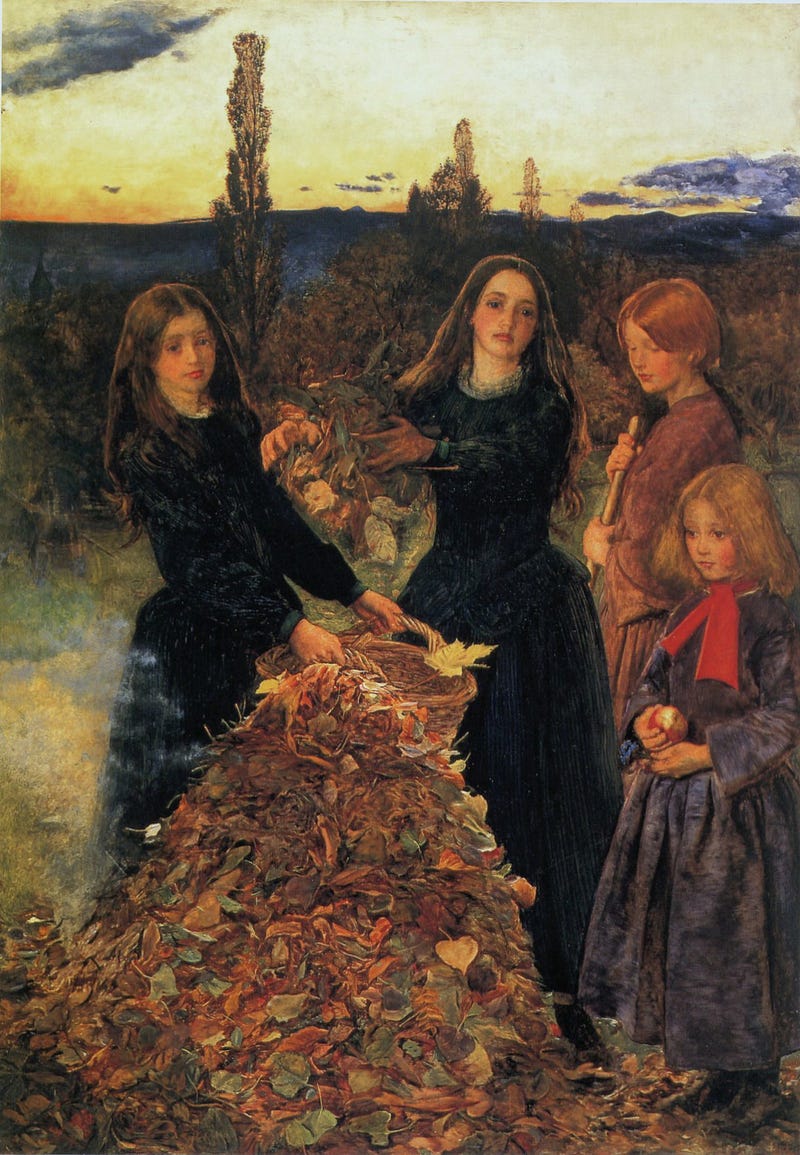

Its magical realism captures the last light of early sunset which is around 4 p.m. in the Northern Hemisphere as we approach Winter Solstice. The girls that pile the autumn leaves into a smoking bonfire are set against a beautiful landscape that seems timeless and yet fleeting in its seasonal transition.
Millais was a talented artist and had been accepted to train at London’s Royal Academy in 1840, when he was just 11 years old — the youngest ever, to this day. Autumn Leaves was painted sixteen years later, shortly after he became an Associate of the Royal Academy. It seems to be a poignant celebration of youth and beauty, avoiding the mawkish portrayal of children common in much Victoriana.
The palette is dominated by a warm, almost golden light that unifies the composition. The colour of the leaves is picked up in the hair and faces of the girls, and draws the eye skyward. Yet it is the solemn gaze of the two girls in the matching dresses that pulls the viewer back into the moment. Their fine dresses are dark green, and they are of a higher social standing than the two younger children, one of whom leans on a garden rake, while the other holds an apple, perhaps just picked from a tree.
The girl at the centre was Sophy Gray, the girl to the left her younger sister, Alice. Just a year earlier, in 1855, Millais had married their older sister, Effie, so these were his sisters-in-law. Effie had been in a loveless marriage with John Ruskin and had met Millais when she modelled for him. They had fallen in love and her prior marriage had been annulled.
It has been suggested that young Sophy also fell in love with the artist, and though he certainly had affection for his sister-in-law and they were, by all accounts, very good friends, the infatuation remained one-sided. Though, clearly, he has shown great care and sensitivity with her portrait here. Her face is aglow and her eyes sparkle with the greatest clarity, indicating that she is the central subject and captivated the artist’s eye as well as the viewer’s.
Autumn Leaves was painted in Perth, which was Effie’s family home in Scotland, and the Gardens are now an urban park with a sculpture by Tim Shutter which commemorates the view shown in this painting. The trees have grown thicker and a church spire now intrudes into the skyline, but the effect of their silhouettes against the bright sky is still much the same.
The painting became a popular, often reproduced image and entered the European cultural consciousness, inspiring other artists and poets over the years. It is thought to have part-inspired the song, Autumn Leaves, first recorded in 1945 that became a jazz standard, featured in at least two films, and has been recorded by an estimated 1,400 different artists.
Millais is of course famous as part of the Pre-Raphaelite Brotherhood which first gathered at his studio in Gower Street, London. His loving attention to details of the natural world is still in evidence as one examines all the different shapes and shades of the autumn leaves gathered into a precarious pile. The soft light and trails of smoke are evocative of precious moments before darkness calls the children inside. He was known to use deliberate symbolism as a narrative element in many of his well-known works, the 1852 painting Ophelia being a prime example.
So, the metaphor of the seasons for periods in life is probably intentional, with autumn being an end to the carefree days of summer, before the hardships of winter. Changing seasons also speak of the passing years and here is a superior example of art being used to arrest that relentless process. It became a Victorian obsession to record youth in its state of vibrant health. The Pre-Raphaelites often sought to celebrate ‘unsullied’ feminine beauty before the loss of innocence and the ravages of experience exerted their irreversible influences.
The dead leaves are perhaps the remnants of youth, now piled high to contain a smouldering heat, a hint of waking passion yet to be fully inflamed. The garden setting and the youngest girl taking a bite from an apple would’ve had obvious Biblical connotations. Millais was to write that he, “intended the picture to awaken by its solemnity the deepest religious reflection.”
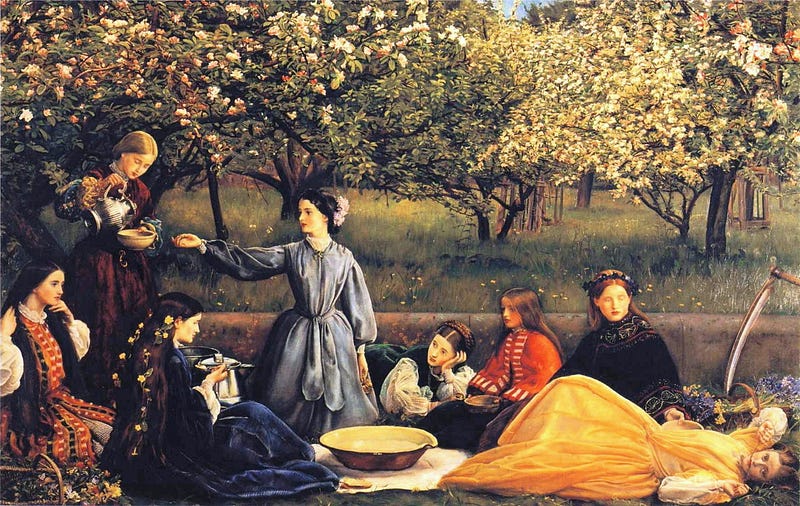
In later years, he would go on to explore other portraits of childhood, some also including Sophy — most notably Spring, which is almost a Botticelli-style gathering of young maidens beneath trees laden with blossom. It was painted shortly after Autumn Leaves and Sophy is at the far left. It is a bright, perhaps optimistic image, though the intrusion of the scythe at the right of the frame brings darker associations.
Some of his paintings of idealised children were later used for Pears Soap adverts — the popular images known as Bubbles and Cherry Ripe were widely reproduced as prints that appealed to Victorian sentimentality. This was a commercial venture which helped him finance an ever-growing family and sparked debates about the relationship between art and advertising.
.JPG)