
For Whom The Bell Tolls
My poem on the Biafran Civil War
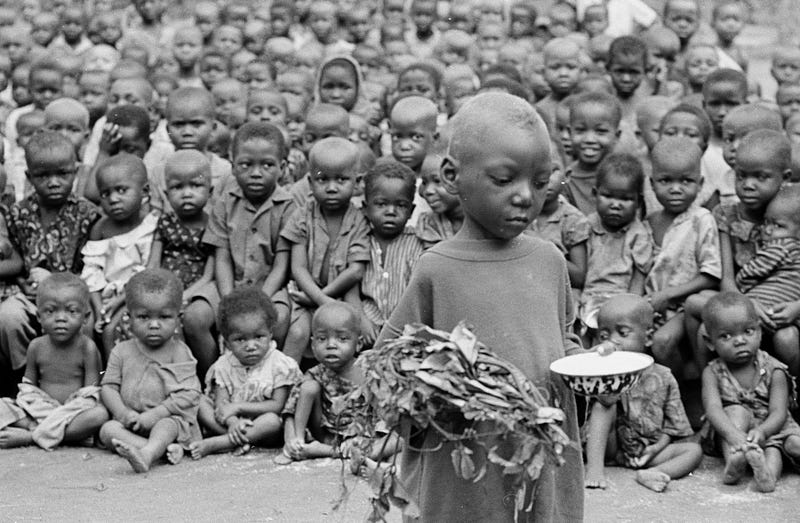
Biafra, You Broke Our Hearts
I was 13 then when the war was declared over. In the aftermath, it is now too late. How will I ever know what demons haunted my parents’ nightmares. Dead children the next morning, I remember My mother’s words. Although fed the night before With hope and trickled down food from the few Nations who dared. Cleansing their guilt over the swollen eyes and bellies of televised skeletons. Every crevice covered in flies, quietly whimpering in the thin hapless arms of their emaciated and parched mothers. Bombs over the hospital, my sister cringing years later at the sound of a plane overhead, running to hide under the table. My brothers’ best friends, soldiers in the wards of my overworked and underequipped father, wounded and limbless, but proud to let them, my young brothers, fondle their machine guns. Boasting the numbers of Nigerian soldiers they’d killed in battle. Their battle! For what?, I ask. Shell-shocked distraction from a brutal war? All those children and innocent civilians starved To a painful death. For what, I ask again? What for?
The guilty, on all sides, forever guilty. And although Dead they shall not be left to rest in peace, amen, For I shall, parade them again, and again with my words. We have a lot to pay for, some might say ‘pray for’ And wash away their hands.
Fast forward 2019
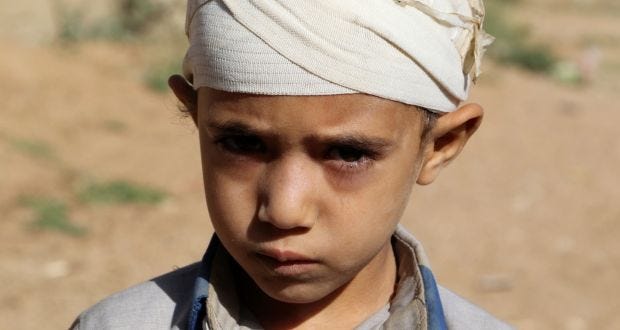
Another brutal and heartbreaking political player’s field is Syria. How long has this civil war been going on? Into its eighth year with an estimated 400,000 deaths. And although declared over, and ISIS beaten, by Donald Trump, the fighting seems far from over.
I so often read and hear the same old rhetorical mantras, reiterated in, “Things will never change, will they?”, “Will we never learn?”, or “History always repeats itself, doesn’t it?
Well, yes, it doesn’t look as if we will ever learn.
There is no guarantee for peace
Biafra
I only have to think of my own personal lifetime and memories emerge of another war, one in which my family was involved: The Biafran War from 6 July 1967 to 15. January 1970. After watching an RTE (Irish National Radio and Television Service) documentary on Biafra last year which was both revealing and shocking, I felt so emotionally drained after it and, in my grief, wrote my poem, Biafra, You Broke Our Hearts.
I would like to share the documentary as a reminder of how we should not close our eyes to the effects of war just because it’s happening far away from us. We should, too, open our hearts to the suffering of those who through no fault of theirs have to flee their homes in order to survive.
The film, almost an hour long, was made in Biafra and Sao Tome in 1969 at the height of the civil war and documents the role of the Irish missionaries during it. Whatever my personal thoughts and opinions are of the Catholic church, after watching this documentary, I have to express my respect and admiration for the many Irish nuns and priests who remained throughout the war and through their endeavour and dedication saved the lives of thousands of malnourished and starving Biafran children.
Thousands and thousands of documented and undocumented lost souls, the exact number unknown forever
I also give credit to the Irish people who, although their government failed to recognise Biafra, gave so much support and provided so much aid relief to mitigate the situation of the Biafran civilians. And once again, to the individual Irish nuns and priests who through their persistence and resolve awakened the eyes of the world to the truth.
The documentary is not always easy to watch as it details a painful picture of the effects of war on the civilian population, especially children. It begins quite harmlessly with interviews with some of the Irish clergy on the situation in Biafra, however, the tragedy unfolds dramatically. At times, I had to look away and just listen to the reporter when I saw some of the scenes of starving children. It is, though, a wonderful story of love, dedication and simply standing up to what you believe in. And giving voice to those who cannot defend themselves.
No child should have to suffer the wrongdoings, to put it mildly, of those in power, whatever side
On a more personal note, my father is one of the doctors mentioned in the documentary who worked in the Holy Rosary hospital in Ihiala near Uli airstrip, the last to fall before Biafra finally surrendered in January 1970.
Postscript
Those who were never brought to justice, are mostly dead now, having allowed the killing of so many innocent children and civilians — an ongoing disaster. Bent only on securing their own interests, I make the political rollcall… Nigeria…Britain…Russia…China… the USA…and more… yes, and even you, President Ojukwu who could have put an earlier end to the war.
I acknowledge and thank poor countries like Haiti and Tanzania for recognising Biafra in her plight but had no voice to support her. And yes, there were countries like France who sent relief aid to Biafra but mainly for political and economic gains.
No political decision-maker really cared, nor ever does


