
For those still in search of The Meaning of Life
This may not be the answer you were looking for
In Douglas Adams’ iconic comedy sci-fi The Hitchhiker’s Guide to the Galaxy, a supercomputer called Deep Thought takes 7.5 million years to calculate The Answer to the Ultimate Question of Life, the Universe, and Everything. The answer is 42. The story is of course a parody of what seems to be a deep philosophical question: What is the Purpose of Life? or, Why Are We Here?
The Spiritual View
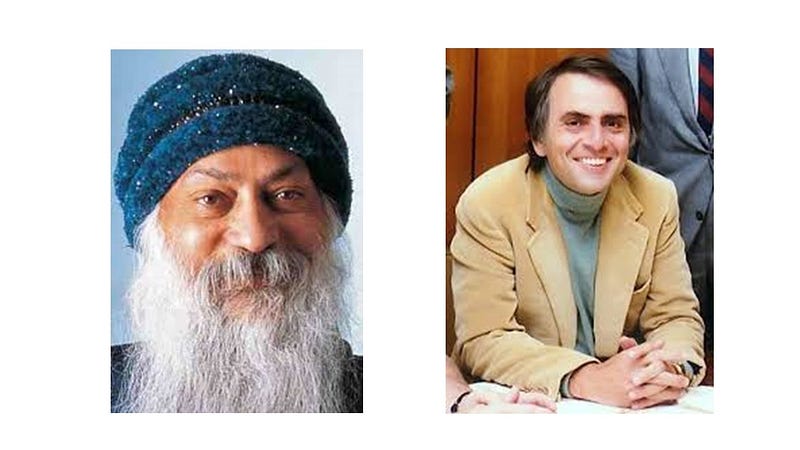
Here’s a quote from Osho, one of the most popular spiritual thinkers from India who also had a huge fan following in the West;
Each person comes into this world with a specific destiny–he has something to fulfill, some message has to be delivered, some work has to be completed. You are not here accidentally–you are here meaningfully. There is a purpose behind you. The whole intends to do something through you.
Hmmm, deep stuff. Unfortunately, the same Osho is also credited with this;
It is very difficult, particularly for the Western mind, to understand that life is purposeless… Life has got no purpose and this is the beauty of it.
Meanwhile here’s a quote from the celebrity atheist Richard Dawkins;
The universe that we observe has precisely the properties we should expect if there is, at bottom, no design, no purpose, no evil, no good, nothing but pitiless indifference.
And then there is Carl Sagan who says;
We live in a vast and awesome universe in which, daily, suns are made and worlds destroyed, where humanity clings to an obscure clod of rock. The significance of our lives and our fragile realm derives from our own wisdom and courage.
How did we come to have such contrasting answers to such a simple question? Is it even a question that deserves a serious answer?
The Two Meanings of ‘Why’
Most people would agree that the English language is full of idiosyncrasies. Here’s one that the philosopher Daniel Dennett¹ points out — the word “why” can have two different meanings depending on the context. It can mean “how come” which asks for a cause e.g. why is the sky blue? It can also mean “what for” which asks for a reason e.g. why are you running? This is not true of every language. For instance, in Spanish you ask como for “how come” and por que for “what for”.
In dealing with why (as in “what for”) questions, traditional worldviews tend to have an anthropocentric bias, assuming blithely that Nature provides things for the benefit of humans. Here we have Ray Comfort, a Christian evangelist, to tell us all about it —
Before Darwin, these were the only kind of answers you would get for why questions relating to the natural world. For instance;
Q. What is a river for?
A. To give us water (or run boats on…)
Q. What are trees for?
A. To give us fruit (or wood or shade…)
Q. What are mosquitoes for?
A. 😕
To give us… malaria?
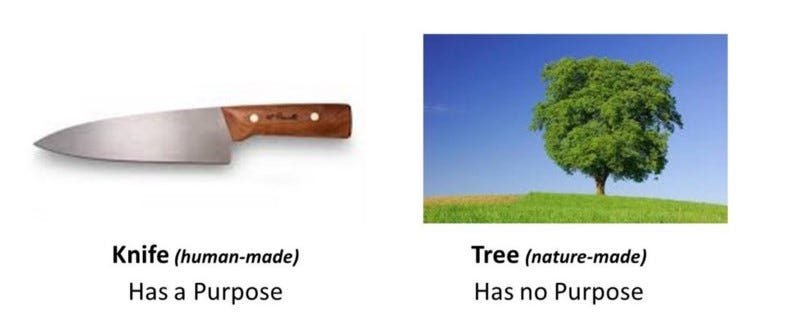
It is quite meaningful, however, to attribute purposes to human artifacts (“man-made objects”, to use a sexist phrase) — just ask the human who created or designed it! For instance;
Q. What is a knife for?
A. To cut things with
Design Without Designers
Science ultimately reduces every “what for” question to a “how come” question. For the living world, this is done by invoking the theory of Evolution by Natural Selection.
Living things appear to be so well-designed it’s impossible to not ask “what are they designed for?” But there is no need to assume an Intelligent Designer to account for the design. It’s a product of the mindless churning of the engine of natural selection, a blind process with no goal and no foresight. Any purpose that we attach to the products of natural selection today, are purely in hindsight. The philosopher Daniel Dennett calls this Design Without Designers, and it is the only kind of design there is in Nature.
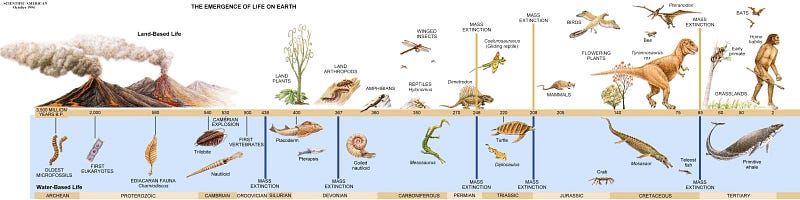
This idea applies equally to all organisms and, of course, that includes us. Starting from the earliest replicators, we are all products of evolution by natural selection. It provides the only scientific answer to the question “where did we come from and why are we here?” But this time, why can only mean “how come”. Since reasons and purposes are never represented in Nature, but only retrospectively attributed by human minds, there isn’t anyone out there to answer our “what for” questions. This leads us to the central argument of this post: The notion of purpose applies only to human-made artifacts and is meaningless for things that occur in Nature.
The Purpose of Purpose²
Saying that there is no purpose behind the existence of life in general is obviously not the same as saying that your life has no purpose. Your purpose as an individual is anything you want it to be. I want to save the planet, I want to be a loving parent, I want to be a good software programmer, are all purposes worth having. But most people find it hard to shake off the feeling that they, and others they care about, have a predestined purpose, one decided at birth by a “higher power”.
There could be several reasons why we have this strange intuition. First, it could be a byproduct of our ability to represent goals, even lifelong goals, and pursue them without getting distracted. For instance, studying hard in school in order to get into a good college in order to get a good job in order to send your kids to a good college… This sort of long term gratification postponement is something unique to the human species. It is also something that is readily subverted. That is, the behaviours originally designed in aid of survival and reproduction, the only “goals” that Nature has for us, can get deployed toward purposes that are irrelevant or even inimical to it (celibate monks and suicide bombers come to mind).
Second, humans being the tool-making species (not the only one but the most sophisticated by far), have the ability to visualize the end-product of a long series of steps prior to performing them. At each step, we have a ready answer for the question “why are you doing this?” We live in an artificial world surrounded by human artifacts for which it is perfectly rational to ask the question “what is it for?” So we find it somehow meaningful to extend these “what for” questions to the products of Nature. We start to imagine that rocks, rivers, trees, animals, and other people have purposes defined by their Creator. But what if the Creator turned out to be as dumb as the primordial soup from which life might have emerged?
Notes
¹ Dennett’s ideas around the theme of this post can be found in Darwin’s Dangerous Idea (1995) and From Bacteria to Bach and Back Again (2017)
² The section title is the name of a 2009 lecture series by Richard Dawkins available on YouTube


