
Rewilding
For the Love of Wildness
Embracing nature in the modern world
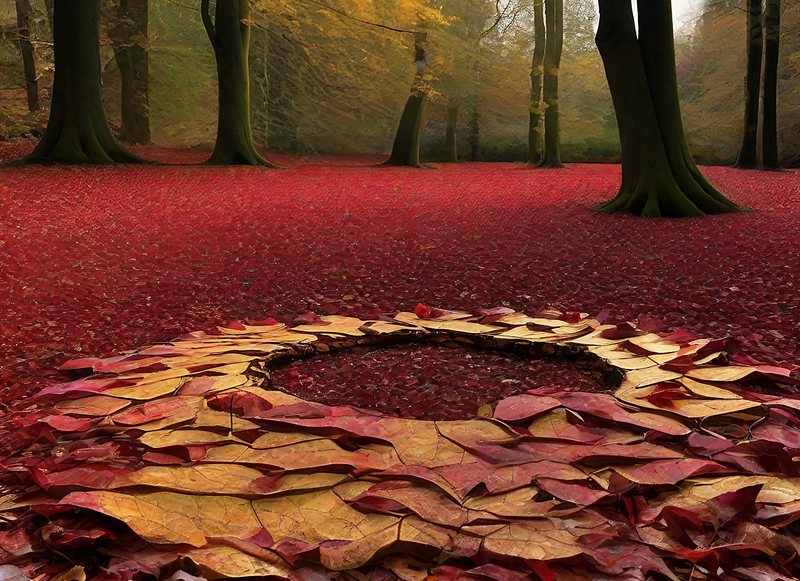
October, and the leaves hissed in the canopy above, like gravel on the seashore. The creaking and groaning of the larger boughs spoke of a restlessness in the air that had replaced the sleepy days of summer.
Even down on the woodland floor, the occasional gust lifted my hair, and the constant fall of leaves was like a rain of fire.
I stood and surveyed my work, bent to make a minor adjustment, then stood again and stepped back. I knew the mosaic of coloured leaves I’d been creating for the past while (time meant less in those days) would not last out the coming storm, but maybe it would remain long enough for a fellow walker in these woods to come across it with surprise and delight, a memory to help make their day.
If not, and subtly graded array of golden and crimson leaves, winding like a dragon between the tree roots, was whipped away in the wind before another human eye could see it, so be it. It didn’t matter.
The value of this art was in its creation, not its permanence.
I was inspired, of course, by the work of Andy Goldsworthy, who’s sculptures of leaves, twigs, stones and even icicles adorned the glossy pages of a large ‘coffee table’ book I had at home.
That was before I had access to the internet. In many ways, Google killed the magic of the world. Nowadays, thousands of such creations can be viewed online at any time, but back then the beautiful works of ephemeral nature art between the covers of Goldsworthy’s book were the only examples I had, and I’d seen nothing else like them.
I spent hours in the woods, not exactly trying to emulate Goldsworthy’s creations, but inspired by him to create my own natural art from leaves, twigs and rocks. It was a kind of dynamic meditation that sometimes absorbed my attention for so long that my ever-present companion Annie, a chocolate Weimaraner with boundless energy, would eventually stop chasing the scents and rustles among the trees and undergrowth, and settle down by my side to wait.
Soothed by the soft hissing of the trees and the delicious mushroomy aroma of the deep humus, I would lose track of time. When I eventually finished, or felt the urge to move on, I would stand up and stretch, Annie would stand up and shake the leaf-litter from her smooth coat, and we would head off long the trail. Annie would bound ahead and sometimes, if the spirit moved me, I would take off with her, sprinting through the trees and across the fields together in joyful abandon, startling birds and squirrels as we went.
Well, Annie is long gone, buried somewhere on Dartmoor amid the wide open spaces where she would love to run for miles, and life for me is no longer as carefree as it was back then. But I still love wildness. Always have.
Here in the UK wildness is not the same as wilderness — these small isles are too overpopulated by humans and sheep for any part of them to be truly called wilderness — but I’ve always been drawn to ancient and wild places. I’ve always loved finding old ruins in the forest, or derelict houses with no roof and trees growing up through the floor.
I’d rather discover a half-hidden path through the woods than trudge along a barren pavement in the city.
I’ve always preferred flocks of birds over flocks of tourists; swarms of butterflies over swarms of shoppers.
I’ve always much preferred overgrown gardens to carefully planted and manicured flower beds. Over the past few years, my wife and I have deliberately let our garden grow increasingly wild.
Inspired by the Blue Campaign for rewilding, and by Nature herself, we’ve turned more and more of our garden over to the wild plants that most people would call ‘weeds’. Thistles and nettles abound, providing food for the caterpillars of red admiral, tortoiseshell, comma and peacock butterflies through the spring and summer, seeds for goldfinches and other birds in the autumn, and shelter for a myriad of small critters through the harsh months of winter.
Rather than set aside patches for these wild plants, we let them grow where they will and cut winding, criss-crossing pathways through them. Various trees and shrubs have self-seeded, and we now have willow, birch, oak, alder and hawthorn, adding height and diversity to the garden. Brambles grow like wildfire around the perimeter, providing nectar for pollinators, cover for nesting birds, and fruit from midsummer and well into the autumn.
Although not a native species, and frowned upon by rewilding purists, we’ve also allowed buddleia to seed and grow to maturity all around the garden, providing an abundance of nectar throughout the summer months for swarms of butterflies and bees. Moths feed on it at night, attracting bats, and there’s always frogs, the occasional toad and a wide range of birds that feed or breed in our modest garden.
It’s not exactly a woodland, but it gets wilder every year, and it’s our way of giving back to the Earth, of doing our bit to help restore some valuable wildlife habitat and offset some of the damage done by the human race in the name of ‘progress’.
Between us, we may not be able to save the planet, but we can do our best to provide a safe and peaceful wild haven in the meantime.