
For the Eyes of God and Birds
A free verse promise — I will write a poem.
Listen to the soundcloud recording while you read for background sounds and a reading of the poem:
If tomorrow my words get swallowed up in darkness become swept away, sucked under dismantled, disarrayed — I will still, write a poem.
If no eyes bend side to side scan, absorb, and envision my metaphor, paint within a fluid scene, and linger there — I will still write a poem.
If I woke up tomorrow with sand beneath my face, the gentle nudging of white-lipped waves pushing and pulling at my feet, if I didn’t know who I was or how I got there or how I’d ever get out of that deserted, tropical place I’d have to find some kind of way to write a poem —
Perhaps I could scratch it out in the sand for the eyes of God and birds pull the long fingers of a palm frond together and trace out the lettering words upon words to settle with the currents of wind to be taken with the tide one dissolved thought after another —
Even in the washing away of them I’d still write poems
Let trees rise from my words. Let mountains rise and puncture the sky, a gentle nod to earth.
Let the dust of these words lift and disperse, carry on into measures of songs to be sung, of heartbeats to be drummed of the breathing in and out of seasons upon seasons
eternal, these births of poetry I am the womb that they be born the matter at hand
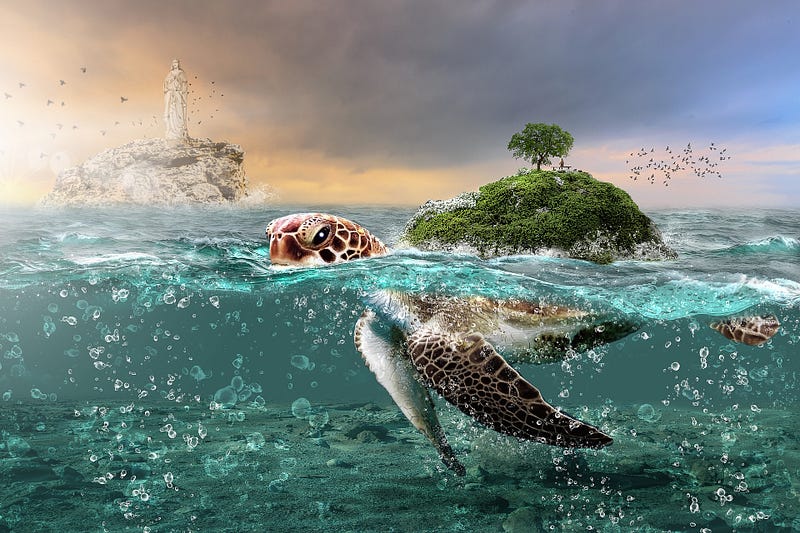
whether they swim racing into currents, riding the backs of greens loggerheads, or twist themselves back into conchs (from whence they likely came) or whether they burrow into minds and disrupt synapses twist into memory — it is no matter to me.
Whether of seahorses (genus Hippocampus) adrift in seaweed hideaways spurning young, gathering plankton futures tied to the life of coral beds, bleaching death-white Or whether of mind matters (also, Hippocampus) adrift in coffee conversations between humans interacting with humans, their predilections just behind the pursing of lips
it is no matter to me a poem is birthed, nonetheless where it goes afterward is on the whims of wind
the un-birthed poem reaches out to me and asks to be given voice
not eyes, not destination not purpose, necessarily —
The fetus poem kicks and claws for birth, squirms and rages and screams and sings and begs for life — not eyes, not eyes, but voice
Without the scanning of eyes across the horizon of words it is of no consequence to me
I will write a poem —
I’ll release it to the sea. Let the breath of conchs devour their own.
Christina Ward is a poet and nature writer from North Carolina. She is the admin of a Facebook Group named Poets on Medium (POM), the editor of seven publications, and a Top Writer in seven tags. You may follow her work or become a fan here: Fiddleheads & Floss Poetry
If you enjoyed this poem, you may also enjoy:


