
For Osteoarthritis, Surgery Is Not Inevitable
A guide for treating and delaying the progression of osteoarthritis

He couldn’t believe it. Three months ago, he thought I was blindly optimistic about his condition, trying to help him avoid an inevitable future. Turns out, he really didn’t need surgery to alleviate his knee pain.
Tom (I changed his name for this story) came to my physical therapy clinic with severe, persistent knee pain. He had a three-year-old grandchild he wanted to play with but was restricted by his ailing right knee. He couldn’t play on the floor unless he had furniture nearby to grab and use to pull himself back up. Even then, he was limited to only a few minutes until the knee pain became too much to bear.
Navigating stairs was miserable. Tom stopped going on long walks with his dog. He frequently canceled golf outings with his friends. The knee pain was a constant in his life.
After reviewing the X-rays with his doctor, Tom was resigned to needing a total knee replacement. Before proceeding, he needed to complete a quick bout of physical therapy (PT). Many insurance companies require attempting conservative care before authorizing surgery.
And so, Tom ended up in my clinic, eager to knock out the minimum visits necessary to satisfy his insurance company and surgeon. But I had other plans for Tom.
Given my training as a certified specialist in orthopedic PT, knowledge of the current research, and clinical experience, I was not convinced Tom was destined for surgery. I have treated similar cases with much success. Tom had a chance to fully rehabilitate his knee with conservative care, focusing on changes to his exercise, diet, and sleep habits.
This does not mean surgery is never warranted. In my 10 years of clinical practice, I have recommended surgery a handful of times. I have cautioned against it countless more.
Treating osteoarthritis conservatively
I explained to Tom that the combination of exercise and lifestyle modification can do wonders for knee pain. It can also delay the progression of osteoarthritis. He wasn’t convinced but also didn’t like giving less than full effort.
He agreed to my care plan which largely follows published research programs. These programs are strictly a starting point. A care plan needs to be personalized, accounting for goals, medical status, exercise history, available exercise equipment, current nutrition habits, and motivations.
The journal Osteoarthritis and Cartilage published the results of a research trial in 2024 that assessed the clinical and cost-effectiveness of a structured conservative treatment program. The physical therapy led program included education and exercise. Over 8–12 weeks, the participants completed 1-hour of supervised exercise twice a week.
The PT prescribed individually tailored resistance exercise programs to increase muscular strength. Most exercises were 2–4 sets with 8–12 repetitions at 60%–70% of 1 repetition maximum. They were instructed to lift until failure. If they could perform two extra reps, such as 12 when prescribed 10, then the resistance was increased. This aligns with research that suggests lifting at or close to failure is best for building muscle and strength.
The participants were also prescribed 30–60 min of cardiorespiratory exercise (brisk walking, running, or bicycling) to be completed at home. Lastly, they were each offered an optional 10-hour Healthy Eating Program. This was in addition to the initial 3-hour education each participant received.
When compared to a control group who received usual care (primary care visit with recommendations for lifestyle changes), the PT-led group reported higher satisfaction, opted for fewer surgeries, and spent fewer healthcare dollars over the following 12 months. These findings align with other trials, showing conservative care can lower the odds of getting surgery.
That’s great news, but this is still a zoomed out view. How do you personalize your treatment to increase the odds of success?
Exercising with OA
There are many ways to exercise and find success. Let’s start with the simplest strategy first.
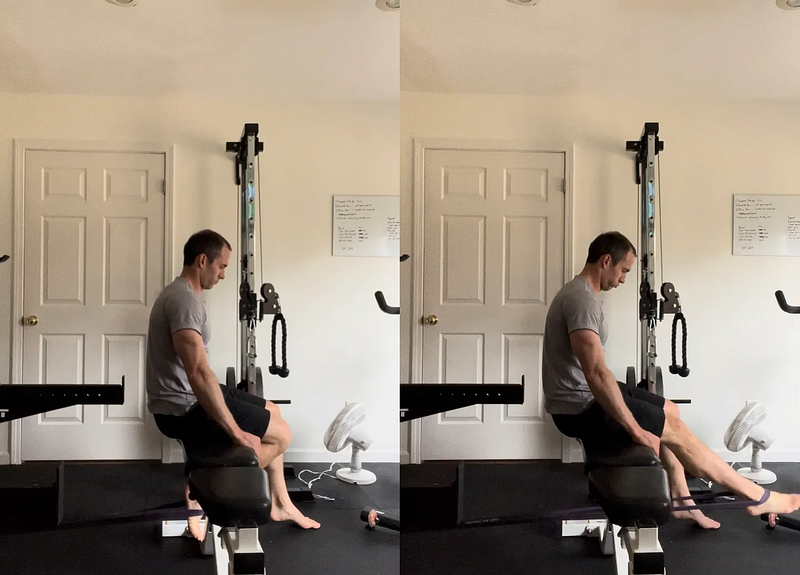
Performing just one type of exercise twice a week can help prevent total knee replacements, according to a 2022 research trial published in Osteoarthritis and Cartilage. Seated on a chair, patients engaged in knee-extensor resistance exercises using an exercise band secured around the ankle and attached to a door behind them. The leg was extended until the knee reached full straightness, creating tension in the band.
For each session, participants completed three sets of twelve repetitions, adhering to a specific tempo: a 3-second concentric (straightening) phase, a 1-second isometric phase, and a 4-second eccentric (lowering) phase. The resistance selected mirrored a twelve-repetition maximum, and patients were directed to continue until reaching volitional muscular failure. The exercise routine was implemented twice a week, with each session consisting of 3 sets of 12 repetitions.
Out of the 117 patients who underwent follow-up evaluations following 12 weeks of exercise, 79 individuals (67.5%) opted to defer surgery. Notably, none of the groups demonstrated enhanced strength, which is expected considering the low dosage. Additionally, the likelihood of muscle gain appears to be minimal. So, while this is a great starting point, to enhance the odds of long-term success, you will need to up the volume of exercise.
Getting stronger and building muscle doesn’t need to be complex. Having OA doesn’t prevent these things either. A study in BMC Musculoskeletal Disorders showed a 12-week lower extremity exercise program can help people with hip OA build muscle.
Age isn’t a limiting factor either, as people over the age of 75 can build muscle and strength, according to a review of 22 studies in Sports Medicine. The key is dosing the exercise appropriately.
To build muscle, you should target a minimum of 10 sets per muscle group per week. Focus on the large muscles. For knee or hip OA, the targets are the quads and gluteals. Squats are the best exercise to target those muscles. You don’t need to load up a barbell to achieve success. Repeated sit-to-stands or air squats can still be challenging enough to develop muscle, provided you do enough repetitions.
As I mentioned earlier, to build muscle and strength, the exercise needs to be difficult and pushed close to failure. That doesn’t mean until you feel a muscle burn. It means until you are unable to complete a full rep. You can still build muscle and strength at lower intensities, but the improvements will be slower.
My two favorite exercises for strengthening your legs are squats and deadlifts. Both have many variations as well, such as goblet squats, split squats, sit to stand, and straight leg deadlift. You can perform some exercises that have similar movements but are less demanding, such as lunges, step-ups (stairs), knee extension, knee curls, bridges, and hip thrusters.
You can find a more comprehensive list here. All of them are safe to use in the presence of osteoarthritis. The same is true for osteoarthritis anywhere in the body, such as the shoulder or ankle. As I have previously written about, you can run and jump without causing more damage. If a doctor or physical therapist tells you otherwise, I suggest finding a new provider.
But that doesn’t mean pain isn’t a limiting factor. No pain, no gain is a terrible exercise philosophy. Start slow and build up your confidence and tolerance to strenuous exercise.
If pain is severely limiting, you have several options.
Treatment for pain
Fortunately, we have a lot of published research to help guide us. Researchers compiled and summarized the different courses of action in a 2023 research paper in Arthritis Care and Research.
Whether you are assessing treatment or prevention, exercise remains the most supported intervention. Physical activity has the potential to offer immediate alleviation of pain by affecting both hormonal responses and the nervous system, as I’ve written about in detail here. This influence can lead to an immediate decrease in pain sensitivity and severity, as highlighted in a 2019 review article published in The Journal of Pain.
But sometimes you need an assist to facilitate exercise. If it hurts too bad to even walk, it’s unlikely you will seek out the gym.
The first thing that comes to mind for pain management is often medication. Many clinical practice guidelines recommend non-steroidal anti-inflammatory drugs (NSAIDs) such as ibuprofen. These shouldn’t be consumed like tic tacs in perpetuity. Aim for the lowest dose and the shortest period possible, monitoring for side effects and discontinuing if not effective. As always, consult a physician for specific dosing recommendations.
Injections are another common treatment sought by people suffering from OA, particularly in the knee. Like NSAIDs, these may provide some relief but are not a solution. Medication and injections don’t improve the body. You can’t build muscle, increase bone mineral density, or improve your endurance with them. You need exercise for those changes.
The Arthritis Care and Research paper compiled a list of treatments that lack research support. They include therapeutic ultrasound, bisphosphonates colchicine, methotrexate, diacerein, and glucosamine and chondroitin combined. Remember, I am not a physician. If you have been prescribed one of those treatment, talk to your provider. Find out why they are prescribing against published practice guidelines.
When should you consider surgery?
The American College of Rheumatology and American Association of Hip and Knee Surgeons, published their recommendations for when someone should obtain a total joint replacement in 2023. They strongly consider surgery for people with hip, knee, and hand OA when there is severe radiographic evidence of OA, marked disability, reduced quality of life, and unsuccessful prior attempts with other treatment modalities.
It’s not one of those but all combined. In PT, we often say “treat the patient, not the image.” If you have severe osteoarthritis but no pain or functional limitations, surgery should be avoided. If you have severe osteoarthritis and limited function, attempt conservative care first.
That’s what happened with Tom. If we weren’t successful in PT, surgery would have been the next step. Understand, that two weeks is not a genuine attempt at conservative care. It takes time for exercise to facilitate change. I recommend at least 3 months of care before electing surgery.
But injury prevention can start before PT.
Taking a long-game approach
There are two primary tactics for delaying surgery. The first is to improve your overall health. The second is to enhance your confidence in your affected joints.
We have already covered strength and muscle mass. The other primary focus on health-related to osteoarthritis is BMI. Clinical practice guidelines strongly recommend weight loss or management for overweight (BMI ≥25 kg/m2) or obese (BMI ≥30 kg/m2) individuals with hip and/or knee OA.
Weight loss plays a crucial role in promoting joint health, yet its significance extends beyond biomechanical factors alone. Rather than solely focusing on reducing stress, the primary aim is to alleviate sustained low-grade inflammation.
Shedding excess weight, particularly if one is overweight, typically enhances metabolic well-being and diminishes low-grade inflammation. This reduction in inflammation is pivotal as it can hinder the healing process and intensify perceptions of pain. Consequently, while losing just 5 pounds might alleviate compressive loads on the knees by 20 pounds, the profound impact on metabolic health is likely to exert a more substantial influence on joint integrity and overall well-being.
Confidence in your joints is directly related to your function. Many things influence confidence. For example, you may avoid kneeling because of expected pain or worry that you won’t be able to stand back up. You may avoid stairs not because it hurts in the moment, but because it will hurt the rest of the day.
BMI, knee strength, depressive symptoms, and current pain all influence knee confidence according to research from Arthritis Care and Research. Depression is a complex topic that I will not unpack in an article. The British Journal of Medicine published a review of 218 studies that concluded exercise is an effective treatment for depression. That doesn’t mean exercise is the only option available or needed for depression. Work with a trained mental health professional to develop a personalized strategy.
At the end of the day, focusing on the fundamentals of healthy lifestyles can reduce the impact of osteoarthritis and the odds of needing future medical care. Aim to meet the physical activity guidelines, achieve 7–8 hours of high-quality sleep per night, and consume a healthy diet.