For Meds to Expel a Miscarried Fetus, My Daughter Had to Say She “Chose” to “End” Her Pregnancy*
Insult Added to Injury

A couple weeks ago, I posted I.V.F-You in response to the Alabama Supreme Court’s noxious decision that frozen human embryos are children which effectively rendered I.V.F. treatments there illegal. This left Alabamans who struggle with infertility even fewer options and the cost of “childcare” ever increasing with thousands of embryos on ice — maybe forever.
Alabama residents had approved a 2018 amendment to the state constitution “‘recogniz[ing] and support[ing] the sanctity of unborn life and the rights of unborn children, including the right to life’ and stat[ing] that no provisions of the constitution provide a right to an abortion or require funding of abortions.” See Alabama State Abortion Policy Amendment. The next logical step, of course, was for the state’s supreme court to find just the right case to endow personhood — and all that means — on a human egg at the moment of fertilization.
In its February 2024 ruling, State Supreme Court Justice Jay Mitchell wrote, “[T]he Wrongful Death of a Minor Act is sweeping and unqualified. It applies to all children, born and unborn, without limitation. It is not the role of this Court to craft a new limitation based on our own view of what is or is not wise public policy. That is especially true where, as here, the People of this State have adopted a Constitutional amendment directly aimed at stopping courts from excluding ‘unborn life’ from legal protection.” Frozen embryos are ‘children,’ Alabama Supreme Court rules in couples’ wrongful death suits.
Suddenly, Alabama’s legislature realized the conundrum it had created. It passed a stop-gap law extending legal protections to I.V.F. service providers in the face of the abortion policy amendment to the Alabama constitution and the supreme court’s declaration of personhood from the moment of fertilization. One clinic observed, “we believe the law falls short of addressing the fertilized eggs currently stored across the state and leaves challenges for physicians and fertility clinics trying to help deserving families have children of their own.” Alabama passed a new IVF law. But questions remain.
With permission, I included in I.V.F-You my daughter Camille and her husband Palmer’s deeply painful history of infertility. I recount portions of that below.
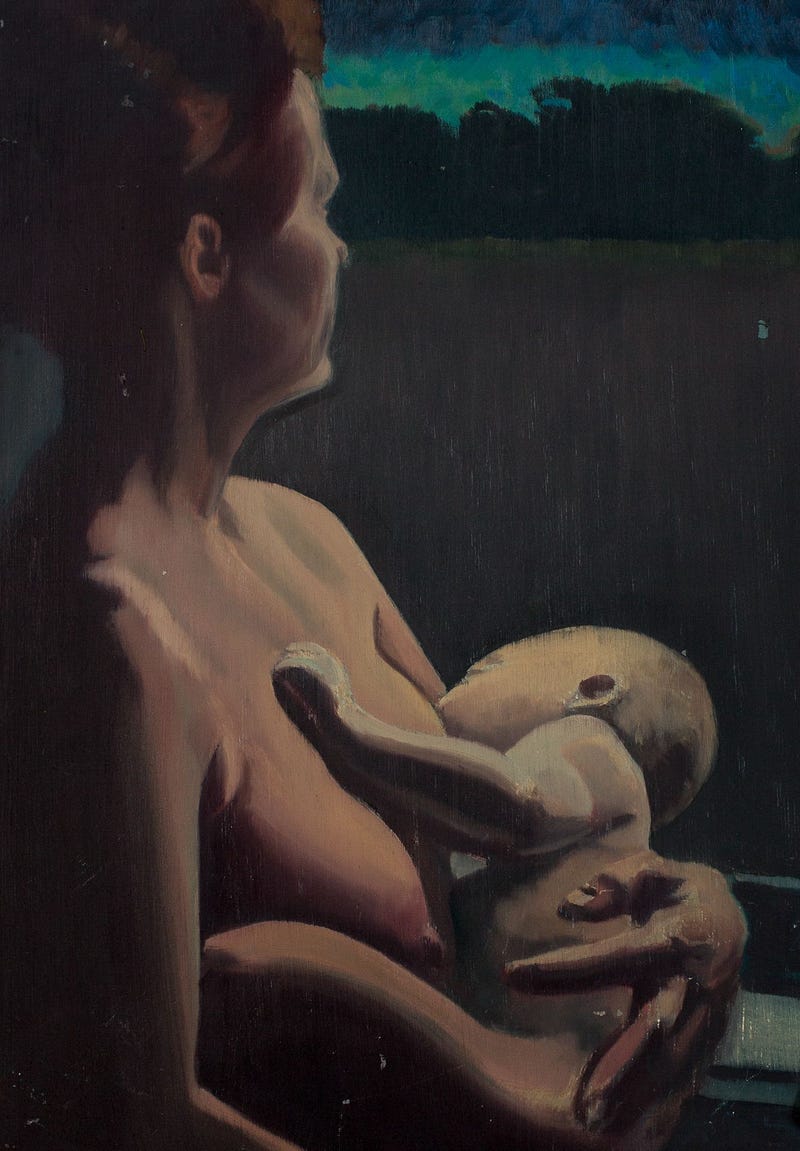
Camille recently learned she was pregnant. Given their painful history, could she and Palmer get their hopes up for this pregnancy? For the next six-and-a-half months, would she live with extreme worry and stress? And what impact would that stress have on her health and that of the fetus? If things went awry, would she blame herself — again?
Her first ultrasound confirmed the gestation age was about seven weeks, her next at nine weeks. She heard the heartbeat and saw little hand appear to wave. She circulated a picture. Things looked good. Promising.
She returned for another ultrasound several days later.
This time, the fetal heart was still. And their hearts broken. Camille was required to undergo a second ultrasound to confirm there was no heartbeat and the fetus was dead. She did. It was.
This “missed miscarriage” meant Camille now had dead fetal tissue and a placenta inside her at just over ten weeks. She could wait and hope her body expelled the dead cells on its own, which is not always successful and can lead to incomplete miscarriage in which “part of the fetus and placenta are still in the uterus, not yet expelled.” Untreated, incomplete miscarriage “can cause very heavy bleeding, prolonged bleeding, cancer, or an infection” — sepsis.
She could schedule and undergo a dilation and curettage (D&C). She would choose not to schedule a dilation and evacuation (D&E) which is usually performed during the second trimester of pregnancy.
After waiting five days, Camille chose to take drugs which are often used to end a pregnancy during the first ten weeks. Mifepristone blocks the body’s progesterone, stopping the pregnancy from growing. Mifepristone also helps the placenta detach from the uterine wall, reducing the likelihood of an incomplete miscarriage.
Some 24–48 hours later she would take misoprostol which causes cramping and bleeding to empty the uterus.
Devastated by the death of her fetus, what must the non-expectant mother do to obtain a prescription for the least invasive method to rid her body of the dead fetal cells and placenta and avoid complications, including sepsis?
Camille lives in Utah. Post Dobbs, on June 24, 2022, “Utah began enforcing its trigger ban, which bans all abortions except in the case of rape, incest, or threat to the life of the pregnant person.” Three days later, the trigger ban was temporarily enjoined and on July 11, 2022, a state district court granted a preliminary injunction further enjoining enforcement. Utah law generally prohibits abortion at 18 weeks. Utah Enforcing 18 Week Ban While Trigger Ban is Enjoined.
To obtain a prescription for the medications, Camille was required to sign a form verifying that she was choosing to end her pregnancy — as though she had decided to abort a developing embryo or fetus. And she had to take the dose of mifepristone in her doctor’s presence. Fortunately, she wasn’t required to provide proof of completion of the extensive verbal and written Utah Department of Health information module or endure the mandatory 72-hour wait period while sepsis set in.
Camille’s good friend Jessica had a different experience. Jessica requires fertility treatments out of state due to an unusual condition, but receives regular monitoring from a local fertility doctor. After a frozen embryo transfer and confirmed pregnancy, she learned her fetus also did not have a heartbeat. Jessica’s out-of-state doctors told her they could not prescribe mifepristone due to the political climate in Utah, that it was “outlawed.” She was only able to take the second medication, misoprostol. She explains: “I cannot even begin to describe how [my doctor’s] triggering political abortion explanation rang through my head while it took me 6 weeks to miscarry. It feels so awful that I couldn’t get the medication that I needed because losing a baby is lumped in with terminating a viable pregnancy, regardless of anyone’s political views.”
I’m reasonably certain that most women, including Camille and Jessica, have no choice in their embryo’s or fetus’s spontaneous death.
I understand the concept of informed consent. See American Medical Association Code of Medical Ethics § 8.08. I don’t understand the compulsion of the many male-dominated state legislatures who use every conceivable legal, psychological, religious, and deceptive trick to control women and prevent or dissuade them from making their own reproductive healthcare decisions.
It could be said, I guess, that someone who wishes to evacuate dead fetal tissue and a useless placenta from her uterus “chooses” to end her pregnancy — so long as “pregnancy” includes carrying around dead embryonic or fetal tissue that could cause serious complications, damage organs and future fertility, and even cause death. See Texas A.G. Ken Paxton Now Leads The Pack As Most Cruel and Inhumane.
I’ve looked everywhere, however, and can’t seem to find that definition. Pregnancy is “[t]he state of carrying a developing embryo or fetus within the female body.”
I’m also guessing many women who must sign a form verifying she was choosing to end her pregnancy would draw the reasonable inference that she had a choice in the spontaneous death of her embryo or fetus and some government agency, pharmaceutical company, or both, would now have record of her decision.
A few days after Camille signed the form verifying that she was choosing to end her pregnancy, she birthed a fetus about the size of her thumb and the accompanying placenta. Her doctor offered the option to send fetal tissue for testing.
Camille sent in the placenta for testing and learned the fetus was female, and had Down syndrome — likely the cause of its spontaneous death. They have named her Estella, which means Star. Camille and Palmer have a therapeutic wellness farm where they serve people who struggle with grief and trauma. I suspect they will plant a tree in Estella’s honor. Had Estella fully developed into personhood and been born alive, Camille and Palmer would have welcomed her into their family.
Below is the history of Camille and her husband Palmer’s struggles with infertility as recounted in I.V.F-You.
I can only assume that for many women, a maternal drive centers a considerable part of their self-worth and purpose in motherhood. For some, I suspect, the religious influence that focuses on “family” — including putative Christian principles — heightens the desire to bear children. For them, the inability to get pregnant (infertility) or carry a pregnancy to term (impaired fecundity) must be demoralizing, crushing. Yet, one in five women (19%) are unable to get pregnant after one year of trying, and one in four (26%) have difficulty getting pregnant or carrying a pregnancy to term. Men also suffer from infertility. Infertility Statistics.
My daughter Camille and her husband Palmer began their voyage into the uncharted world of infertility in 2010 as they began trying to have children.
No luck.
In 2012, Camille underwent an exploratory laparoscopy to see what the problem might be.
In 2013, she had three inter-uterine inseminations.
No luck.
They underwent in vitro fertilization in 2014. The process involves pretty much the opposite of abortion care in both concept and practice. The hopeful, prospective mother receives hormone treatments to encourage her ovaries to mature multiple eggs at once rather than the usual one that ovulates monthly. Several weeks later, the eggs are removed from the follicles within her ovary, a single sperm is injected into each ovum or sperm is introduced to the ovum in a petri dish, the embryos are evaluated for quality, and an embryo is transferred to her uterus where it may or may not implant. Usually, multiple eggs are extracted and fertilized, so the non-transferred ones are frozen for possible later use. They transferred two low quality embryos (all they had).
No luck.
They tried again. Camille and Palmer’s embryos all died in the lab.
Unfortunately, Camille’s eggs were deemed low quality for her age, and her reproductive providers recommended donor eggs.
They adopted a baby girl in 2014.
Throughout this process, Camille researched every resource she could to learn about infertility and find assistance in addressing it. She helped create an infertility support group. She learned that “there had been groups and individuals who advocated for and attended to the needs of Utah’s infertility population in the past; however, the gap continued to exist because there was not an organization in Utah dedicated to providing direct support to those struggling with infertility.”
“These gaps,” she explained, “included education for Utah’s infertility population as a whole, and someone to be an interface between organizations and people not associated with infertility. People just didn’t know where to turn, and they needed a safe place dedicated to helping them navigate their infertility journey.” Camille’s Story.
Camille, an LCSW, founded the Utah Infertility Resource Center in 2015. UIRC “provides education and emotional support to those who are struggling to grow their families so they are empowered, strengthened, and equipped to move forward on their respective journeys.” UIRC has assisted thousands of people who struggle with infertility. She has handed the reigns of UIRC to other capable professionals and now focuses her practice on individual clients who struggle with infertility, miscarriage, stillbirth, and other reproductive healthcare issues.
They adopted another baby girl in 2015, their first daughter’s Irish twin.
In 2018, a donor provided them eggs which they had fertilized with Palmer’s sperm. The result was eight frozen embryos, two of which were genetically abnormal and not compatible with life.
In early 2018, Camille discovered she was pregnant, without the assistance of IVF.
Seven months later, on Thanksgiving Day, her little girl was stillborn.
In 2020, they transferred one of the frozen embryos from 2018, it implanted, and she carried the pregnancy to term. Her healthy boy was born in April 2021.
Camille and her husband have five embryos cryopreserved plus the two that are genetically abnormal and not compatible with life.
The last even in their struggle with infertility is the most recent miscarried pregnancy discussed above.
I cannot speak for Camille or Palmer. From my perspective as a concerned observer, what they experienced in their years-long struggle with infertility were feelings of failure, shame, self-doubt, unworthiness, loss of meaning and purpose, anxiety and depression, and embarrassment. They also spent tens of thousands of dollars in their quest to become parents.
R.VanWagoner https://medium.com/@richardvanwagoner publishes. https://richardvanwagoner.medium.com/subscribe
*My brother the very talented fiction writer and novelist, Robert Hodgson Van Wagoner, deserves considerable credit for offering both substantive and technical suggestions to https://medium.com/@richardvanwagoner. Rob’s second novel, a beautifully written suspense drama that takes place in Utah, Wyoming, and Norway, dropped on November 17, 2020. Available on Amazon, Barnes and Noble, Apple Bookstore and your favorite local bookshop, this novel, The Contortionists, which Rob himself narrates for the audio version, is a psychological page-turner about a missing child in a predominantly Mormon community. I have read the novel and listened to the audio version twice. It is a literary masterpiece. The Contortionists is not, however, for the faint of heart.
**Richard J Van Wagoner is my father. His list of honors, awards, and professional associations is extensive. He was Professor Emeritus (Painting and Drawing), Weber State University, having served three Appointments as Chair of the Department of Visual Arts there. He guest-lectured and instructed at many universities and juried numerous shows and exhibitions. He was invited to submit his work as part of many shows and exhibitions, and his work was exhibited in many traveling shows domestically and internationally. My daughter Angela Van Wagoner, a professional photographer, photographed more than 500 pieces of my father’s work. The photographs of my father’s art reproduced in https://medium.com/@richardvanwagoner are hers.