
For Evidence of Emotional Maturity, Look at a Person’s Capacity to Be Alone
Why even the happiest romantic relationships can fail to provide the fulfilment we crave
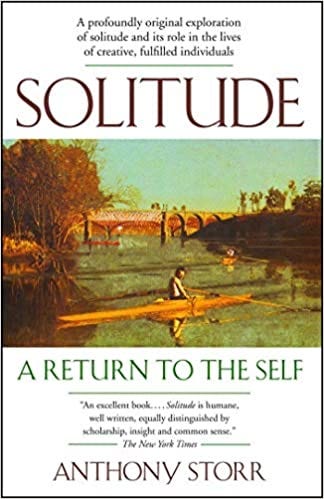
In a culture obsessed with marriage and coupling, solitude gets short shrift. There is, though, one esteemed book on the topic that has maintained its lofty status more than three decades after its initial publication in 1988. I’m talking about the psychiatrist Anthony Storr’s “Solitude: A Return to Self.”
The back cover of a recent printing of Solitude poses this question: “In the supreme importance that we place on intimate relationships, have we overlooked the deep, sustaining power of solitude in human life?” Of course, Anthony Storr’s answer is yes.
He reminds us that “the capacity to form attachments…is considered evidence of emotional maturity.” Yet, he adds, “Whether there may be other criteria of emotional maturity, like the capacity to be alone, is seldom taken into account.”
“Even those who have the happiest relationships with others,” Storr maintains, “need something other than those relationships to complete their fulfillment.”
Beyond Intimate Relationships: What We Need to Be Fulfilled
What else is it that we need? Here are a few of Storr’s answers:
The capacity to be alone: “…some development of the capacity to be alone is necessary if the brain is to function at its best, and if the individual is to fulfill his highest potential. Human beings easily become alienated from their own deepest needs and feelings. Learning, thinking, innovation, and maintaining contact with one’s own inner world are all facilitated by solitude.”
Work: “In the present climate, there is a danger that love is being idealized as the only path to salvation. When Freud was asked what constituted psychological health, he gave as his answer the ability to love and work. We have over-emphasized the former, and paid too little attention to the latter.”
The life of the mind: Attachment theory “does less than justice to the importance of work, to the emotional significance of what goes on in the mind of the individual when he is alone, and, more especially, to the central place occupied by the imagination in those who are capable of creative achievement. Intimate attachments are a hub around which a person’s life revolves, not necessarily the hub.”
Interests: “Everyone needs interests as well as interpersonal relationships; and interests, as well as relationships, play an important part in defining individual identity and in giving meaning to a person’s life.”
Relationships that are not so intimate: “The modern assumption that intimate relationships are essential to personal fulfillment tends to make us neglect the significance of relationships which are not so intimate.”
When Is the Capacity to Be Alone Particularly Valuable?
Solitude, Storr believes, is important to our everyday lives. Sometimes, though, its significance is amplified.
When something big and unnerving has happened: “The capacity to be alone is a valuable resource when changes of mental attitude are required. After major alterations in circumstances, fundamental reappraisal of the significance and meaning of existence may be needed. In a culture in which interpersonal relationships are generally considered to be the answer to every form of distress, it is sometimes difficult to persuade well-meaning helpers that solitude can be as therapeutic as emotional support.”
When we need healing: “…some of the most profound and healing psychological experiences which individuals encounter take place internally, and are only distantly related, if at all, to interaction with other human beings.”
Why Our Overinvestment in Marriage Can Backfire
Storr believes that we overvalue marriage, and that’s not even good for marriage: “…there is always an element of uncertainty in interpersonal relationships which should preclude them from being idealized as an absolute or seen as constituting the only path toward personal fulfillment. It may be our idealization of interpersonal relationships in the West that causes marriage, supposedly the most intimate tie, to be so unstable. If we did not look to marriage as the principal source of happiness, fewer marriages would end in tears.”
[Want to learn more? Take a look at this collection of articles on all sorts of topics relevant to single life. Here’s the collection of writings about solitude. Watch my TEDX talk, “What no one ever told you about people who are single.” Check out my website. Find my other stories on Medium here. Disclosure: Links to books may include affiliate links.]


