
Football Value Betting Guide 2023/24
The Complete Guide to Value Betting (EV) in Football
Become a better gambler using simple maths, the fundamentals of Value Betting, bankroll management and a systematic approach to value betting.
- What is Value Betting?
- What are Decimal Odds and Implied Probabilities?
- What are True Odds?
- Bookmaker Book Balancing
- How to Identify Value Bets
What is Value Betting?
A value bet (+EV) is when the bookmaker’s odds are better (higher) than an outcome's true odds (actual likelihood).
These value bets exist because bookmakers must balance their books and other market factors.
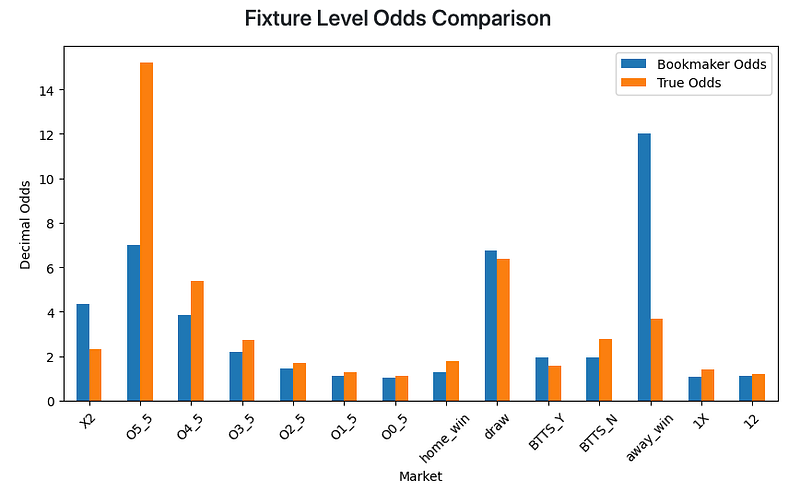
The value bets are where the Bookmaker Odds (blue) are higher than the True Odds (orange). e.g. Away Win, Draw, and Both Teams to Score (BTTS_Y) are all value bets for this fixture.
If you correctly identify Value Bets, you can expect to be a profitable gambler in the long run.
But how can you calculate value bets, and what are true odds?
Decimal Odds and Implied Probability
Odds are usually Fractional, American (Moneyline) or Decimal.
Decimal odds of 3.0 (2/1 or +200) imply that if you bet £1, you will receive a total of £3 if you win that bet.
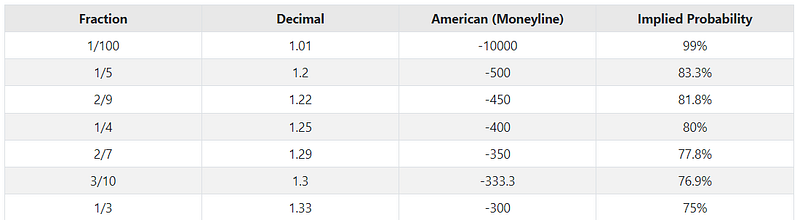
You can find a converter from your preferred format here.
Odds are a representation of the implied probability of an outcome. If you’re being offered odds of 3.0, then there is a 33% implied probability of that outcome occurring (1/decimal odds = implied probability or 1/3.0 = 33%).
This makes it much easier to recognise that you’re placing a bet based on the likelihood of that outcome.

For example, before the World Cup Final of 2022, the implied probabilities of the full-time outcome were a 35.7% (1/2.8) chance of Argentina winning, 33.78% (1/2.8) for France to win and a 33.33% (1/3) of a draw.
But what if you thought that the chances of Argentina winning are 50%? What would the true odds be?
What are True Odds?
Bookmakers won’t show you the “True Odds” of an outcome. You’re looking at the “Bookmaker Odds” of an outcome.
What odds would you accept for a perfectly fair coin flip landing on heads (e.g. 50% of landing on heads)?
You should take anything equal to or higher than even odds (2.0, 1/1 or +100). Anything less than even odds, and you’ll lose money over the long run (-EV).
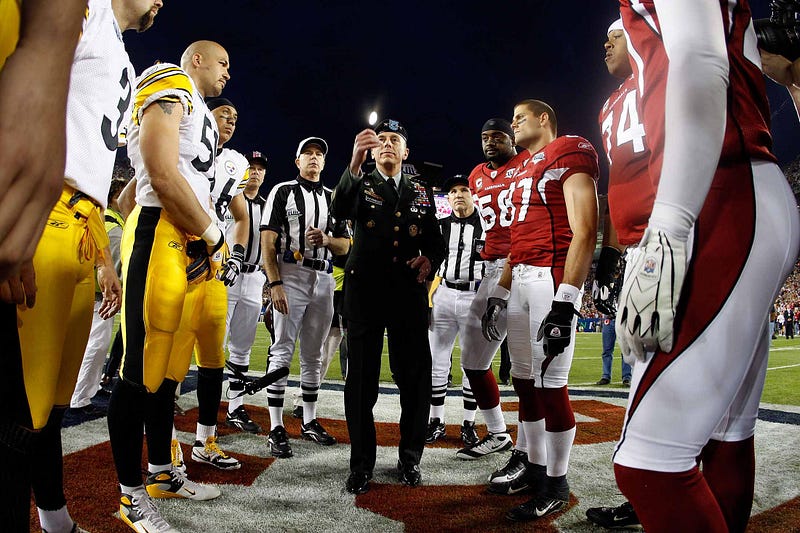
This is why betting on the Super Bowl Coin Toss is unprofitable. The bookmakers never offer the true odds of the outcome.
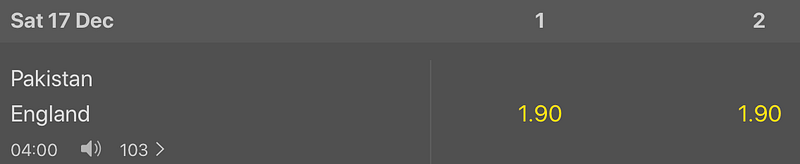
For example, the bookmakers are offering odds of 1.9 for heads. This implies that your bet is 52% (1/1.9) likely to win. But your bet is actually 50% likely to win, so you should be getting the (better) true odds of 2.0.
The bookmakers rarely offer the true odds on an outcome because otherwise, they’d lose money in the long run. In casinos, this is known as “The House Edge”.
So, if you believe that Argentina has a 50% chance of winning, the true odds are 1/50% = 2.0 (evens), and a value bet will be any bet with odds greater than 2.0.
Bookmaker Book Balancing
Value bets will always exist because of how bookmakers balance their books and offer their odds to entice customers to bet more.
The gambling community agreed Manchester City was the clear favourite when they played Brentford last season. They bet heavily on Manchester City to win the game.
Before kick-off, the bookmaker's odds of Brentford winning were 12. These odds imply that Brentford had an 8.3% (1/12) chance of winning.
Do you think that’s fair?
Why were the bookmakers offering such high returns on Brentford to win?
Because most people were betting on Manchester City to win.
Let’s pretend that draws don’t exist — a bookmaker takes £100,000 of bets on Manchester to win at odds of 2 and £1,000 of bets on Brentford at odds of 4. The bookmaker risks paying out £200,000 if Manchester wins and £4,000 if Brentford wins out of the £101,000 of bets they’ve accepted.

To avoid a huge loss if Manchester City win, the bookmaker offers better odds (e.g. 12 instead of the true odds of 4) for Brentford to win to incentivise gamblers to bet on Brentford winning. Winning £12 from a £1 bet is far more tempting than the prospect of winning £4 from £1.
This ensures they still make a profit (assuming that gamblers now put more money on Brentford to win).
This (along with other book-balancing methods) is why you will rarely be offered the true odds by the bookmaker. Instead, you’ll be offered the bookmakers odds that ensure bookmakers win over the long run.
How to Identify Value Bets
A value bet is when a bookmaker has mispriced an outcome. If you can predict outcomes accurately by using decimal odds and implied probabilities, you can bet on the bookmaker's odds when your true odds are lower than what the bookmakers offer.
The Poisson distribution is a common method to calculate outcomes in sports, and you can see how I implemented it into the Systematic Sports Football Betting Algorithm and identified value bets in this article:
Published By Systematic Sports
Systematic Sports algorithm accurately predicts outcomes in football games and compares these predictions to bookmakers to identify value bets.


