avatarCorinne Nita

Free AI web copilot to create summaries, insights and extended knowledge, download it at here

2807

Abstract

soccer-world-cup-history-evolution">Consultative Committee of the Football Association</a> denied women playing grounds, passing a resolution insisting soccer wasn't suitable for women and must be discouraged.</p><p id="c6cf">Women's soccer suffered a fifty-year ban, which they vehemently and determinedly contested. Their persistent activism coerced European clubs to integrate women's teams in 1969, and the Federation of Independent European <a href="https://time.com/6289539/womens-world-cup-2023-history/">Female Football</a> held the first women's world competition in 1971, the second in 1972, and international tournaments continued throughout the 1980s.</p><p id="2aa5">US women's soccer accelerated when the Supreme Court passed the 1972 federal civil rights act known as <a href="https://www.britannica.com/event/Title-IX">Title IX,</a> which prohibited gender discrimination in public schools and required equal opportunities for women and men. Sexist opponents fought the ruling, and parents claimed the Title impeded their sons, but the courts upheld the law, forcing federally funded schools to recognize the decision in the late 1980s.</p><p id="8f47">American women would finally receive university scholarships and the same opportunities as men's school programs because why shouldn't we?</p><p id="766f">As Title IX decreased the gaping gender discrimination hole in US schools, FIFA trialed a <a href="https://en.wikipedia.org/wiki/1988_FIFA_Women%27s_Invitation_Tournament">1988 World Cup </a>before allowing China to host the 1st FIFA World Championship for Women's Football for the M&M's Cup in 1991. Yet, the Football Association withheld its World Cup Trademark, shortened the games to 80 instead of 90 minutes, contemplated using a <a href="https://www.theguardian.com/football/2019/jun/18/womens-world-cup-game-changing-moments-no-3-china-in-1991">smaller ball</a>, and offered no prize money.</p><p id="ccfa" type="7">“They were afraid our ovaries were going to fall out if we played 90” — US captain April Heinrichs joked</p><p id="c58c">The poorly resourced teams essentially paid to play — a <a href="https://time.com/6289539/womens-world-cup-2023-history/">$15 daily</a> wage didn't cover much. They cut their <a href="https://time.com/6289539/womens-world-cup-2023-history/">out-of-pocket costs</a> by taking multi-stop flights, bunking in one-room bed and breakfasts, and wearing men's hand-me-down uniforms, but they weren't there for fame, money, or luxury. They were there to play, and the grueling six games in fourteen days in peak summer didn't phase them.</p><p id="f6a1">In 1991, the US won its first world soccer championship, but no one knew anything about the victory. One journalist attended the competition, and <a href="https://www.ourgamemag.com/2015/06

Options

/07/the-silent-trigger-the-91ers/">SportsChannel America</a> provided minimal television coverage. The women's team just achieved a feat no one in the US had accomplished, yet there were no media, adoring fans, or anyone when they returned from China.</p><p id="ca56">The team said goodbye at the airport to catch connecting flights to resume their jobs and education like they didn't just conquer the globe, but US women's soccer didn't end there. They made history again at the <a href="https://en.wikipedia.org/wiki/1995_FIFA_Women%27s_World_Cup#Ranking_of_third-placed_teams">1995 Women's World Cup</a> and the first women's soccer <a href="https://en.wikipedia.org/wiki/Football_at_the_1996_Summer_Olympics_%E2%80%93_Women%27s_team_squads">Olympic tournamen</a>t in 1996, but the 1999 World Cup captured their historic triumph, which they repeated in <a href="https://en.wikipedia.org/wiki/FIFA_Women%27s_World_Cup#Hosts">2015 and 2019</a>. They're also favored to win the 2023 Cup held in Australia, which is severely under-promoted and broadcasted.</p><p id="4422">Still, the Fédération insists women's soccer isn't popular enough to receive the same prize money as men, which is three times the amount, yet invests fewer resources in women's promotion, advertising, sponsorship, branding, and other marketing strategies. FIFA isn't interested in but can't ignore women's soccer because we will play whether it is unofficial or official, and no one will stop us this time.</p><p id="5c5f">Women's soccer isn't a fad that will disappear because sexist, perverse, conservative men deem it unsuitable, yet masculinity culture and bigotry still demean women athletes. Perhaps insecurities compel men to misconstrue the four-time world champion US women's team's public relations match against under-15 boys as an unintentional loss. Or, they parrot foolish rhetoric because they're dumb enough to believe pubescent children could defeat professional athletes.</p><p id="8255">Whichever the case, the fight never ends because discrimination continues, but we will play.</p> <figure id="410a"> <div> <div> <img class="ratio" src="http://placehold.it/16x9"> <iframe class="" src="https://cdn.embedly.com/widgets/media.html?src=https%3A%2F%2Fwww.youtube.com%2Fembed%2FQVNZRHIZVL8%3Ffeature%3Doembed&amp;display_name=YouTube&amp;url=https%3A%2F%2Fwww.youtube.com%2Fwatch%3Fv%3DQVNZRHIZVL8&amp;image=https%3A%2F%2Fi.ytimg.com%2Fvi%2FQVNZRHIZVL8%2Fhqdefault.jpg&amp;key=a19fcc184b9711e1b4764040d3dc5c07&amp;type=text%2Fhtml&amp;schema=youtube" allowfullscreen="" frameborder="0" height="480" width="854"> </div> </div> </figure></iframe></div></div></figure><p id="3c3f">And France gets it.</p></article></body>

Football Associations Banned Women's Soccer Because it Was Too Popular

Women's sports are endlessly compared to men's, yet they relentlessly receive less finance and resources, which men have never had to fight for.
By FS-Stock via Adobe Stock

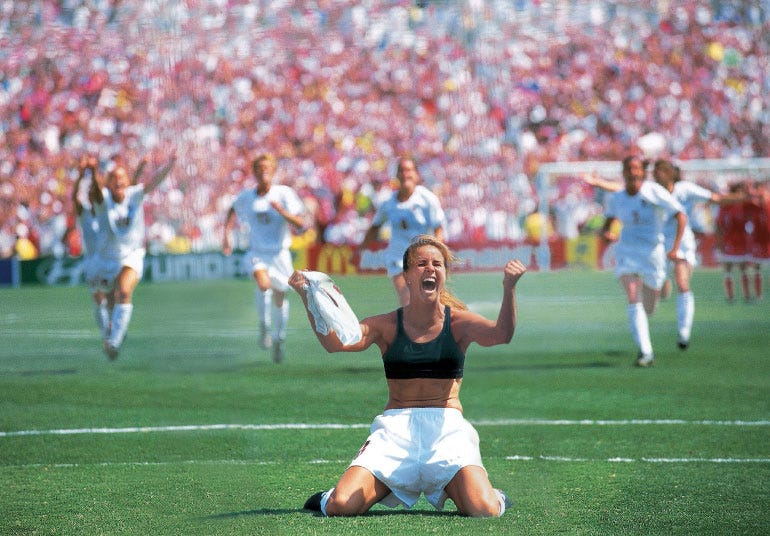
The image of Brandi Chastain ripping off her jersey after scoring the game-winning goal in the 1999 Fédération Internationale de Football Association (FIFA) Women's World Cup championship shootout against China is symbolic. On her knees with her arms raised and fists clenched toward the sky, Chastain reveled in the glory of achieving the world's first-ranked women's soccer team.

Chastain's pure ecstasy captured an era in American culture and women in sports globally. A sold-out crowd of 90,185 filled the Rose Bowl in Pasadena, California, to watch the final, making it the largest ever for a women's sporting event. Women's soccer established a sizeable (profitable) following by the third FIFA Women's World Cup, yet the athletes are endlessly compared to the Men's World Cup, which has existed since 1930.
Brandi Chastain via Sports Illustrated

Men frequently bared their chests after scoring goals, but a woman unabashedly celebrating victory raised conservative perverts' eyebrows. Chastain's muscle-toned torso glistening in the sun enraged FIFA, who in 2004 ruled men and women who remove their jerseys would receive a yellow card (warning) because it has a brand to uphold.

The institution, caught in numerous scandals, has always worried players (the product) would harm its image, which is why FIFA ignored women's soccer until 1988. However, women didn't start kicking balls when the Fédération noticed they existed; we have played since at least the 19th century.

Women independently organized leagues that attracted 25,000 to 55,000 fans per game until their popularity was too much for faint-hearted aristocrats. In 1921, the Consultative Committee of the Football Association denied women playing grounds, passing a resolution insisting soccer wasn't suitable for women and must be discouraged.

Women's soccer suffered a fifty-year ban, which they vehemently and determinedly contested. Their persistent activism coerced European clubs to integrate women's teams in 1969, and the Federation of Independent European Female Football held the first women's world competition in 1971, the second in 1972, and international tournaments continued throughout the 1980s.

US women's soccer accelerated when the Supreme Court passed the 1972 federal civil rights act known as Title IX, which prohibited gender discrimination in public schools and required equal opportunities for women and men. Sexist opponents fought the ruling, and parents claimed the Title impeded their sons, but the courts upheld the law, forcing federally funded schools to recognize the decision in the late 1980s.

American women would finally receive university scholarships and the same opportunities as men's school programs because why shouldn't we?

As Title IX decreased the gaping gender discrimination hole in US schools, FIFA trialed a 1988 World Cup before allowing China to host the 1st FIFA World Championship for Women's Football for the M&M's Cup in 1991. Yet, the Football Association withheld its World Cup Trademark, shortened the games to 80 instead of 90 minutes, contemplated using a smaller ball, and offered no prize money.

“They were afraid our ovaries were going to fall out if we played 90” — US captain April Heinrichs joked

The poorly resourced teams essentially paid to play — a $15 daily wage didn't cover much. They cut their out-of-pocket costs by taking multi-stop flights, bunking in one-room bed and breakfasts, and wearing men's hand-me-down uniforms, but they weren't there for fame, money, or luxury. They were there to play, and the grueling six games in fourteen days in peak summer didn't phase them.

In 1991, the US won its first world soccer championship, but no one knew anything about the victory. One journalist attended the competition, and SportsChannel America provided minimal television coverage. The women's team just achieved a feat no one in the US had accomplished, yet there were no media, adoring fans, or anyone when they returned from China.

The team said goodbye at the airport to catch connecting flights to resume their jobs and education like they didn't just conquer the globe, but US women's soccer didn't end there. They made history again at the 1995 Women's World Cup and the first women's soccer Olympic tournament in 1996, but the 1999 World Cup captured their historic triumph, which they repeated in 2015 and 2019. They're also favored to win the 2023 Cup held in Australia, which is severely under-promoted and broadcasted.

Still, the Fédération insists women's soccer isn't popular enough to receive the same prize money as men, which is three times the amount, yet invests fewer resources in women's promotion, advertising, sponsorship, branding, and other marketing strategies. FIFA isn't interested in but can't ignore women's soccer because we will play whether it is unofficial or official, and no one will stop us this time.

Women's soccer isn't a fad that will disappear because sexist, perverse, conservative men deem it unsuitable, yet masculinity culture and bigotry still demean women athletes. Perhaps insecurities compel men to misconstrue the four-time world champion US women's team's public relations match against under-15 boys as an unintentional loss. Or, they parrot foolish rhetoric because they're dumb enough to believe pubescent children could defeat professional athletes.

Whichever the case, the fight never ends because discrimination continues, but we will play.

And France gets it.

Gender Discrimination
2023 Womens World Cup
Women In Sports
All For The Game
Relentless Pursuit
Recommended from ReadMedium