
Fooling Yourself
The Pathological Ego At Work
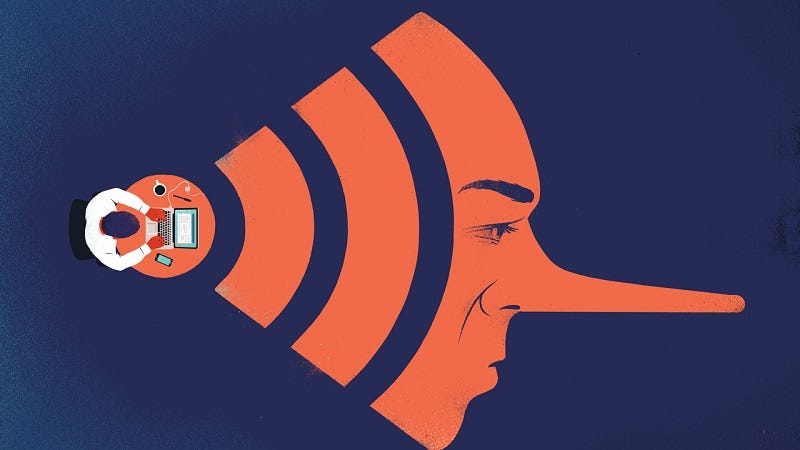
Even though you think it and think it often does not mean it is true
For one, we’re pretty sure that we are our thoughts. And for two, we’re pretty sure that the thoughts we think are mostly true. I mean, we never set out to think lies now, do we? Well, some do (like fiction writers), but I’m staying with the majority at this point.
But most of us are utterly blind to the fact that what masquerades as certainties — both externally and internally as it happens — are mostly just opinions, guesses, unbridled thoughts drawing on who knows what ego-sustenance.
In fact, there are very few certainties around. Today, the naysayers’ most nightmarish predictions about the now ubiquitous internet and its continuous avalanche of “info” are well beyond true: these days, not only do thousands of fresh (read: regurgitated) opinions about just about anything, see the digital light of day every second, there is no telling who’s out to scam you, frighten you, impress you, or inform you. There is no longer any telling who is telling the truth to the best of their ability. The terrible, terrible deformity known as “fake news” has rendered trust meaningless and has in the process destabilized a world population. I know that’s saying a lot, but I believe that is true. Or, I should add, those not destabilized have been driven to cynicism.
Today, the only way to know (or believe) that a penny dropped from say three feet will soon hit the floor (or ground) is to drop one and look. I would no longer take anyone’s online word for it and that is the sad swan song of the much heralded freedom of information lauded so much only a couple of decades ago.
Yes, this information is “free” but, sadly, also in that word’s darker meaning of “valueless.”
Some news outlets that have built their reputation on unreliability now strut their waves as sheer entertainment. Others attempt to balance this insanity with “objective” reporting, but who can even afford to be objective these days? I’m thinking ad revenue.
Personally, I trust The Guardian site’s reporting and take on the news, with the awareness that The Guardian will lean to the left and make the right-hand news a little more egregious (if that’s even possible) than it might objectively be.
And in the midst of all this insanity, we arrive at conclusions, and we sense that somehow these conclusions are correct — after all, they are our conclusions and we do not set out to lie, do we?
When it comes to news as entertainment there are no boundaries. The more outrageous the more entertaining. The danger, the real danger (and I believe we crossed this line a year or two ago) is that we are now numbed, as in desensitized, to even the worst lies.
Our ex-president, reportedly, told in excess of thirty thousand lies, publicly, during his presidency. That piece of poignant information should shock us, should floor us, should kill us. But we shake our heads and say, okay, so what?
Many years ago I thought about an alternate ending the Hans Christian Andersen’s The Emperor’s New Clothes. It went like this:
“But he has nothing on, he’s butt naked,” said the small child.
“Yeah, we know,” said the crowd.
I forget what public insanity at the time prompted this new take on the ending of Andersen’s cautionary tale, but it applies ten-fold, hundred-fold today.
George Saunders wrote an essay called “The Braindead Megaphone”, written well before the most recent disastrous presidency. Do yourself a favor and track it down, read it. Again, it applies ten-fold, hundred-fold today.
How do we regain trust in the media, when even the “truest” outlets cannot help but slant reported news in their ideology’s favor. We cannot check every fact (like the dropped penny) for ourselves. We have to trust someone or something, at least to a trustable extent — whatever that might mean.
Me, I have the urge to pack things up and drop off the grid. Sell my place in town and find some cottage up in the mountains or down some remote creek or deep inside some foreboding forest. Dylan said we don’t need a weatherman to know which way the wind blows, and that’s the kind of certainty I would want to head for and settle in.
Unfortunately, or fortunately perhaps, I’m too old to survive long on my own out in the Jack London wilderness, I’ll simply have to adapt the grid to my needs and take what I come across with heaping teaspoons of salt, and even then never to count on it as entirely true.
All this said, it is with great relief and a sort of homecoming that I break open a Chekhov book of short stories, translated by Constance Garnett (so long ago that Tim Berners-Lee wasn’t even a twinkle in daddy’s eye yet — Garnett died in 1946 whereas Berners-Lee was both in 1955 — so I feel pretty safe about the World Wide Web having influenced Garnett), a version I feel I can trust, for I don’t think Garnett had any agenda other than to render Chekhov as truly and clearly as possible.
Who knows what slant (what spin) current translators might put on Chekhov’s stories — yes, I know, overly cynical, but it’s my musing and I can be as cynical as I please.
So, I break open the Chekhov story and I sink into the comfortable, though quite realistic fiction of nineteenth-century Russia — far away from Putin and Ukraine and wobbling NATO — where I can trust the words I read.
© Wolfstuff
P.S. If you like what you’ve read here and would like to contribute to the creative motion, as it were, you can do so via PayPal: here.


