
Food Swamps vs. Food Deserts, & Their Impact on Health
The latest research shows how just having a healthy option isn’t enough.

Table of Contents
· Food swamps: where healthy choices are drowned out · Health risks in food deserts vs. food swamps · How do we combat food swamps, individually and collectively? · In summary: Converting food deserts to food swamps is not enough for public health
Since the 1970s, there has been widespread public health discussion around the rise of “food deserts.” In a normal desert, there’s not much growing; it’s all sand (or ice, as deserts can be cold), and little in the way of edible plant material.
The term “food desert” has been officially used since 1995, and refers to an area where there are few to no options for fresh and healthy food available for sale. In a food desert, most foods for sale are either unhealthy or are preserved; instead of finding fresh fruits and vegetables, options are dried or canned.
In contrast to food deserts is the food oasis, a location where there is excellent access to grocery stores and produce shops. In the United States, a food desert is defined based on the distance to the nearest supermarket:
- In a city area, it’s when there are no supermarkets within 1 mile.
- In a rural area, it’s when there are no supermarkets within 10 miles.
Here’s a 2016 USDA map that shows the approximate locations of food deserts in the United States:
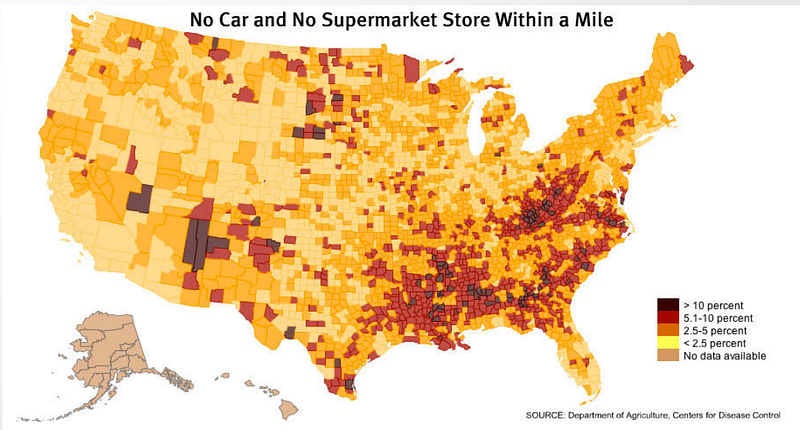
In the darkest areas, greater than 10% of the residents simply have no way to easily access a supermarket or source of fresh groceries.
Food deserts are bad, but they aren’t the only issue when it comes to food access. This is where a new definition has been introduced: the food swamp.
Food swamps: where healthy choices are drowned out
A food desert is defined by lack of availability; in an area defined as a food desert, there aren’t any options for fresh food.
But in a food swamp, there is some fresh food — but it’s drowned out by the number of unhealthy options. In these areas, there may be a supermarket or a farmer’s market, but there are also an abundance of fast food restaurants, convenience stores, and other sources of junk food.
And new research shows that, even when there are some healthy options, we tend to go with what is convenient. Because of this, food swamps are turning out to be dangerous to the public health as well.
This means that just having a nearby grocery store with fresh produce options isn’t enough; we ordinary people aren’t going to always choose the grocery over a fast food option. And the more fast food and unhealthy options that are nearby, the less likely we are to choose the healthier option — and the more it’s reflected in our health.
Additionally, food swamps may cover far more of the United States than food deserts:
- The USDA reports that, as of 2017, 12.8% of the population (39.5 million people) live in food deserts.
- In a 2023 study (not yet published but presented at the American Stroke Association), 72.5% of the participants were in a food swamp, where there were more than 5 times more unhealthy food choices than healthy ones.
So what do the statistics say about your health in one of these areas?
Health risks in food deserts vs. food swamps
One of the biggest concerns is obesity, but it’s a complex, multi-faceted issue that cannot be pinned down to a single source. Obesity prevalence is significantly associated with sex, racial ethnic identity, and socioeconomic status; all of these factors impact obesity rates.
Looking at correlation, at least, does show a clear link between food deserts and obesity rates. Individuals living in food deserts showed a 24% higher rate of obesity, in a 2006 study across 4 states.
Of course, just because a grocery store is present doesn’t mean that people will preferentially choose to shop at it. This may be why food swamps also have an effect on obesity rates. One study in 2019 suggested that, even if individuals in a food desert received access to healthy ingredients at the same prices as their current unhealthy diet, nutritional inequality only fell by about 10%. Another study found that the presence of nearby unhealthy fast food stores, but not supermarkets, were significantly linked with obesity.
In fact, having a supermarket near your house (within 1 mile) will lead to an average BMI decrease — but only by about 0.115, which is not going to make a huge difference for most people. (For comparison, a “normal” BMI is between 18.5 to 25, while an “obese” BMI is considered >30.)
It may be that we have a harder time finding the direct effects of food deserts because those effects also spill over into food swamps. People living in food swamps may make the same unhealthy choices as in food deserts, even though the healthy food is technically present and available.
This is where the recent study into food swamps came in. It found that, looking at 18,000 adults, the risk of stroke was approximately 13% higher in food swamps. And studies show that individuals in food swamps consume more unhealthy food than those not in swamps.
How do we combat food swamps, individually and collectively?
Unfortunately, because they’re a complex and market-driven problem, there is not going to be any easy solution to food swamps. You can water a food desert by encouraging a grocery store to move in, but what if there are still too many unhealthy food options in competition, choking out the grocery store and still encouraging unhealthy eating habits?
Joint U.S. government group efforts provide financial assistance to communities to encourage the expansion of grocery stores and farmers’ markets, and there have been expansions of SNAP (Supplemental Nutrition Assistance Program) benefits for low-income individuals to allow these to also be spent at farmers’ markets.
There have also been pushes by local groups to control the number of unhealthy food options through zoning restrictions. Restricting the number of approved fast food restaurants through zoning can help shift the ratio back towards healthier food options.
Another approach is to improve transportation options, to enable easier access to healthy food at grocery stores. The evidence shows that more unhealthy food tends to be chosen more often out of convenience, while individuals are willing to travel for healthier food if they have the means to do so. Pushing for better public transit options makes it easier for people to reach healthy food.
On the individual level, if you live in a food swamp, the best move is to be cognizant of the healthiness of the food you consume. Unhealthy food choices are always convenient and tempting, and setting plans to explicitly eat healthier meals can help avoid the temptation — but the better solution is to push for community-wide change.
In summary: Converting food deserts to food swamps is not enough for public health
Many of us have heard of “food deserts”, places where the only food available is unhealthy. No grocery stores, no corner markets with fresh fruit and vegetables, only fast food and dried/jarred/preserved foods available.
These days, however, the bigger concern is “food swamps”, where there are healthy food options — but they’re drowned out by the number of unhealthy options. And evidence shows that, even when we could go the extra mile to make a healthy food choice, we’re too tempted by what is easy, and go for unhealthy options more if they’re more available.
Far more of the United States is in a food swamp, versus a food desert. Are you making the impulse decision to eat fast food, even when there are healthier options available?
Studies show that food swamps are dangerous to the public health. Should we push to try and reduce their impact through zoning and financial incentives?
Enjoyed the story? Consider sharing it on Twitter — you can tag me @swestreich with your thoughts.
Not yet a paid Medium member? Consider joining: you can read unlimited articles, and you can earn money if you try publishing your own articles. Use my referral link and you support my writing, at no additional cost to you:


