
The Lasting Effects of Food Insecurity
The ramifications of growing up in a culture that values cheap, convenient food over all else
Hear more from Nikki, along with experts from No Kid Hungry and Food Forward, on episode five of the Seriously? America! podcast.
My family wasn’t poor when I was growing up. Emotionally bankrupt, sure, but not financially poor. We had a roof over our heads and food in the fridge and a brand-new Nintendo Entertainment System, complete with two games and wired controllers, sitting atop the television in the living room.
Despite my parents’ persistent cries of “not enough money,” I had everything I needed and they were able to feed their vices while never missing a bill payment. But, as has been the case with many other aspects of my childhood, I discovered as an adult that there was something amiss with the way my body was nourished when I was a kid — a disconnect which set off a chain reaction that continues now, as I slide into the last few years of my fourth decade.
A little kid will eat what tastes good.
A large part of my therapy this last year has centered around my weight and my relationship with food. This dysfunctional, co-dependent relationship has been around for as long as I can remember, and while I worked on building healthier eating habits, I also looked backward in an attempt to unravel the experiences that got me here in the first place.
But when I look back to my past experiences around food, I often come up blank. I don’t actually have many memories of eating when I was a kid, and my parents don’t really ever remember feeding me, either.
My family didn’t technically have issues regarding access to food, as far as I know. What we did have, though, was an apathy so intense that it verged on nihilism.
I don’t think my parents ate very much. My dad consumed cigarettes and coffee for breakfast, and I don’t ever really remember my mother eating anything at all, aside from planned dinners maybe once weekly. They both drank beer from the time they got home from work until they went to bed at night.
Our cabinets were stuffed with boxed convenience foods and highly-processed food products such as Hamburger Helper and Velveeta “cheese,” and I was largely left to my own devices when I got hungry.
Breakfast and lunch were easy. I ate cereal with milk each morning, usually with a few teaspoons of sugar poured over it, and I bought school lunch — whatever that was in the 80s and 90s. Dinner was the wildcard.
Since my parents were mostly drinking their dinner, there wasn’t a set “dinner time,” and I didn’t really have any cues about what, and how much, I should be eating. I remember making myself sandwiches out of Wonder Bread, Kraft singles, and Peter Pan peanut butter. When I got older, I’d eat SpaghettiOs straight out of the can, or sometimes I’d heat up condensed chicken-noodle soup in a bowl and eat it with a sleeve of crumbled-up Saltines. I’d often end up eating two cans of the soup, though, because I wasn’t aware you were supposed to add water to dilute it, and it wasn’t filling enough to eat just one can.
Sometimes I couldn’t figure out what to eat, and I’d scour the cabinets and eat cookies or crackers or popcorn or candy until I was full.
I could probably count on one hand the number of times I ate fruit or vegetables before the age of about twenty-five.
So I guess I had food access issues growing up, even if my family technically didn’t.
Packaged foods can set off a vicious cycle.
These convenience foods — calorically-dense, salt- and preservative-laden pseudofoods borne out of a catastrophically successful movement to make food cheap for Americans — were all I knew until I grew up and moved out. I realized much too late that this early diet had made it immeasurably harder for me to have a positive relationship with food as an adult.
The reason? Caloric density.
Caloric density is a measurement of how much energy a food contains per unit measure. A 100-gram stalk of broccoli has about 34 calories, for example (low caloric density), while a 100-gram candy bar has about 500 (high caloric density).
Calories in themselves aren’t bad, of course. We need calories for energy. But, consistently eating foods that are high in caloric density can affect everything from your hormones to your behavior and decisions around food.
After eating that 100-gram broccoli stalk, for example, you’ll feel about as full as you would after eating the candy bar, because of the volume of food is roughly the same. But if you’ve eaten the candy bar, you’ll have consumed 17 times as many calories, and you’ll likely have done it so quickly that your body has no idea you’ve taken in so much energy. When you’re eating a high-caloric-density food, your hunger doesn’t go away until you’ve consumed way too much; in my case, since I didn’t feel full, I would often continue eating even more high-caloric-density foods until, in one sitting, I’d exceeded my entire energy need for the day.
When most of what you can get your hands on is very calorically-dense, your body learns it can’t trust the hunger and fullness signals it receives, and it begins to ignore them. For me, that resulted in binge eating, eating when I saw food (even when I wasn’t hungry), and weight that felt unmanageable.
These habits become deeply ingrained.
On my best days, now, when I’m feeling well-rested and well-taken care of and my house is clean and my fridge is stocked, I can use this knowledge to make better decisions about what to eat when my tummy starts to rumble.
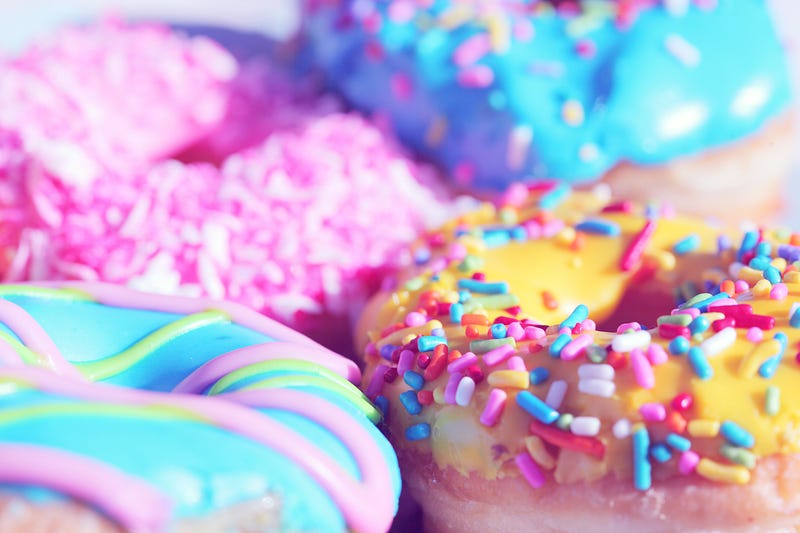
But most days aren’t my best days, and often when I’m hungry I really would rather eat one or six of those brightly-colored donuts. Even after months of intentionally reshaping my relationship with food, my first instinct when I get hungry is to grab at a muffin or a bag of chips — a 250-calorie snack that I know will not fill me up — rather than a 50-calorie serving of fruit or vegetables that will satisfy me.
It is still a conscious effort to substitute fresh fruits and vegetables for chips and candy, though I know the whole foods are better for me in every way. And even when I go to meticulous effort to plan nightly meals for my family, I still routinely forget to cook a vegetable with dinner.
Many people don’t have a way out.
Many years ago, when I was a young, naïve, bright-eyed middle-school teacher, I had a student who was very overweight. One day, he came to school without the appropriate uniform.
“I need to send him to the office,” I told a colleague. “He doesn't have a uniform.”
She shook her head and narrowed her eyes. “No,” she said. “Call the boss. He’s probably got something Isaac can wear.”
I was working at a no-excuses charter school, and had been fairly indoctrinated into the idea that kids needed to exercise responsibility always and there was no lenience for these kinds of infractions. “Why?” I asked.
“His family’s really poor,” she explained. “They can’t afford clothes. Sometimes they don’t even have electricity.”
I was dumbfounded that no one had shared this with me before, but also taken aback at the fact that someone who was so heavy could be poor. I had always imagined that, if your family couldn't afford food, you’d be rail-thin. “Sometimes all they can afford is McDonalds,” the other teacher explained, and that’s when all the pieces began coming together for me.
People living in poverty often have no choice but to consume low-cost, high-caloric-density foods. It’s one reason that children who live in poverty are more likely to be obese than children who don’t.
This lack of access to high-quality food creates the same cycle from which I still suffer to this day. Our brains and our bodies are trained to crave and consume food that is dense in calories. We need more of it to feel full. We eat more calorie-dense food. We gain weight. We can’t lose it, because when we try to change our eating habits, we are left with the impossible task of deciding whether to eat foods that are expensive and undesirable to us (but will make us full and healthy) or to eat foods that we enjoy and can afford, but cut down the calories (and so we feel like we’re starving).
And, so, here we are, at a dead-end, the inevitable destination after a generations-long journey of ignorance, apathy, misinformation, and, in many cases, generational poverty — all of which our political establishment has supported if not outright created.
Fortunately for me and my children, I possess the drive to help us all live full and healthy lives, the desire to learn more about food and its effects on our bodies, and the financial resources to purchase organic, whole foods for my family to eat. But there are millions of children whose parents, despite trying their hardest, are unable to support their families in this way.
Some food rescues, like Lovin’ Spoonfuls, have popped up in my area recently, and I wholeheartedly support their mission — to redistribute perishable food to organizations that work to help the economically disadvantaged. It’s not enough to reach everyone, but at least some families can have a better shot at building a strong body and mind by developing a healthy relationship with food.
As for me, I think I have finally found a way, at the tender age of thirty-six, to undo the havoc that my early diet wreaked on my body and my mind. I am working on my eating habits and lifestyle choices, and looking forward to being my healthiest in the decades ahead of me.
I’m determined to break this cycle into which I’ve fallen, and to help ensure that my kids develop positive habits that will support them for a lifetime. Raising children is hard and expensive; feeding them whole foods and pasture-raised protein is nearly as hard. Sometimes I just want to push the easy button and grab something cheap and fast.
And, sometimes, I do. But, now, rather than being a reflex driven by the dregs of a neglectful childhood, it is an educated choice that fits within a larger, mostly healthy, lifestyle.
My wish for the world is that, one day, we all are able to make such choices.
Subscribe to my newsletter to keep in touch. Tweet | Gram | Book